



Introduction
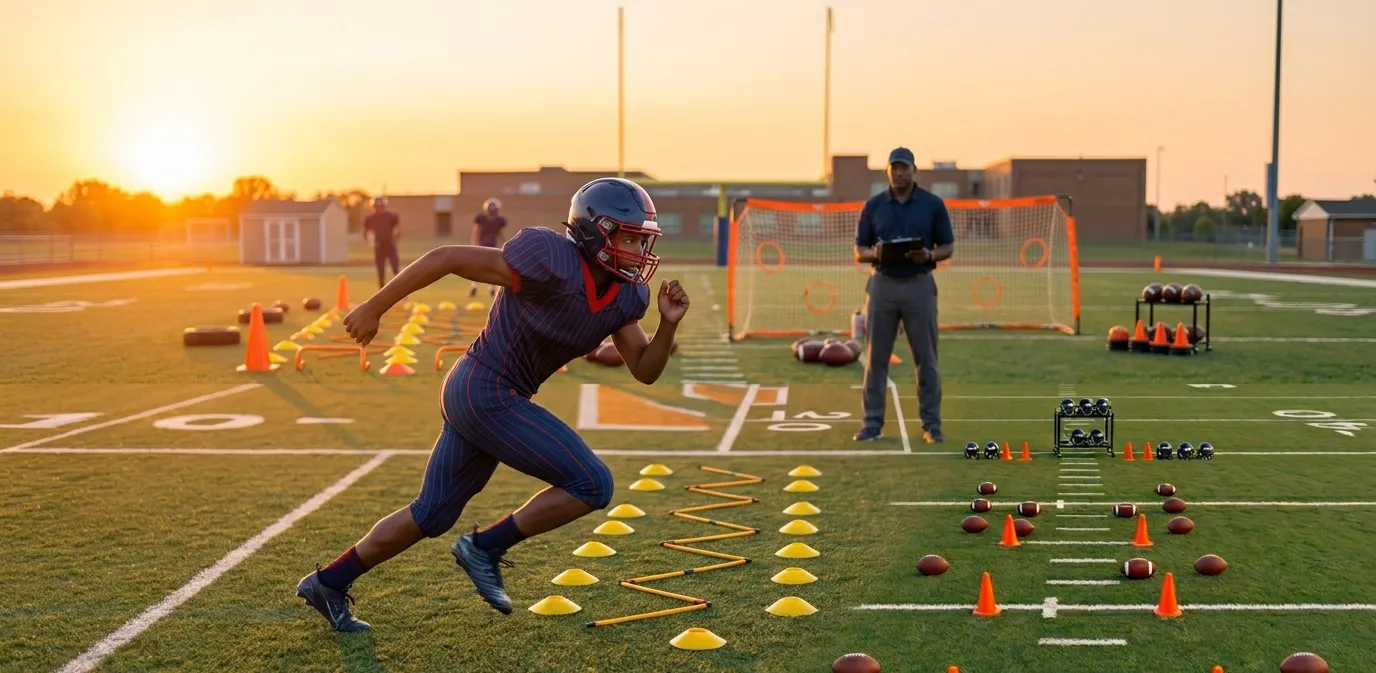
A good football workout plan for beginners can save you from weeks of wasted effort. Many new players run extra laps, follow random workouts online, or spend hours in the gym without seeing real results on the field. They often struggle with conditioning, slow footwork, poor recovery, and a lack of confidence during practice. Without a clear plan, beginners often train hard but fail to improve the skills that matter most in football.
As a youth football coach, I often see beginners focus on the wrong things. Some players spend all their time lifting weights, while others only run conditioning drills. The players who improve the fastest follow a balanced approach that combines strength, speed, conditioning, recovery, and football skills. This 4-week workout plan gives you a clear path to follow. It helps you build athletic ability, prepare for football practice, and create habits that support long-term success. If you are new to the sport, starting with a structured approach to football training for beginners can help you develop the right habits from day one.
Updated for 2026: This beginner football workout plan has been reviewed and updated with current training recommendations, recovery guidance, workout progression tips, and practical advice for new players training at home or on the field.
Who Is This Workout Plan For?
If you are preparing for your first football season, getting ready for youth or high school football, or looking for a structured way to improve your fitness, this plan is designed for you. Instead of guessing what workouts to do, you will follow a simple weekly schedule that builds strength, conditioning, speed, and confidence step by step.
- Follow a balanced plan that includes strength, speed, conditioning, and football skills.
- Train 5 to 6 days per week with at least one full rest day.
- Focus on proper movement and technique before increasing intensity.
- Track your progress each week using fitness benchmarks.
- Stay consistent for all 4 weeks to see the best results.
Before You Start This Football Workout Plan
| Requirement | Recommendation |
|---|---|
| Age | 10+ |
| Experience | Beginner |
| Equipment | Football, cones, resistance band |
| Session Length | 45-60 minutes |
| Training Days | 5 per week |
| Location | Field or backyard |
What Makes a Good Football Workout Plan for Beginners?
Many beginners think football training means lifting weights every day. In reality, successful football players develop several athletic qualities at the same time. Along with physical training, players should spend time practicing football fundamental drills to improve overall performance on the field.
Build Athletic Foundations Before Advanced Training
Before working on advanced exercises, beginners should learn proper movement patterns. Good movement mechanics make every football skill easier to perform.
For example, proper running form can improve sprint speed. Good balance can improve footwork. Strong movement fundamentals also help reduce injury risk during practice and games.
New players should focus on learning basic exercises correctly before increasing intensity.
Balance Strength, Speed, and Conditioning
Balance Strength, Speed, and Conditioning
Football requires multiple physical abilities. Strength helps players create force during movement. Speed helps them reach the ball faster. Football conditioning allows them to maintain effort throughout practice and games.
A balanced football workout plan includes:
- Strength training
- Speed training
- Agility training
- Football conditioning
- Recovery sessions
To build these skills effectively, combine this workout plan with Football Speed and Agility Drills for Beginners to improve acceleration and change of direction, Football Footwork Drills to develop quicker, more controlled movement, and Football Warm-Up Drills Before Practice to prepare your body before every training session.
Focusing on only one area can limit overall development.
Make Recovery Part of the Plan
Recovery habits support consistent training and help prevent overtraining. Following a proper football warm-up routine before training and a football stretching routine after workouts can improve recovery and reduce muscle stiffness.
Beginners should schedule regular recovery days and prioritize:
- Quality sleep
- Proper hydration
- Stretching
- Mobility exercises
Recovery habits support consistent training and help prevent overtraining.
Focus on Consistent Progress Instead of Intensity
Many new players try to do too much too soon. This approach often leads to fatigue and poor performance.
A better strategy is to make small improvements every week. After building a solid fitness base, continue improving with football practice plans for beginners to develop your skills step by step. Consistent progress creates better long-term results than short bursts of hard training.
Assess Your Starting Fitness Level
Before beginning any football workout plan, it helps to understand your current fitness level. A simple assessment provides a starting point and makes it easier to track progress over time.
You do not need special equipment for these tests. Record your results and compare them again after four weeks.
Simple fitness assessments help establish a baseline so you can measure improvements over time. Tracking your results is a common practice in strength and conditioning programs for athletes.
Upper-Body Strength Check
Perform as many push-ups as possible using proper form.
This test measures basic upper-body strength and muscular endurance.
Lower-Body Strength Check
Perform bodyweight squats with controlled movement.
Strong legs support sprinting, footwork drills, and explosive movement on the field.
Speed and Conditioning Check
Run a short sprint and record your time.
A 20-yard sprint works well for beginners. This test provides a useful speed baseline and helps track improvement throughout the program.
Core Stability Check
Hold a plank position for as long as possible while maintaining good posture.
Core stability supports balance, movement control, and athletic performance.
Beginner Fitness Assessment Table
| Assessment | Beginner Goal |
|---|---|
| Push-Ups | 10+ Repetitions |
| Bodyweight Squats | 15+ Repetitions |
| Plank Hold | 30 Seconds |
| 20-Yard Sprint | Record Baseline Time |

Do not worry if your results fall below these targets. The purpose of this assessment is to create a starting point. Improvement matters more than perfection.
The 4-Week Football Workout Plan for Beginners
This football workout plan follows a simple progression model. Each week builds on the previous one. As a result, beginners can improve fitness without feeling overwhelmed.
The goal is to develop strength, football conditioning, speed, and movement skills while allowing enough time for recovery.
Week 1: Build Movement Fundamentals
The first week focuses on learning proper exercise technique and movement mechanics.
Main goals:
- Learn exercise form
- Improve body control
- Develop basic footwork
- Establish training habits
Beginners should focus on quality movement rather than workout intensity.
Week 2: Improve Conditioning and Work Capacity
During the second week, players begin increasing their training volume.
Main goals:
- Improve football conditioning
- Build endurance
- Increase activity levels
- Maintain proper technique
This phase prepares the body for more demanding workouts.
Week 3: Develop Strength and Power
The third week introduces more challenging strength exercises.
Main goals:
- Increase total-body strength
- Improve force production
- Support explosive movement
- Continue conditioning development
Strength gains can improve sprint performance and overall athletic ability.
Equipment Needed for This Football Workout Plan
- Football
- Cones
- Resistance Bands
- Stopwatch
- Water Bottle
Week 4: Combine Speed, Strength, and Football Skills
The final week combines everything learned during the program.
Main goals:
- Improve athletic performance
- Develop football-specific movement
- Increase confidence
- Prepare for future training
By this stage, players should notice improvements in conditioning, movement quality, and overall fitness.
4-Week Progression Table
| Week | Primary Goal |
|---|---|
| Week 1 | Movement Fundamentals |
| Week 2 | Football Conditioning |
| Week 3 | Strength Development |
| Week 4 | Football Performance |
What Can Beginners Expect After 4 Weeks?
- Better conditioning
- Improved movement quality
- More confidence during practice
- Increased strength
- Better recovery habits
- Improved football fitness
Weekly Football Workout Schedule
The following schedule balances training and recovery. It provides enough work to support improvement while giving beginners time to recover.
| Day | Focus |
|---|---|
| Monday | Speed and Footwork Training |
| Tuesday | Strength Training |
| Wednesday | Recovery Session |
| Thursday | Agility and Conditioning |
| Friday | Full-Body Football Workout |
| Saturday | Football Skill Training |
| Sunday | Rest Day |
| Day | Focus | Suggested Time |
|---|---|---|
| Monday | Speed and Footwork | 45 Minutes |
| Tuesday | Strength Training | 45–60 Minutes |
| Wednesday | Recovery | 20–30 Minutes |
| Thursday | Agility and Conditioning | 45 Minutes |
| Friday | Full-Body Workout | 45–60 Minutes |
| Saturday | Football Skills | 45 Minutes |
| Sunday | Rest | Recovery Day |
Each training day has a specific purpose. This structure helps beginners improve steadily without excessive fatigue.
In the next section, we will break down each workout day and explain exactly what exercises to perform, how many sets to complete, and how to progress through the program safely.
Monday Workout: Speed and Footwork Training
Speed is one of the most valuable skills in football. Even beginners can improve their speed by focusing on proper movement and consistent practice. This workout helps build acceleration, coordination, and better footwork. Players who want to improve balance and movement efficiency can add extra football footwork drills to their weekly training routine.
Dynamic Warm-Up
Start every workout with a dynamic warm-up. This prepares the body for movement and lowers the risk of injury.
Complete 5 to 10 minutes of:
- High knees
- Butt kicks
- Walking lunges
- Arm circles
- Leg swings
- Light jogging
Focus on smooth movement instead of rushing through the exercises.
Sprint Development Drills
Sprint training helps players improve acceleration and first-step quickness.
Perform:
- 4 × 10-yard sprints (Rest: 60 seconds between sprints)
- 4 × 20-yard sprints (Rest: 60–90 seconds between sprints)
- 2 × 40-yard runs at moderate effort (Rest: 90 seconds between runs)
Pay attention to body position. Lean slightly forward and drive your arms as you run.
Footwork and Movement Exercises

Good footwork helps players change direction quickly and stay balanced during competition.
Complete:
- Cone shuffle drill: 3 rounds (Rest: 30–45 seconds between rounds)
- Forward and backward cone drill: 3 rounds (Rest: 30–45 seconds between rounds)
- Lateral movement drill: 3 rounds (Rest: 30–45 seconds between rounds)
Keep your knees bent and stay under control throughout each drill.
Cool-Down Routine
Finish the session with:
- Light walking
- Hamstring stretches
- Quad stretches
- Calf stretches
Spend 5 to 10 minutes cooling down before ending the workout. Hold each stretch for 20 to 30 seconds without bouncing.
Monday Workout Summary
- Estimated workout time: 45–55 minutes
- Difficulty: Beginner
- Recovery before next workout: 24 hours
- Focus: Speed, acceleration, footwork, and movement control
Tuesday Workout: Strength Training for Beginners
Strength training helps football players become more powerful and resilient. Beginners should focus on learning proper form before increasing weight or volume.
Lower-Body Exercises
Strong legs support sprinting, jumping, and explosive movement.
Perform:
| Exercise | Sets | Reps |
|---|---|---|
| Bodyweight Squats | 3 | 12 |
| Reverse Lunges | 3 | 10 Each Leg |
| Glute Bridges | 3 | 15 |
| Step-Ups | 3 | 10 Each Leg |
Move through each repetition with control.
Upper-Body Exercises
Upper-body strength supports blocking, ball security, and overall athletic performance.
Perform:
| Exercise | Sets | Reps |
|---|---|---|
| Push-Ups | 3 | 10-15 |
| Incline Push-Ups | 3 | 10 |
| Resistance Band Rows | 3 | 12 |
| Shoulder Press | 3 | 10 |
Use resistance bands or light dumbbells if available.
Core Development
A strong core improves balance, posture, and movement control.
Perform:
| Exercise | Sets | Time/Reps |
|---|---|---|
| Plank | 3 | 30 Seconds |
| Side Plank | 2 | 20 Seconds Each Side |
| Dead Bugs | 3 | 10 |
| Bird Dogs | 3 | 10 |
Focus on quality movement rather than speed.
Training Volume Guidelines for Beginners
Many new players believe more training always leads to better results. However, excessive training often slows progress.
Follow these simple guidelines:
- Stop each set before complete exhaustion.
- Rest between exercises.
- Focus on proper form.
- Increase difficulty gradually.
Consistent training produces better results than overly hard workouts. Gradually increasing training volume gives your body time to adapt while reducing the risk of overtraining and unnecessary fatigue.
Tuesday Workout Summary
- Estimated workout time: 50–60 minutes
- Difficulty: Beginner
- Recovery before next workout: 24–48 hours
- Focus: Lower-body strength, upper-body strength, and core stability
Wednesday Recovery Session
Recovery days help the body adapt to training. They also reduce soreness and prepare players for the next workout.
Mobility Work
Mobility exercises improve movement quality and flexibility.
Spend 10 minutes performing:
- Hip circles (30 seconds each direction)
- Arm circles (30 seconds forward and backward)
- Deep squat holds (30 seconds × 2)
- Ankle mobility drills (1 minute per ankle)
Move slowly and stay controlled. Focus on improving your range of motion instead of rushing through each exercise.
Stretching Routine
Stretch major muscle groups after mobility work.
Focus on:
- Hamstrings
- Quads
- Calves
- Hip flexors
- Shoulders
Hold each stretch for 20 to 30 seconds.
Sleep and Hydration Habits
Recovery does not stop when the workout ends.
Aim for:
- 8 to 10 hours of quality
- sleepDrink water regularly throughout the day and replace fluids lost during training.
- Eat balanced meals that include lean protein, complex carbohydrates, healthy fats, and fruits or vegetables.
Wednesday Recovery Summary
- Estimated session time: 20–30 minutes
- Difficulty: Very Easy
- Recovery before next workout: Ready for Thursday’s session
- Focus: Mobility, flexibility, hydration, and muscle recovery
Thursday Workout: Agility and Conditioning
Football players rarely move in a straight line. They must react, change direction, and maintain effort throughout a game. If you want additional change-of-direction exercises, these football agility drills can help improve quickness and body control.
Change-of-Direction Drills

Perform:
- T-Drill: 3 rounds (Rest: 45–60 seconds between rounds)
- 5-10-5 Shuttle Run: 3 rounds (Rest: 60–90 seconds between rounds)
- Cone Box Drill: 3 rounds (Rest: 45–60 seconds between rounds)
Stay low and plant your feet firmly before changing direction.
Conditioning Circuit
With this:
Complete the following circuit three times:
- 20 seconds jumping jacks
- 20 seconds bodyweight squats
- 20 seconds mountain climbers
- 20 seconds high knees
Rest for 60 seconds after completing each full circuit before starting the next round.
Building Football Endurance
Finish the workout with:
- 4 × 50-yard runs (Walk back to the starting point as your recovery between runs.)
Maintain good running form throughout the session and focus on finishing each sprint with consistent effort.
Coach’s Tip
Focus on smooth, controlled movements before trying to move faster. Good technique builds better agility and helps reduce the risk of injury.
Thursday Workout Summary
- Estimated workout time: 45–55 minutes
- Difficulty: Intermediate for beginners
- Recovery before next workout: 24 hours
- Focus: Agility, conditioning, endurance, and change of direction
Friday Workout: Full-Body Football Development
This workout combines strength, conditioning, and explosive movement.
Strength and Power Circuit
| Exercise | Reps | Rest |
|---|---|---|
| Squats | 12 | Move directly to the next exercise |
| Push-Ups | 12 | Move directly to the next exercise |
| Walking Lunges | 10 each leg | Move directly to the next exercise |
| Resistance Band Rows | 12 | Rest 90 seconds after completing the full circuit |
Complete 3 rounds of the circuit. Perform each exercise back-to-back, then rest for 90 seconds before starting the next round.
Explosive Movement Exercises
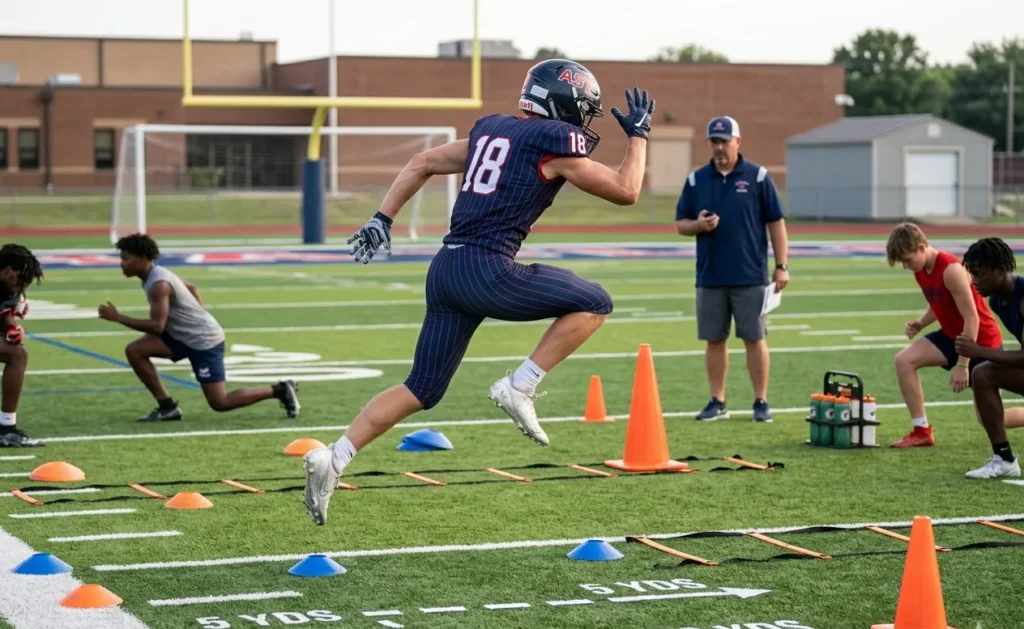
Explosive power helps players accelerate faster and react more quickly.
Perform:
- Broad Jumps: 3 × 5 (Rest: 60–90 seconds between sets)
- Jump Squats: 3 × 8 (Rest: 60 seconds between sets)
- Lateral Bounds: 3 × 6 each side (Rest: 45–60 seconds between sets)
Focus on quality movement and safe landing mechanics. Stop the set if your jump height or landing technique begins to decline.
Athletic Development Focus
The goal of this workout is not bodybuilding. The goal is to improve athletic performance.
Focus on:
- Movement quality
- Balance
- Coordination
- Body control
These skills support football performance at every position. Prioritize good technique over speed or heavier resistance. As your strength and coordination improve, gradually increase the difficulty while maintaining proper form.
Common Mistakes to Avoid
- Landing with stiff knees after jumps.
- Rushing through exercises instead of maintaining good form.
- Skipping the recommended rest periods.
- Choosing speed over control.
Friday Workout Summary
- Estimated workout time: 50–60 minutes
- Difficulty: Moderate
- Recovery before next workout: 24–48 hours
- Focus: Full-body strength, explosive power, coordination, and athletic performance
Saturday Football Skill Training
Fitness matters, but football players must also develop football skills.
This session combines athletic training with practical football work. Beginners who want a more structured introduction can also follow this first week football practice plan alongside the workout schedule.
Catching Fundamentals
Perform:
- Stationary catches: 25 repetitions (Rest: 30–45 seconds after every 10 catches)
- Short-route catches: 20 repetitions (Rest: 45–60 seconds between sets)
- High-point catches: 10 repetitions (Rest: 60 seconds between sets)
Focus on securing the ball before turning upfield.
Throwing and Ball Handling
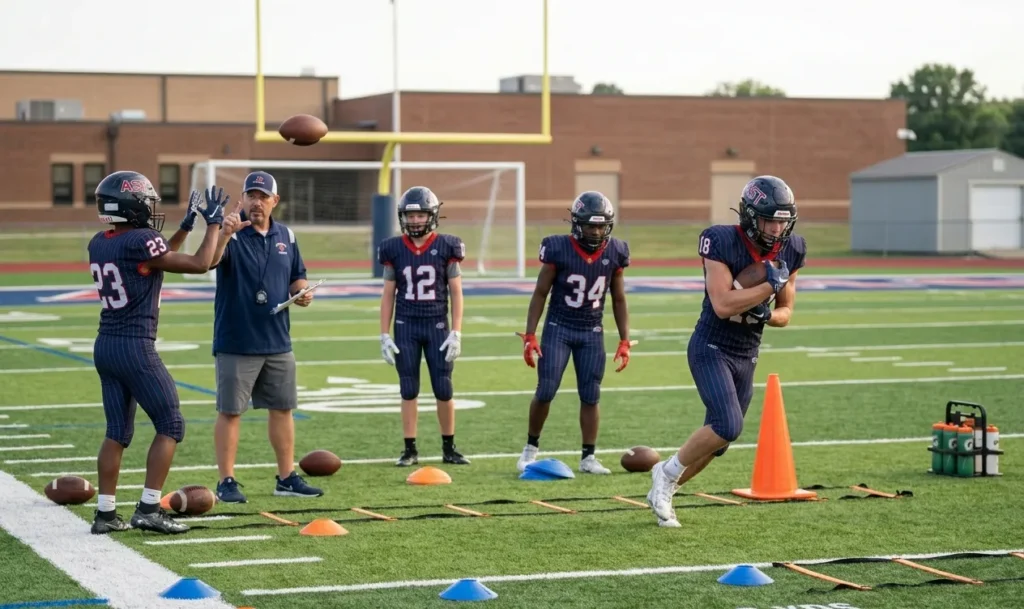
Quarterbacks can work on:
- Grip
- Release mechanics
- Accuracy
Other players can practice:
- Ball security
- Hand-to-hand transfers
- Carrying technique
Spend 10 to 15 minutes practicing these skills. Take 30 to 60 seconds of rest between drills to maintain good technique.
Position-Specific Practice
Players should spend time developing skills that match their position.
Examples include:
- Route running for wide receivers
- Ball carrying for running backs
- Backpedal drills for defensive backs
- Stance work for linemen
Saturday Workout Summary
- Estimated workout time: 45–60 minutes
- Difficulty: Beginner
- Recovery before next workout: Full recovery on Sunday
- Focus: Catching, throwing, ball handling, and position-specific skills
Practice Repetitions and Skill Development
Skill improvement comes from consistent repetitions.
Instead of trying complex drills, focus on mastering the basics.
A beginner who performs fundamental skills correctly will often develop faster than a player who rushes into advanced training.
By the end of the week, players will have completed speed training, strength work, agility training, football conditioning, recovery sessions, and football skill development. This balanced approach creates a strong foundation for long-term success.
Sunday: Rest and Recovery
Recovery is an important part of every football workout plan. Your muscles grow stronger during recovery, not while you’re training. Taking one full recovery day each week helps reduce fatigue, lowers the risk of injury, and prepares you for the next week of workouts.
Active Recovery (Optional)
If you feel good, spend 15 to 20 minutes doing light activity such as:
- Easy walking
- Light cycling
- Gentle stretching
- Foam rolling (if available)
Keep the intensity low. The goal is to improve blood flow, not to challenge your body.
Recovery Checklist
Before starting a new training week, try to:
- Get 8 to 10 hours of sleep
- Drink plenty of water throughout the day
- Eat balanced meals with protein, carbohydrates, and healthy fats
- Stretch any muscles that still feel tight
- Prepare your equipment for next week’s workouts
Sunday Recovery Summary
- Estimated activity time: 15–20 minutes (optional)
- Difficulty: Rest Day
- Recovery before next workout: Ready for Monday
- Focus: Muscle recovery, mobility, hydration, and preparation for the next training week
How to Repeat This Workout Plan
After completing the first week, repeat the schedule for 4 weeks while gradually increasing the challenge. You can progress by:
- Adding 1 to 2 repetitions to each exercise.
- Increasing resistance when your form stays consistent.
- Running each sprint with better technique and control.
- Reducing rest times slightly as your fitness improves.
If you feel unusually sore or tired, take an extra recovery day before increasing the workload.
Football Workout Adjustments by Age Group
Not every beginner should follow the same training volume. Younger players need more focus on movement skills and fun activities, while older players can handle additional strength and conditioning work.
The goal at every age is to develop athletic ability safely while building confidence.
Ages 8–10
Players in this age group should focus on:
- Basic movement skills
- Coordination
- Balance
- Running mechanics
- Football fundamentals
Recommended training:
- 3 workout days per week
- Short training sessions of 30 to 45 minutes
- Plenty of recovery time
Avoid heavy strength training. Instead, use bodyweight exercises and skill-based activities.
Ages 11–13
This stage is ideal for building athletic foundations.
Focus on:
- Footwork drills
- Speed development
- Bodyweight strength exercises
- Football conditioning
- Skill development
Recommended training:
- 3 to 4 workout days per week
- Sessions lasting 45 to 60 minutes
Players should continue learning proper movement mechanics before increasing training intensity.
Ages 14–18
Older beginners can handle a more structured football workout plan.
Focus on:
- Strength training
- Speed training
- Agility training
- Position-specific skills
- Football conditioning
Recommended training:
- 4 to 5 workout days per week
- Sessions lasting 60 to 75 minutes
Recovery remains important even as training volume increases.
How Different Positions Can Adjust This Workout Plan
Every football position has different physical demands. While all beginners should follow the same basic plan, small adjustments can improve position-specific development.
Quarterbacks
Quarterbacks should spend extra time on:
- Throwing mechanics
- Accuracy drills
- Footwork
- Core stability
Good footwork often leads to more consistent passing performance.
Running Backs and Wide Receivers
These players rely heavily on speed and quick movement.
Additional focus areas include:
- Sprint training
- Route running
- Change-of-direction drills
- Acceleration work
Explosive movement is often more valuable than maximum strength for these positions.
Defensive Players
Defensive players benefit from:
- Lateral movement drills
- Backpedal drills
- Reaction training
- Football conditioning
Quick reactions and good positioning can make a major difference during games.
Common Football Workout Mistakes Beginners Should Avoid
Many beginners work hard but still struggle to improve because of simple training mistakes.
Avoiding these mistakes can help you progress faster and stay healthy throughout the season.
Doing Too Much Too Soon
One of the biggest mistakes is increasing training volume too quickly.
Many new players try to train every day. This often leads to soreness, fatigue, and poor performance.
Instead, increase workload gradually.
Ignoring Recovery Days
Recovery days are part of the training process.
Skipping recovery can reduce performance and increase injury risk.
Use recovery days for:
- Stretching
- Mobility work
- Light activity
- Sleep and hydration
Skipping Warm-Ups
A proper dynamic warm-up prepares the body for movement.
Starting intense exercise without warming up can increase injury risk and reduce performance.
Spend at least five minutes preparing your body before every workout.
Focusing Only on Strength Training
Strength matters, but football requires much more.
Players also need:
- Speed
- Agility
- Conditioning
- Football skills
A balanced program develops all of these areas together.
Neglecting Football Skills
Some beginners spend all their time in the gym and very little time practicing football.
Strength supports performance, but football skills win games.
Always include time for:
- Catching
- Throwing
- Ball security
- Footwork
- Position training
Signs You May Be Overtraining
- Constant soreness
- Low energy levels
- Trouble sleeping
- Poor workout performance
- Lack of motivation
Signs You Are Ready for a More Advanced Program
After several weeks of consistent training, many players wonder when they should increase difficulty.
Look for these signs before moving to a more advanced football workout plan.
Improved Conditioning
You finish workouts with less fatigue than before.
You can complete conditioning sessions without extended rest periods.
Better Recovery Between Workouts
Soreness decreases and energy levels improve.
Your body feels ready for the next workout instead of constantly exhausted.
Consistent Strength Improvements
Exercises that once felt difficult now feel manageable.
You can perform more repetitions while maintaining proper form.
Faster Sprint and Agility Performance
Your sprint times improve.
Footwork drills feel smoother and more controlled.
You can change direction more quickly while maintaining balance.
When several of these signs appear together, it may be time to increase training intensity or follow a more advanced football training program.
Beginner Football Progress Tracker
Tracking progress helps players stay motivated and identify areas that need improvement.
Use the table below at the beginning and end of the program.
| Area | Starting Point | 4-Week Goal |
|---|---|---|
| Push-Ups | Record Score | Improve Repetitions |
| Plank Hold | Record Time | Hold Longer |
| Sprint Speed | Baseline Time | Faster Time |
| Conditioning | Baseline Fitness | Improved Endurance |
| Football Skills | Current Level | Better Consistency |
Small improvements each week often lead to significant results over time.
Nutrition Tips for Better Results
Your workout plan will be more effective when you support it with good nutrition. Focus on eating balanced meals that include lean protein, complex carbohydrates, healthy fats, fruits, and vegetables.
Drink water before, during, and after training to stay hydrated. Eating a protein-rich meal or snack within a couple of hours after your workout can also support muscle recovery and growth.
You do not need expensive supplements to get started. For most beginners, a balanced diet and proper hydration provide the nutrients needed to support consistent training and recovery. These recommendations align with sports nutrition guidance from the Academy of Nutrition and Dietetics, Dietitians of Canada, and the American College of Sports Medicine.
Continue Learning
Keep building your football skills with these beginner-friendly guides. Explore the next step in your training and continue improving your performance.
Football Speed & Agility Drills
Develop acceleration, agility, and explosive movement for better on-field performance.
Read Guide →Football Footwork Drills
Improve balance, coordination, and quick feet to move more efficiently during every play.
Read Guide →Football Warm-Up Drills
Prepare your body before every workout and reduce the risk of common training injuries.
Read Guide →Football Stretching Drills
Increase flexibility, improve mobility, and recover faster after football training sessions.
Read Guide →Football Drills for Beginners
Explore our complete beginner football training hub with step-by-step drills and practice guides.
Read Guide →Final Thoughts
The biggest mistake beginner football players make is believing they need advanced workouts to see results. In reality, steady progress often produces better outcomes than trying to train harder every day. Building strength, improving football conditioning, developing footwork, and practicing football skills all take time. Players who stay consistent with the basics usually improve faster than those who constantly switch programs.
From my experience working with beginner players, the most successful athletes are the ones who commit to the process and focus on improving a little each week. This football workout plan for beginners is designed to help you build a strong foundation, develop healthy training habits, and prepare for future football practices and games. Stay patient, trust the process, and focus on long-term improvement. The skills and habits you build now can support your football development for years to come. The goal of this football workout plan is not to become an elite athlete in four weeks. The goal is to build habits, fitness, and football skills that prepare you for future practices, games, and more advanced training.
Frequently Asked Questions
How many days per week should beginners work out for football?
Most beginners do well with four to six training days per week, including recovery sessions and rest days.
Can beginners follow this football workout plan at home?
Yes. Most exercises in this program require little or no equipment. Cones, resistance bands, and a football can make training more effective, but they are not required.
Do beginner football players need weight training?
Weight training can help older beginners build strength. However, learning proper technique and movement mechanics should always come first.
How long does it take to get in football shape?
Many beginners notice improvements in conditioning, strength, and movement within four to six weeks of consistent training.
What is the most important part of a football workout plan?
Consistency is the most important factor. A simple plan followed regularly often produces better results than an advanced program followed inconsistently.
Should beginners change this workout plan after four weeks?
Yes. After completing the first four weeks, gradually increase the challenge by adding a few repetitions, using more resistance, improving sprint intensity, or practicing more advanced football drills. Continue to prioritize proper technique and recovery as your training volume increases.
References
- National Strength and Conditioning Association (NSCA). Essentials of Strength Training and Conditioning. 5th ed. Human Kinetics.
- PubMed. Resistance training among young athletes: safety, efficacy and injury prevention effects. https://pubmed.ncbi.nlm.nih.gov/19204579/
