




If you play football, you may have noticed this problem. You may be able to run fast, but football is about much more than straight-line speed. Every play requires you to cut, change direction, stay balanced, and react quickly. Your steps feel slow, you lose balance, and other players move past you. This is where football agility drills become important. This is a common issue, especially for beginners and youth players. Most players train speed, but they ignore agility, which is why their movement does not improve in real game situations.
I have seen this many times during training. Players work hard, but they do not focus on footwork and control. When they start using proper football agility drills, the change is clear. Their cuts become sharper, their reaction time improves, and they stay under control while changing direction. In this guide, you will learn simple and effective drills that fix these problems and help you perform better on the field. If you are new to football, start with ourfootball speed and agility drills for beginners guide before practicing these advanced agility movements.
Quick Takeaway: Football Agility Drills
- Train agility 2–3 times per week
- Start with ladder and cone drills if you are a beginner
- Focus on quick steps and balance, not just speed
- Add reaction drills as you improve
- Track progress using 5-10-5 shuttle time
- Focus on proper technique before increasing speed.
What Are Football Agility Drills?
Football agility drills are training exercises that help players change direction quickly, stay balanced, react faster, and move under control during a game. These drills improve the movement skills needed in almost every football position, from avoiding defenders to making sharp cuts and reacting to the play.
Football agility drills help improve:
- Quick feet
- Change of direction
- Balance
- Body control
- Reaction time
These skills help quarterbacks escape pressure, running backs make sharper cuts, wide receivers create separation, and defenders stay with the ball carrier. Good agility is not about moving as fast as possible. It is about staying balanced and in control while changing direction.
Why Football Agility Drills Improve On-Field Performance
Football agility drills help players move with better control during real game situations. Instead of focusing on straight-line running, they improve the skills needed to cut, react, stop, and change direction efficiently.
Football agility drills help improve:
- Faster change of direction
- Better body control
- Quicker reaction time
- Improved balance
- More efficient movement on the field
These improvements help players make cleaner cuts, recover quickly after changing direction, and stay balanced during every play. As a result, they can react with more confidence and maintain better control on the football field.
Position-Specific Benefits of Football Agility Drills
Football agility training helps every player move more efficiently during real game situations. Better agility improves balance, reaction time, body control, and change of direction, making it easier to perform position-specific movements on the field.
Wide Receivers
Agility training helps wide receivers run cleaner routes, create separation from defenders, and change direction without losing speed. To build these skills, practice wide receiver drills.
Running Backs
Quick cuts, better balance, and body control help running backs avoid defenders, find running lanes, and make sharper cutbacks. You can build these skills with running back drills.
Defensive Backs
Defensive backs use agility to backpedal smoothly, react to receivers, break on the ball faster, and stay in coverage. Continue with defensive back drills.
Linebackers
Linebackers rely on agility for lateral movement, quick pursuit angles, and changing direction while tracking ball carriers.
Quarterbacks
Better agility helps quarterbacks move inside the pocket, reset their feet, avoid pressure, and stay balanced before throwing the ball. Practice these movements with quarterback drills.
Key Components of Football Agility Training
To improve agility, players need to develop these core movement skills:
- Balance
- Coordination
- Reaction Time
- Change of Direction
- Body Control
Each drill in this guide develops one or more of these movement skills to help you stay balanced, react faster, and change direction with confidence during real football plays.
Types of Football Agility Drills
Football agility drills can be grouped by the movement skill they develop. Some drills improve quick direction changes, while others focus on reaction time, coordination, or body control.
| Drill Type | Primary Benefit |
|---|---|
| Cone Drills | Improve change of direction, balance, and body control while teaching players to make sharper cuts. |
| Ladder Drills | Develop quick feet, coordination, and efficient movement patterns. |
| Shuttle Drills | Improve deceleration, acceleration after a turn, and change of direction. |
| Reaction Drills | Build reaction time and decision-making by responding quickly to visual or verbal cues. |
Warm-Up Before Football Agility Drills
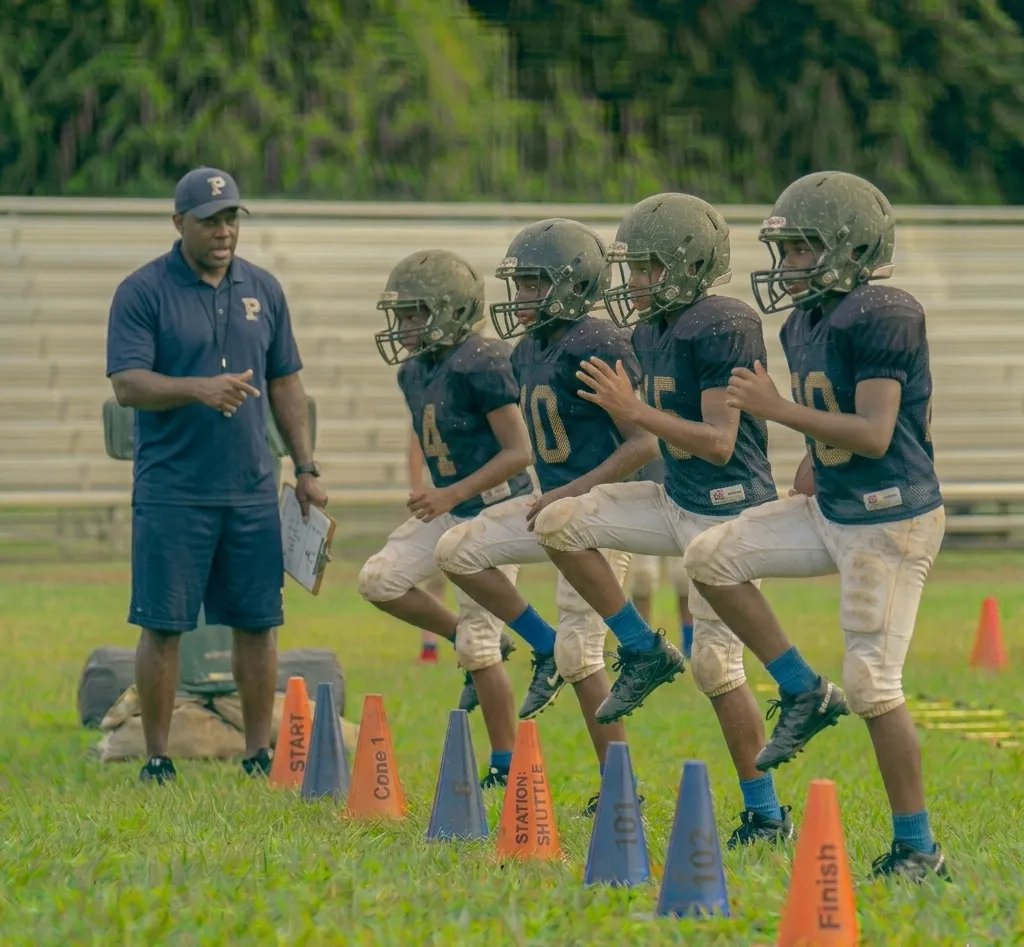
Warm Up Before Football Agility Drills
Always complete a short dynamic warm-up before football agility drills to prepare your muscles and joints for quick changes of direction.
- Light jogging (2–3 minutes)
- High knees
- Butt kicks
- Leg swings
- Dynamic stretching
This short warm-up prepares your body for agility training and helps reduce the risk of injury. For a complete routine, follow our football warm-up drills before practice guide. This approach is consistent with guidance from USA Football and the National Strength and Conditioning Association (NSCA).
Equipment Needed for Football Agility Drills
Most football agility drills require only a few basic training tools. If you are a beginner, you can start with simple equipment or use household items as substitutes.
- Cones (or small markers)
- Agility ladder
- Reaction ball (optional)
- Stopwatch or timer
- Open training space
- Athletic shoes with good grip
If you do not have cones or a ladder, use water bottles, chalk, or other markers to create your drill setup at home.
| Goal | Best Drill | Skill Focus |
|---|---|---|
| Improve foot speed | Ladder drills | Quick feet |
| Change direction | 5-10-5 shuttle | Speed + control |
| Route running | Zig zag drill | Sharp cuts |
| Defense movement | Box drill | Balance |
| Reaction speed | Mirror drill | Awareness |
Best Football Agility Drills for Beginners
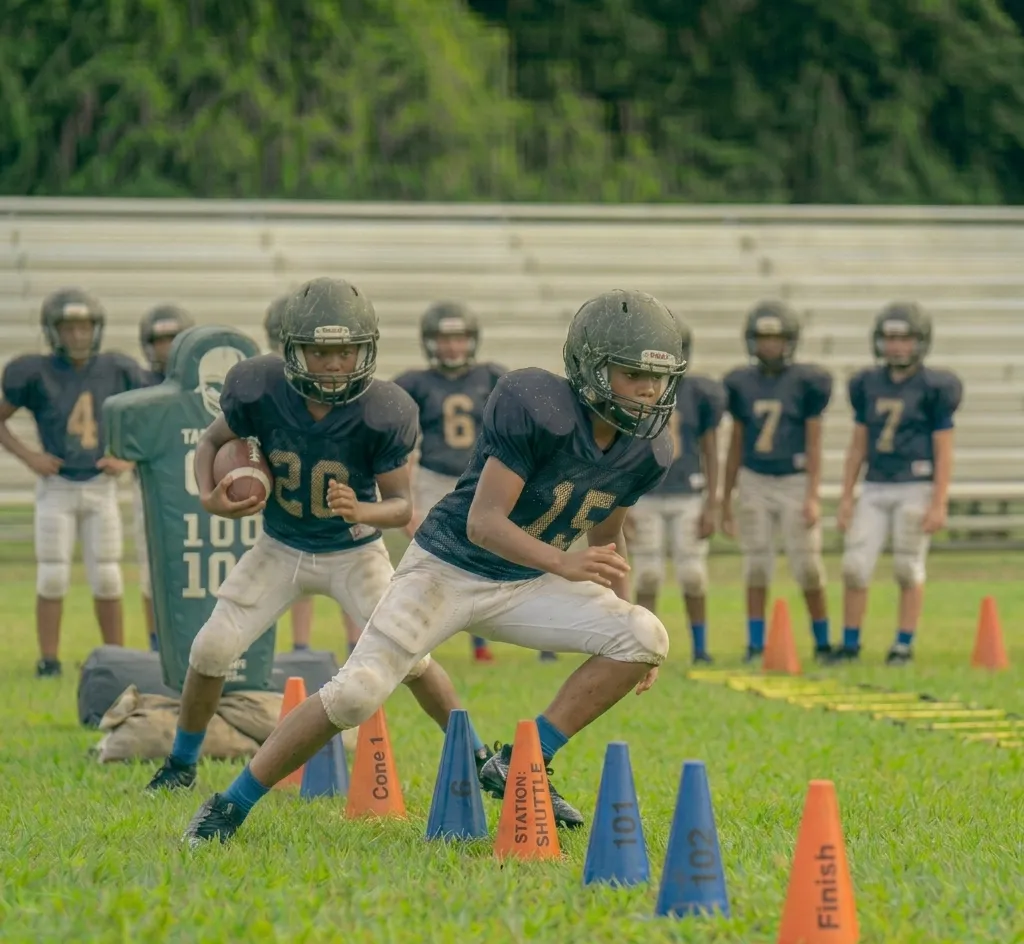
These drills are simple, effective, and used in real training.
1. 5-10-5 Shuttle Drill
Best For: Change of direction, lateral movement, and body control.
Setup
- Place 3 cones in a straight line, 5 yards apart.
How to Perform
- Start at the middle cone.
- Sprint 5 yards to one side and touch the line.
- Change direction and sprint 10 yards to the opposite side.
- Turn again and sprint back through the middle cone to finish.
Coach Tip
Stay low, plant your outside foot firmly, and explode out of each turn without taking extra steps.
Common Mistake
Crossing your feet while changing direction instead of taking short, controlled steps.
Read our complete 5-10-5 Shuttle Drill guide for step-by-step instructions, coaching tips, common mistakes, and drill variations.
2. T Drill
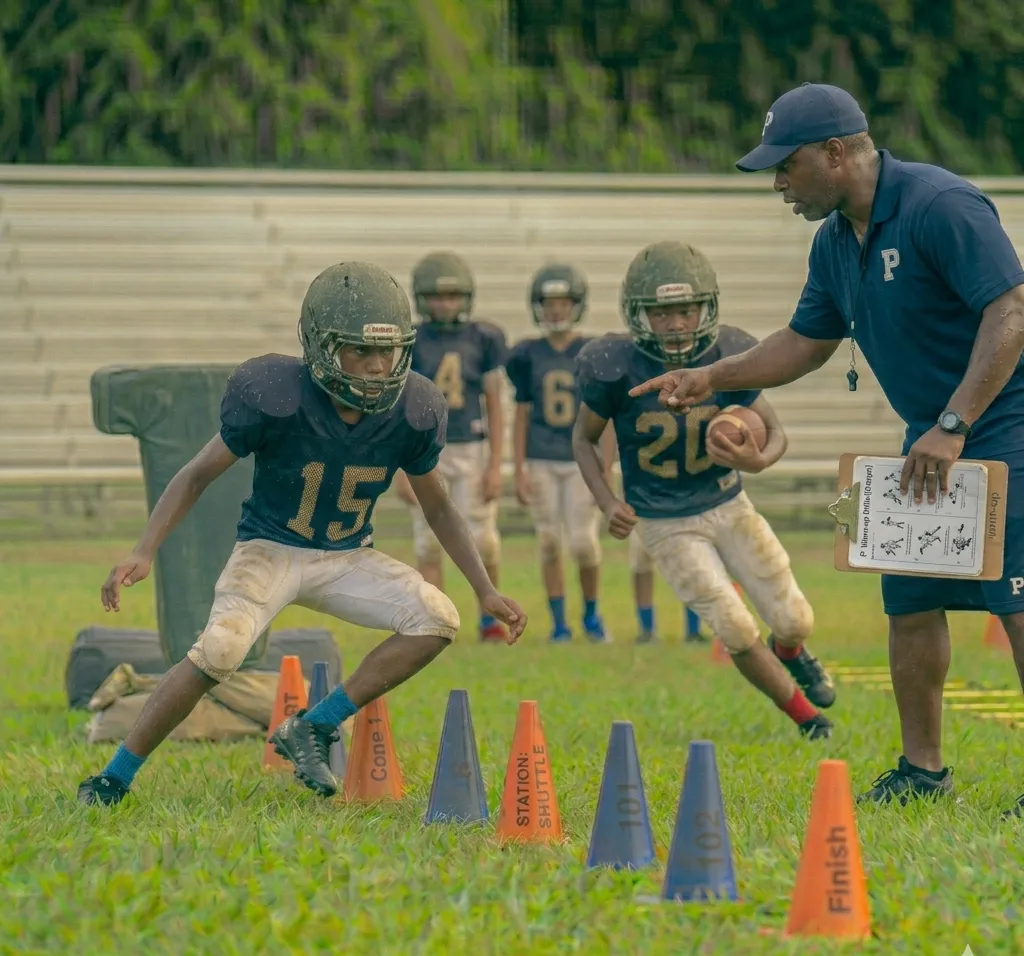
Best For: Multi-direction movement, lateral quickness, and body control.
Setup
- Place 4 cones in a “T” shape.
- Leave about 5 yards between each cone.
How to Perform
- Sprint to the middle cone.
- Shuffle to the left cone.
- Shuffle across to the right cone.
- Return to the middle cone.
- Backpedal to the starting point.
Recommended Reps
Complete 4–6 repetitions with 30–45 seconds of rest between each set.
Key Tip
Stay low, shuffle without crossing your feet, and keep your eyes forward throughout the drill.
Common Mistake
Crossing your feet while shuffling or standing upright during direction changes.
This overview covers the basics. For detailed setup, step-by-step instructions, coaching tips, common mistakes, variations, and FAQs, visit our T Drill guide.
3. L Drill (3 Cone Drill)
Best For: Change of direction, turning ability, and body control.
Setup
- Place 3 cones in an “L” shape.
- Leave about 5 yards between each cone.
How to Perform
- Start at the first cone.
- Sprint to the second cone and return to the start.
- Sprint back to the second cone, run around the third cone, and return to the starting cone.
- Complete the drill while staying under control through every turn.
Recommended Reps
Complete 4–6 repetitions with 30–45 seconds of rest between each set.
Key Tip
Stay low, take short, controlled steps around each cone, and keep your balance through every turn.
Common Mistake
Taking wide turns or slowing down too much before changing direction.
4. Zig Zag Drill
Best For: Change of direction, sharp cuts, and body control.
Setup
- Place 5–6 cones in a zig-zag pattern, about 3–5 yards apart.
How to Perform
- Sprint to the first cone.
- Plant your outside foot and cut toward the next cone.
- Continue through each cone while maintaining balance.
- Finish the drill without slowing down between cuts.
Recommended Reps
Complete 4–6 repetitions with 30–45 seconds of rest between each set.
Key Tip
Keep your hips low, plant your outside foot firmly, and make quick, controlled cuts around each cone.
Common Mistake
Taking long strides or making wide turns, which slows down your direction changes.
5. Box Drill
Best For: Multi-direction movement, balance, and body control.
Setup
- Place 4 cones in a square, about 5 yards apart.
How to Perform
- Sprint to the first cone.
- Shuffle to the second cone.
- Backpedal to the third cone.
- Shuffle to the fourth cone.
- Sprint back to the starting point.
Recommended Reps
Complete 4–6 repetitions with 30–45 seconds of rest between each set.
Key Tip
Stay balanced during every movement and transition smoothly between sprinting, shuffling, and backpedaling.
Common Mistake
Standing upright or losing control while changing movement directions.
6. Ladder Drill
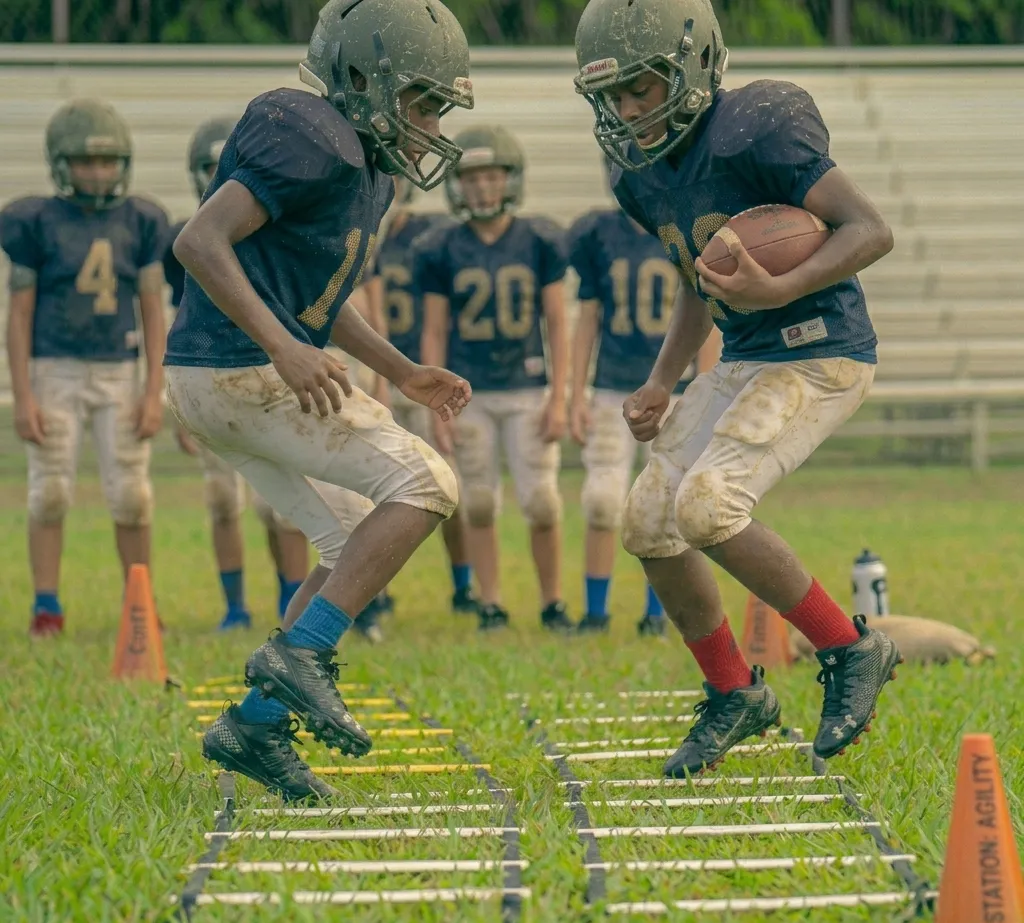
Best For: Quick feet, coordination, and agility.
Setup
- Lay an agility ladder flat on the ground.
- Stand at one end of the ladder.
How to Perform
- Step into each ladder box one foot at a time.
- Keep your feet light and move through the ladder as quickly as possible.
- Swing your arms naturally to maintain balance.
- Continue to the end of the ladder without stepping on the rails.
Recommended Reps
Complete 4–6 repetitions with 30–45 seconds of rest between each set.
Key Tip
Keep your steps short, stay on the balls of your feet, and focus on accuracy before increasing speed.
Common Mistake
Looking down the entire time or stepping on the ladder rails instead of maintaining a smooth rhythm.
7. Mirror Drill
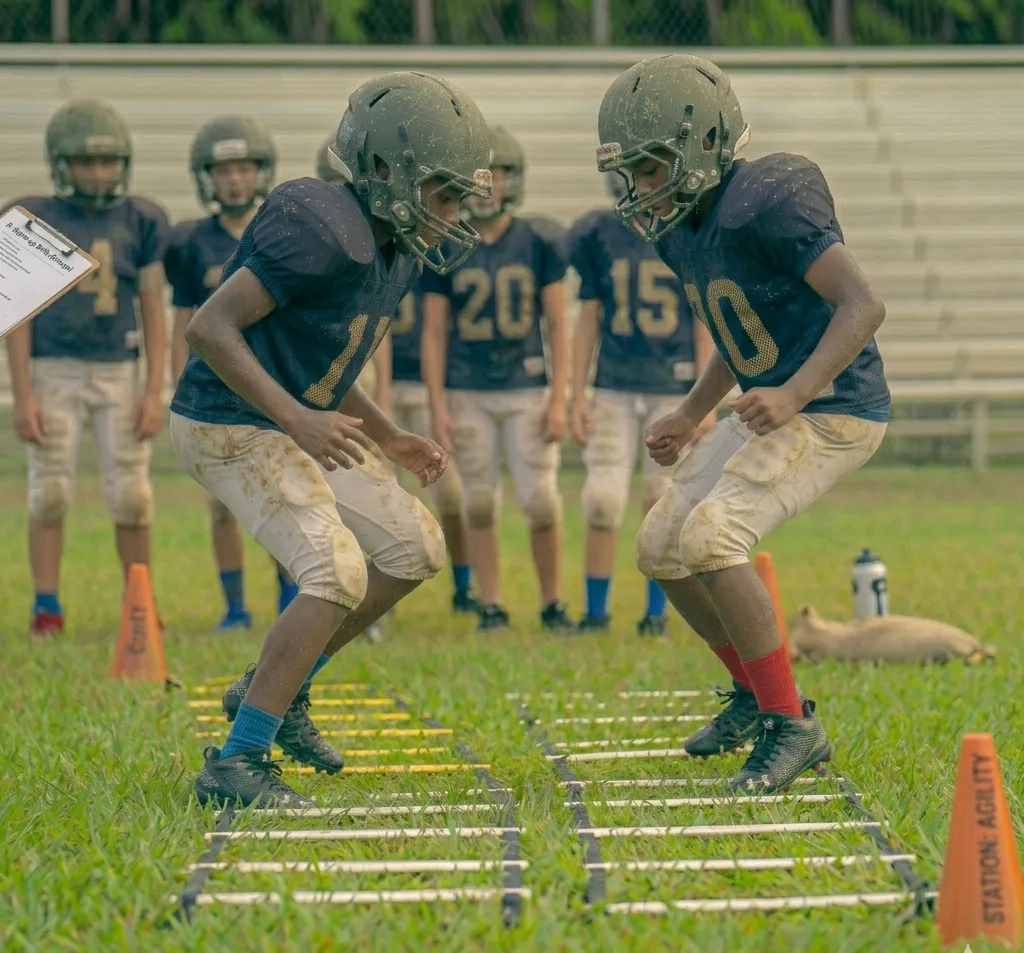
Best For: Reaction time, body control, and defensive movement.
Setup
- Stand facing a partner about 3–5 yards apart.
- One player leads while the other mirrors every movement.
How to Perform
- Start in an athletic stance.
- The lead player moves left, right, forward, or backward.
- Mirror every movement as quickly as possible without crossing your feet.
- Continue for 15–20 seconds, then switch roles.
Recommended Reps
Complete 4–6 repetitions, switching roles after each set.
Key Tip
Keep your eyes on your partner’s hips and react quickly while staying balanced.
Common Mistake
Watching the feet instead of the hips or crossing your feet during lateral movement.
8. Reaction Ball Drill
Best For: Reaction time, hand-eye coordination, and quick decision-making.
Setup
- Stand in an open area with a reaction ball.
- Hold the ball at waist height.
How to Perform
- Drop the reaction ball onto the ground.
- React quickly to its unpredictable bounce.
- Catch the ball before it stops moving.
- Repeat from different starting positions.
Recommended Reps
Complete 8–10 repetitions with 20–30 seconds of rest between each set.
Key Tip
Stay on the balls of your feet and keep your eyes on the ball from the moment it leaves your hand.
Common Mistake
Reacting too late or reaching across your body instead of moving your feet first.
Football Agility Drills You Can Do at Home
You do not need a full football field to improve agility. Many football agility drills can be practiced in a backyard, driveway, garage, or other small open space using simple equipment or household items.
Ladder Drill
An agility ladder helps improve quick speed, coordination, and balance. Players can use tape or chalk if they do not have a ladder.
Zig Zag Cone Drill
Place cones or household objects in a zig zag pattern and practice making sharp cuts while staying balanced and under control.
Shuttle Drill with Markers
Use shoes, bottles, or small markers to create a short shuttle course. Focus on acceleration, deceleration, and quick changes of direction.
Even a small backyard or driveway provides enough space for effective agility practice. If you want more home-friendly workouts, explore our backyard football drills guide.
Football Agility Drills by Position
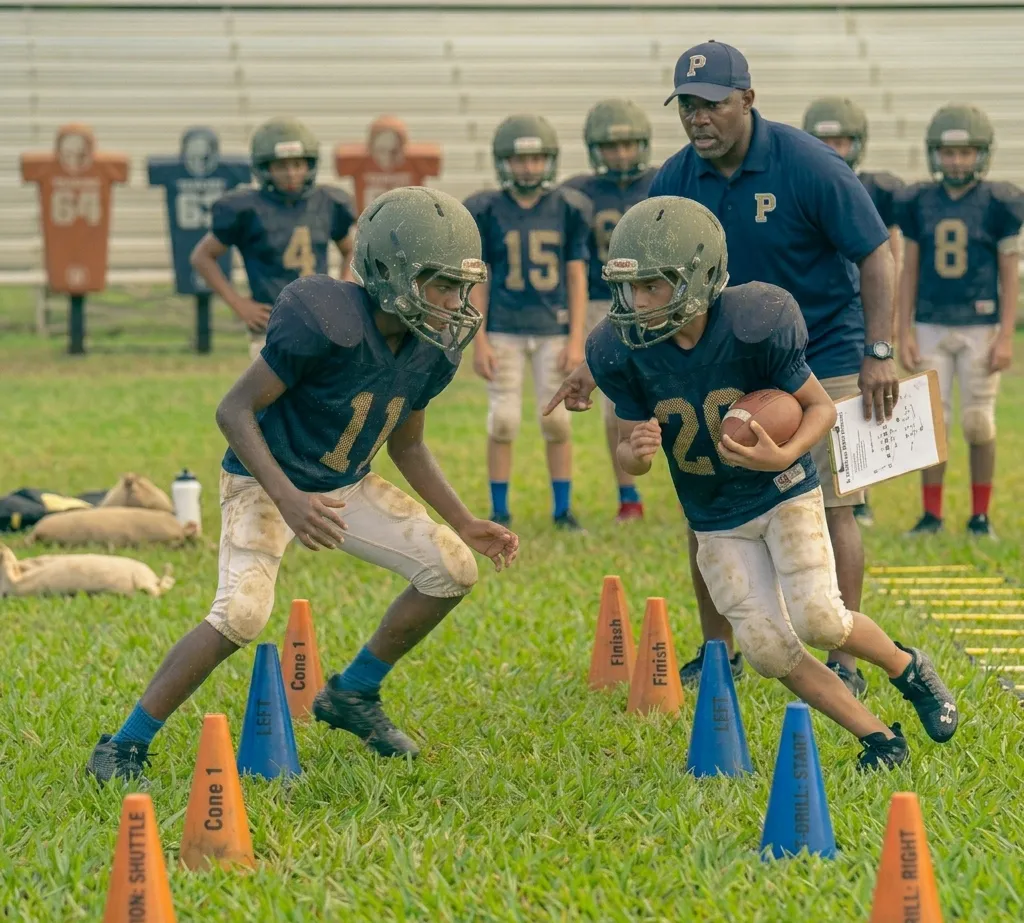
Quarterbacks
Recommended Drills: Ladder Drill, T Drill
These drills improve pocket movement, quick feet, and body control while moving under pressure.
Wide Receivers
Recommended Drills: Zig Zag Drill, Ladder Drill
These drills help wide receivers create separation, run sharper routes, and change direction efficiently.
Running Backs
Recommended Drills: Shuttle Drill, Cone Drill
These drills improve quick cuts, balance, and acceleration through running lanes.
Defensive Backs
Recommended Drills: Backpedal Drill, Mirror Drill
These drills develop reaction time, coverage movement, and smooth transitions while defending receivers.
Linebackers
Recommended Drills: Box Drill, Reaction Ball Drill
These drills improve lateral movement, pursuit angles, and quick reactions to the ball carrier.
Defensive Linemen
Recommended Drills: Short Shuttle Drill, Box Drill
These drills help defensive linemen improve lateral movement, change direction quickly, and react faster off the line of scrimmage. Build these skills further with our football trench drills.
Beginner to Advanced Football Agility Progression
Beginner → Ladder + cone drills
Intermediate → Shuttle + zig zag drills
Advanced → Reaction + game-speed drills
| Level | Focus | Recommended Drills |
|---|---|---|
| Beginner | Footwork and balance | Ladder drill, zig zag drill |
| Intermediate | Change of direction | T drill, 5-10-5 shuttle drill |
| Advanced | Reaction and game-speed movement | Mirror drill, reaction drills, position drills |
Signs You Are Ready for More Advanced Agility Drills
You may be ready to progress if you can:
- Stay balanced during quick cuts and direction changes.
- Maintain smooth, controlled footwork throughout each drill.
- React quickly to movement without hesitating.
- Complete drills with good technique instead of rushing.
- Recover comfortably between repetitions while maintaining consistent performance.
If you still lose balance or struggle with technique, continue practicing beginner drills until your movements feel controlled and consistent.
Weekly Football Agility Training Plan
| Week | Main Focus | Recommended Drills |
|---|---|---|
| 1–2 | Footwork and coordination | Ladder drill, cone drill |
| 3–4 | Change of direction | Shuttle drill, T drill |
| 5–6 | Reaction and body control | Mirror drill, box drill |
| 7–8 | Game-speed movement | Combination drills and position drills |
Signs Your Agility Is Improving
- Faster change of direction.
- Better balance during cuts.
- Quicker reaction time.
- More control while running routes.
- Less wasted movement.
How Long Does It Take to Improve Football Agility?
Improving agility takes time and consistent practice. Most players notice better footwork and movement within a few weeks, but game-speed performance takes longer to develop.
| Training Stage | Expected Improvement |
|---|---|
| Beginners | 3–4 weeks |
| Consistent training | 6–8 weeks |
| Game-speed movement | 8–12 weeks |
Beginners: 3–4 Weeks
Most beginners start seeing better balance, footwork, and body control after a few weeks of regular training.
Consistent Training: 6–8 Weeks
With two or three sessions each week, players usually improve acceleration, deceleration, and change-of-direction ability.
Game-Speed Movement: 8–12 Weeks
Game-speed agility takes longer to develop. As players gain experience, they become faster at reacting, making cuts, and changing direction under pressure.
Common Mistakes in Football Agility Drills (And How to Fix Them)
- Standing too upright → stay low
- Taking long steps → use short quick steps
- Skipping warm-up → always prepare first
- Losing balance → control your movement
| Mistake | Fix |
|---|---|
| Long steps | Short quick steps |
| Standing upright | Stay low |
| Skipping warm-up | Dynamic warm-up |
| Looking down | Keep eyes forward |
How to Measure Improvement in Football Agility Drills
Track your performance every 2–4 weeks to see how your agility is improving. Small improvements in time, balance, and movement control are signs that your training is working.
| What to Measure | How to Track It |
|---|---|
| 5-10-5 Shuttle Drill | Record the time it takes to complete the drill and compare it with previous results. |
| L Drill (3 Cone Drill) | Measure how quickly you finish the drill while maintaining good technique. |
| Reaction Speed | Count how quickly you respond during mirror drills or reaction ball drills. |
| Movement Quality | Check whether your cuts are sharper, your balance is better, and your footwork feels smoother. |
Record your results in a training log and compare them every few weeks instead of after every workout.
Football Agility Tests Used in Training
Many coaches use agility tests to measure movement skills, change of direction, and reaction time. These tests help track progress and identify areas that need improvement.
| Agility Test | What It Measures |
|---|---|
| 5-10-5 Shuttle Test | Acceleration, deceleration, and change of direction. |
| L Drill (3 Cone Drill) | Agility, body control, and turning ability. |
| T Drill | Multi-direction movement, lateral quickness, and balance. |
| Mirror Drill | Reaction time and defensive movement. |
You do not need to complete every test after each workout. Testing every 4–6 weeks is usually enough to measure your progress while keeping your focus on training.
5-10-5 Shuttle Test
One of the most common agility tests used in football training. It measures acceleration, deceleration, and the ability to change direction quickly.
3 Cone (L Drill) Test
Also called the L Drill, this test evaluates body control, acceleration, balance, and smooth direction changes while running around three cones.
T Drill Test
The T Drill measures lateral movement, coordination, balance, and multi-direction agility while sprinting, shuffling, and backpedaling.
Mirror Reaction Test
This partner drill evaluates reaction time, defensive movement, and the ability to respond quickly to another player’s actions.
Football Agility Tests and How Coaches Measure Performance
Football coaches use agility tests to evaluate change-of-direction ability, body control, acceleration, and movement efficiency. These tests are also widely used during player evaluations and higher-level football programs.
5-10-5 Short Shuttle
One of the most common football agility tests. It measures acceleration, deceleration, and how quickly a player can change direction over short distances.
3-Cone Drill
Also called the L Drill, this test evaluates body control, balance, acceleration, and the ability to make sharp cuts while maintaining speed.
T Drill
The T Drill measures lateral movement, coordination, balance, and multi-direction agility through sprinting, shuffling, and backpedaling.
NFL Combine Testing
At higher levels of football, including the NFL Combine, agility tests such as the 3-Cone Drill and 20-Yard Shuttle help evaluate a player’s movement skills. While most beginners do not need combine-level scores, tracking your own times over several weeks is an effective way to measure improvement.
Key Takeaways
- Train agility two or three times each week.
- Focus on proper footwork before increasing speed.
- Position-specific drills improve game performance.
- Track progress with shuttle tests and timing.
- Consistent practice leads to better movement and reaction time.
Conclusion
Football agility drills help players move with better balance, quicker reactions, and more control during real games. The biggest improvements come from practicing the basics consistently instead of rushing into advanced training. Focus on good technique, increase your speed gradually, and track your progress every few weeks.
As your agility improves, continue challenging yourself with more advanced drills while maintaining proper form. If you want to build complete athletic movement, continue with our football speed and agility drills for beginners, football footwork drills, and football warm-up drills before practice guides to develop speed, coordination, and game-ready movement.
📚 References
The information in this guide is supported by trusted football coaching and athletic performance resources.
Continue Your Football Training
Build on what you learned in this guide with these beginner-friendly football training resources.
Frequently Asked Questions
How often should beginners practice football agility drills?
Most beginners should practice football agility drills 2 to 3 times per week. This gives your body enough time to recover while improving balance, quick feet, and change-of-direction skills.
What is the best football agility drill for beginners?
Ladder drills and cone drills are excellent starting points. They help build coordination, body control, and movement technique before progressing to more advanced drills.
Can I improve football agility without an agility ladder?
Yes. You can use tape, chalk, or household objects to mark footwork patterns. Cone drills, shuttle runs, and zig zag drills are also effective without an agility ladder.
How long does it take to improve football agility?
Most beginners notice better balance, coordination, and quicker movement after 4 to 8 weeks of consistent training. Results depend on your practice routine, effort, and recovery.
Should I train speed and agility on the same day?
Yes. Many coaches combine speed and agility training in the same workout because both skills work together during football. Begin with speed drills while you are fresh, then move to agility drills.
What is the difference between speed and agility in football?
Speed is your ability to run fast in a straight line. Agility is your ability to stop, change direction, and react quickly while staying under control. Football players need both skills to perform well during games.
Which football positions benefit the most from agility drills?
Every position benefits from agility training. Wide receivers, running backs, defensive backs, linebackers, and quarterbacks all rely on quick footwork, balance, and fast direction changes during a game.
What mistakes should beginners avoid during agility training?
The most common mistakes are standing upright, taking long steps, looking down, rushing through drills, and skipping the warm-up. Focus on proper technique before trying to move faster.
