



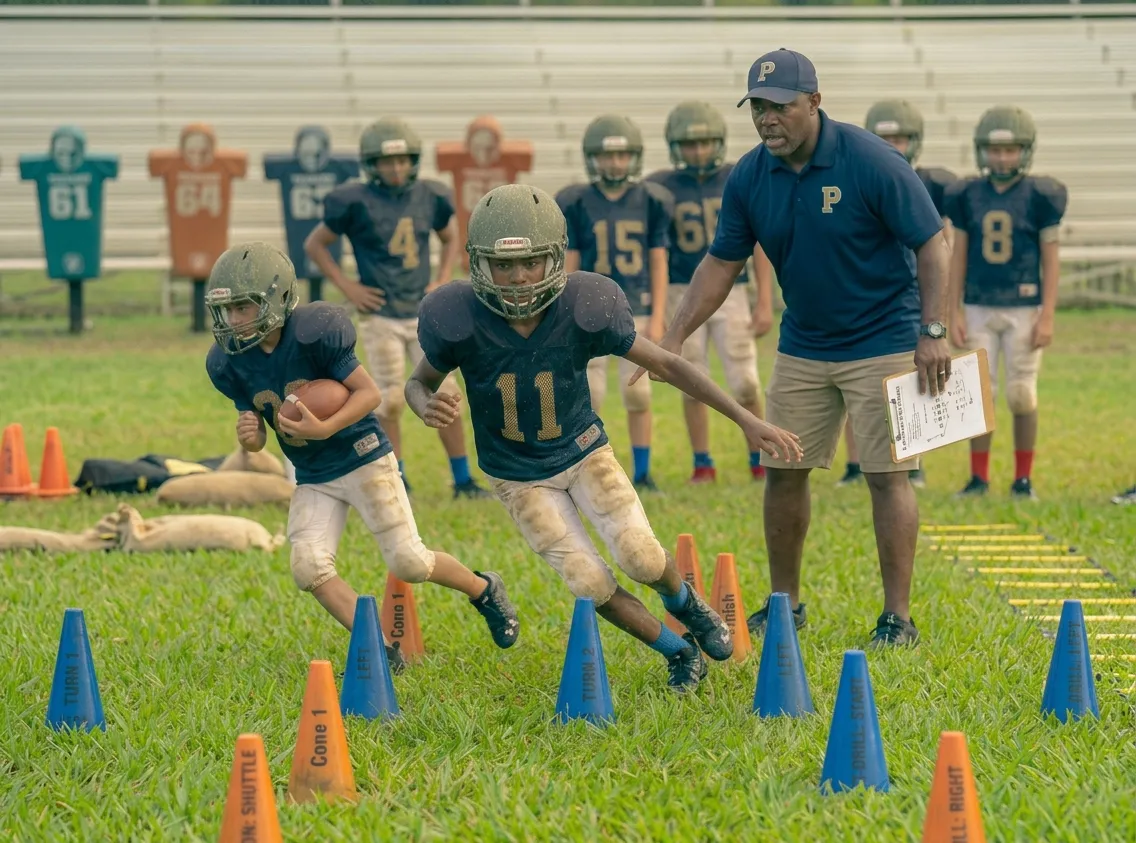
Many football players can run fast in a straight line but struggle when they need to cut, change direction, or react quickly during a game. Losing balance during a sharp turn or taking extra steps before accelerating often slows players down and creates missed opportunities on the field.
Cone drills for football are simple agility exercises that use cone setups to improve footwork, balance, acceleration, reaction time, and change of direction. These drills teach players how to move with control instead of relying only on speed, making them valuable for every position on the field. Players who want to develop overall movement skills can also practice our Football Agility Drills.
From watching youth practices and beginner training sessions, one problem appears again and again. A wide receiver rounds off a route instead of making a sharp cut. A defensive back reacts a split second too late. A running back loses balance while changing direction in traffic. In most cases, the issue isn’t effort or athletic ability. It’s a lack of proper movement training. Building stronger fundamentals with our Football Footwork Drills can help players improve their cutting technique and body control
This guide covers the best cone drills for football players, explains what each drill develops, and shows how to use them to build quicker feet, sharper cuts, and better game movement. Whether you’re a beginner, a youth coach, or a player looking to improve agility, these drills will help you move with more confidence and control. If you’re new to training, start with our complete Football Drills for Beginners guide to build your skills step by step.
Key Takeaways
- Cone drills improve agility, footwork, balance, reaction time, and change of direction.
- Most drills use 3–6 cones spaced 3–10 yards apart, depending on the drill and skill level.
- Focus on proper technique and body control before increasing speed.
- Practice cone drills 2–3 times per week to build consistent movement skills.
- Players of every position can use cone drills to improve game-ready movement and athletic performance.
📘 What You’ll Learn
In this guide, you’ll learn:
- What cone drills are and why they matter in football.
- The best cone drills for beginners and youth players.
- Which drill matches your position and training goals.
- Common mistakes that slow player development.
- A beginner-friendly cone drill workout plan.
- How to improve speed, agility, and footwork through consistent practice.
What Are Cone Drills in Football?
Cone drills for football are agility and movement exercises that use cone setups to improve footwork, speed, balance, acceleration, reaction time, and change of direction. They teach players how to move efficiently, stay under control, and make quicker cuts during real game situations.
Instead of simply running in a straight line, players sprint, shuffle, backpedal, and change direction around cones using different movement patterns. These drills build the movement skills needed for almost every position on the field, making them a regular part of youth, high school, and advanced football practices.
Whether you’re learning the fundamentals or improving game performance, cone drills help you:
- Move faster while staying balanced by combining cone training with our Football Balance Drills.
- Change direction with better control.
- Improve footwork and body coordination.
- React more quickly during plays.
- Build confidence when making sharp cuts and sudden movements.
Benefits of Cone Drills for Football Players
Unlike straight-line sprinting or position-specific practice, cone drills help players build the balance, coordination, body control, and movement mechanics needed to perform common football movements more efficiently.
Regular cone drill training can help players:
- Improve agility and overall movement efficiency.
- Develop quicker footwork. Players can build these skills further with our Football Footwork Drills.
- Improve reaction time during game situations.
- Build better balance and body control. For additional stability training, practice our Football Balance Drills.
- Make cleaner cuts with less wasted movement.
- Increase confidence when changing direction at speed.
These benefits apply to every position. Wide receivers use cone drills to run sharper routes, defensive backs improve their reaction and coverage skills, and running backs develop quicker cuts and better body control in traffic.
Who Should Use Cone Drills?
Cone drills can be adapted for almost any age or skill level and are useful for:
- Youth football players learning fundamental movement skills.
- Beginner players building coordination and confidence. If you’re new to the game, start with our Football Drills for Beginners guide.
- Coaches planning structured team practices.
- Parents helping children practice safely at home.
- Experienced players who want to improve agility and change of direction.
Start with simple cone patterns and controlled movement. As technique improves, gradually increase speed, add more complex patterns, and introduce reaction-based drills to better prepare for game situations. Coaches and parents can also use our Football Drills Step by step to introduce new skills in a logical training order.
Which Cone Drill Should You Choose?
Not every cone drill develops the same skill. If your goal is to improve a specific area of your game, use the guide below to choose the right drill before starting your workout.
| If Your Goal Is… | Best Drill | Primary Skill Developed |
|---|---|---|
| Improve foot speed | Foot Fire Drill | Quick footwork and coordination |
| Develop sharper cuts | Zig Zag Drill | Change of direction and balance |
| Build overall agility | T Drill | Agility, lateral movement, and body control |
| Improve lateral movement | Lateral Box Drill | Side-to-side movement and balance |
| React faster to plays | Star Pattern | Reaction time and multi-directional movement |
| Improve overall movement | 4-Corner Drill | Balance, agility, and direction changes |
| Improve footwork during cuts | Chair Pattern | Footwork, balance, and controlled movement |
Coach’s Tip: If you’re a beginner, start with the 4-Corner Drill and Foot Fire Drill before moving to more advanced drills like the T Drill or Star Pattern. Building good movement mechanics first makes advanced drills more effective and helps reduce common technique mistakes.
Best Cone Drills for Football Players
The drills below build the movement skills every football player needs, including quicker footwork, better balance, faster reactions, and sharper changes of direction. Start with controlled movements and proper technique before increasing your speed.
4-Corner Drill
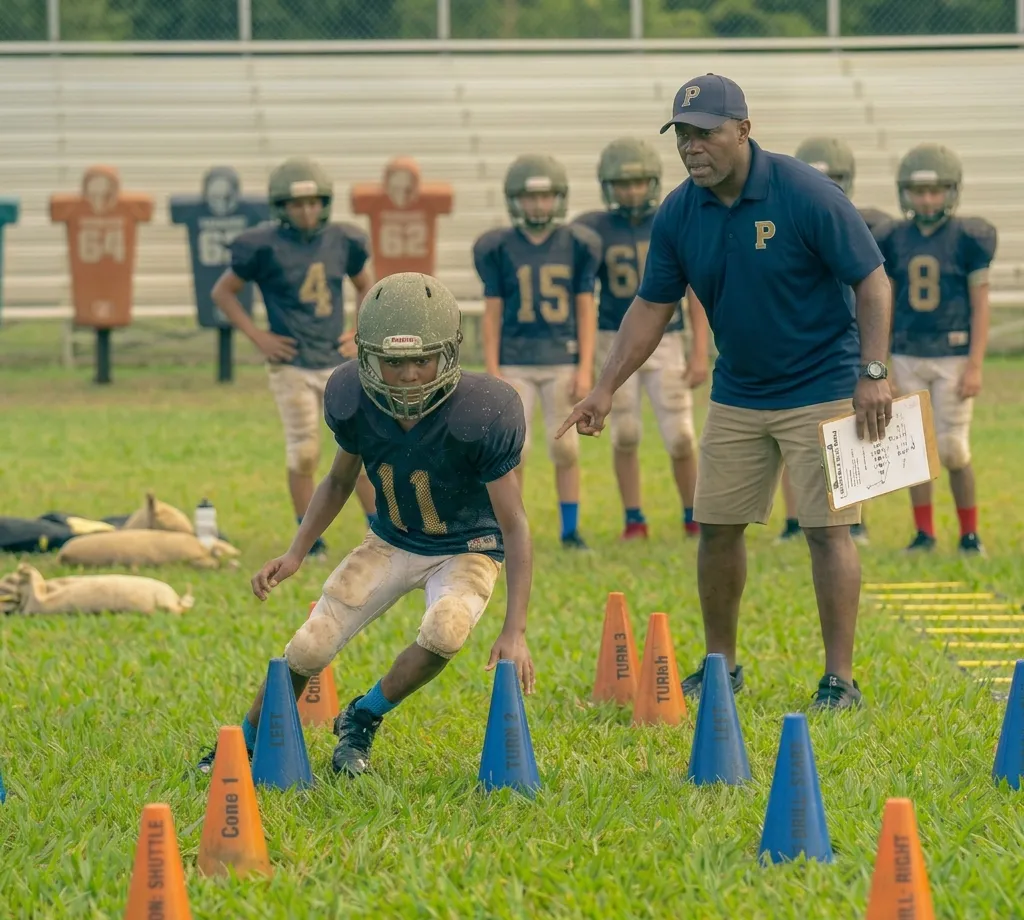
Purpose: Improve agility, balance, and quick direction changes.
Setup
- Place four cones in a square, about 5 yards apart.
How to Perform
- Sprint from one cone to the next in a square pattern.
- Stay under control while changing direction.
- Repeat for several rounds without slowing down through each turn.
Focus On
- Quick, controlled footwork.
- Sharp turns without losing balance.
Common Mistake
Standing too upright while turning, which slows down direction changes and reduces balance.
Coaching Tip
Stay low, bend your knees, and plant your outside foot before changing direction.
Best For
Defensive backs, linebackers, and beginner players developing agility.
Game Application
This drill helps defensive players react faster, stay balanced, and change direction more efficiently when covering receivers or pursuing the ball.
Zig Zag Drill
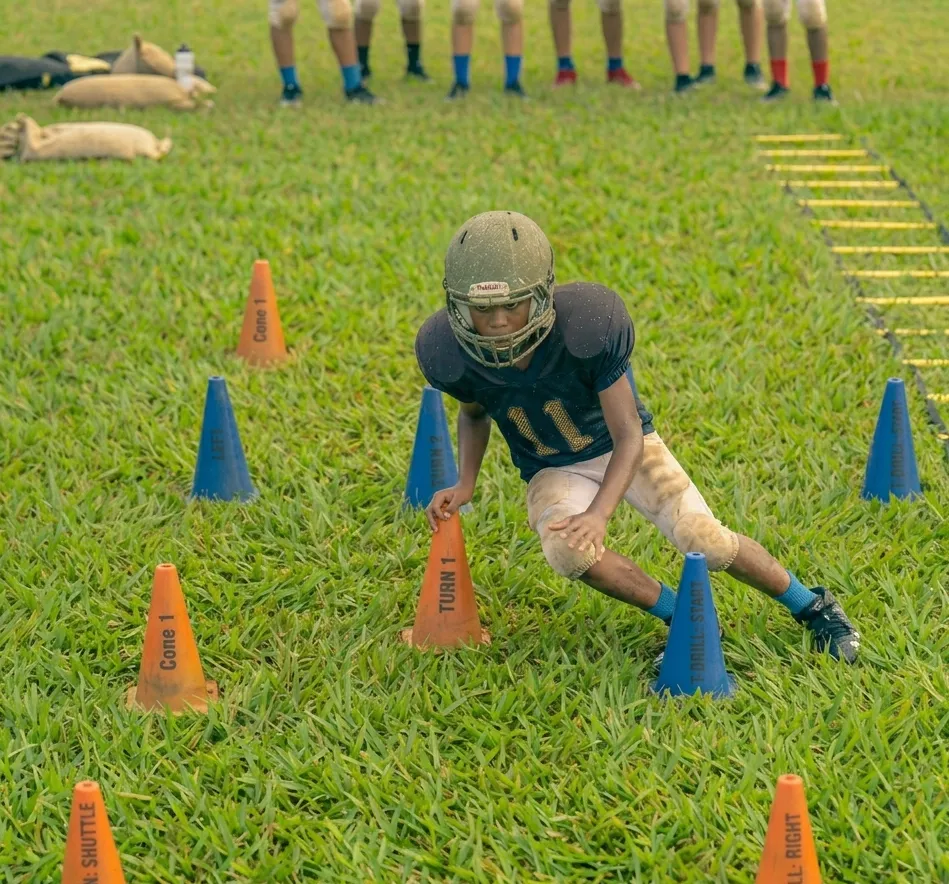
Purpose: Develop sharp cuts, body control, and efficient route-running movement.
Setup
- Place cones in a zig zag line, about 3–5 yards apart.
How to Perform
- Sprint toward the first cone.
- Plant your outside foot firmly before changing direction to maintain balance and generate a faster cut.
- Stay balanced and accelerate out of every turn.
Focus On
- Sharp cuts.
- Balance.
- Smooth acceleration after each change of direction.
Common Mistake
Taking extra steps before changing direction, which slows movement and wastes time.
Coaching Tip
Plant your foot firmly, keep your hips low, and explode out of each cut.
Best For
Wide receivers, running backs, and players working on agility.
Game Application
The Zig Zag Drill improves the quick cuts and controlled movements needed for route running, avoiding defenders, and changing direction during open-field play. Players looking to improve these skills can continue with our Wide Receiver Drills.
Foot Fire Drill
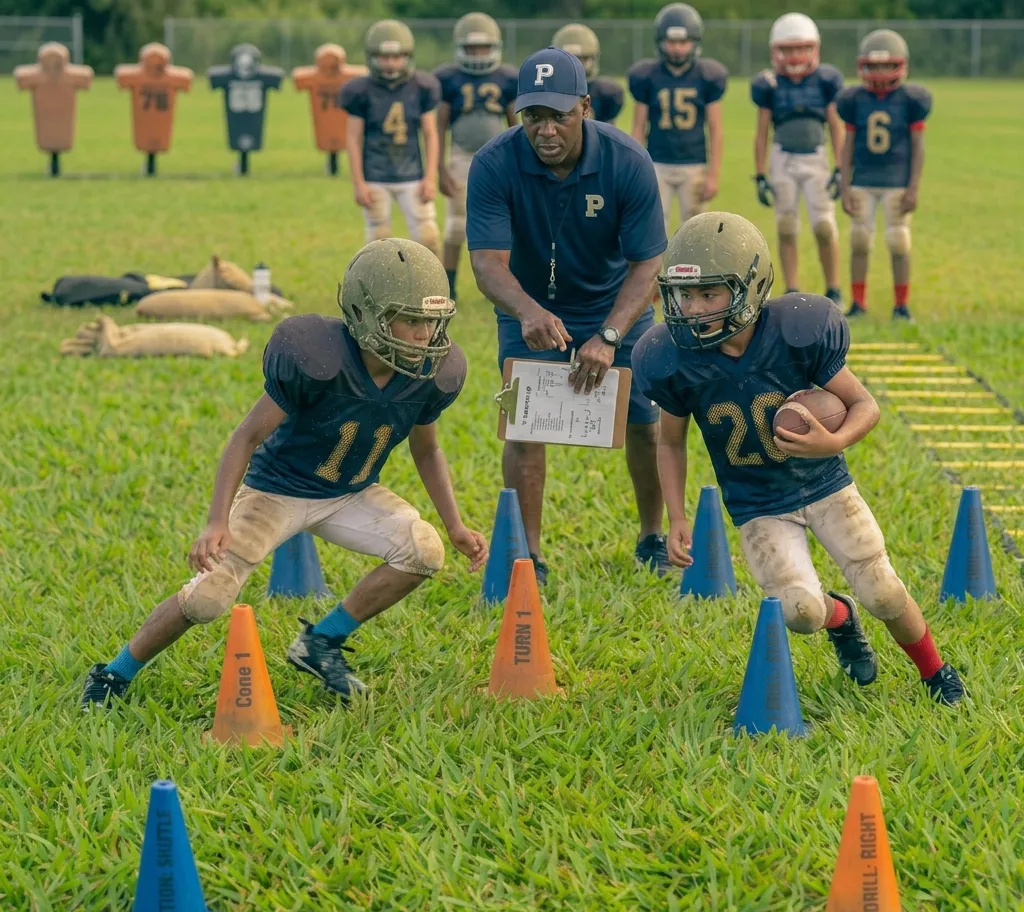
Purpose: Improve foot speed, coordination, and quick reactions before accelerating or changing direction.
Setup
- Place two cones 1–2 yards apart.
- Stand between the cones in an athletic stance with your knees slightly bent.
How to Perform
- Start in an athletic stance with your knees slightly bent before moving your feet as quickly as possible.
- Stay on the balls of your feet throughout the drill.
- Keep your upper body balanced while pumping your arms naturally.
- Continue for 15–20 seconds, then rest and repeat.
Focus On
- Fast foot movement.
- Coordination.
- Maintaining balance while moving quickly.
Common Mistake
Taking heavy steps or letting your heels touch the ground, which slows your foot speed and reduces control.
Coaching Tip
Keep your feet light, stay low, and make quick, controlled movements instead of taking large steps.
Best For
Wide receivers, defensive backs, linebackers, and beginner players developing quicker feet.
Game Application
The Foot Fire Drill improves the quick reactions and fast foot movement players need at the line of scrimmage, when changing direction, or preparing to accelerate into a play.
Lateral Box Drill
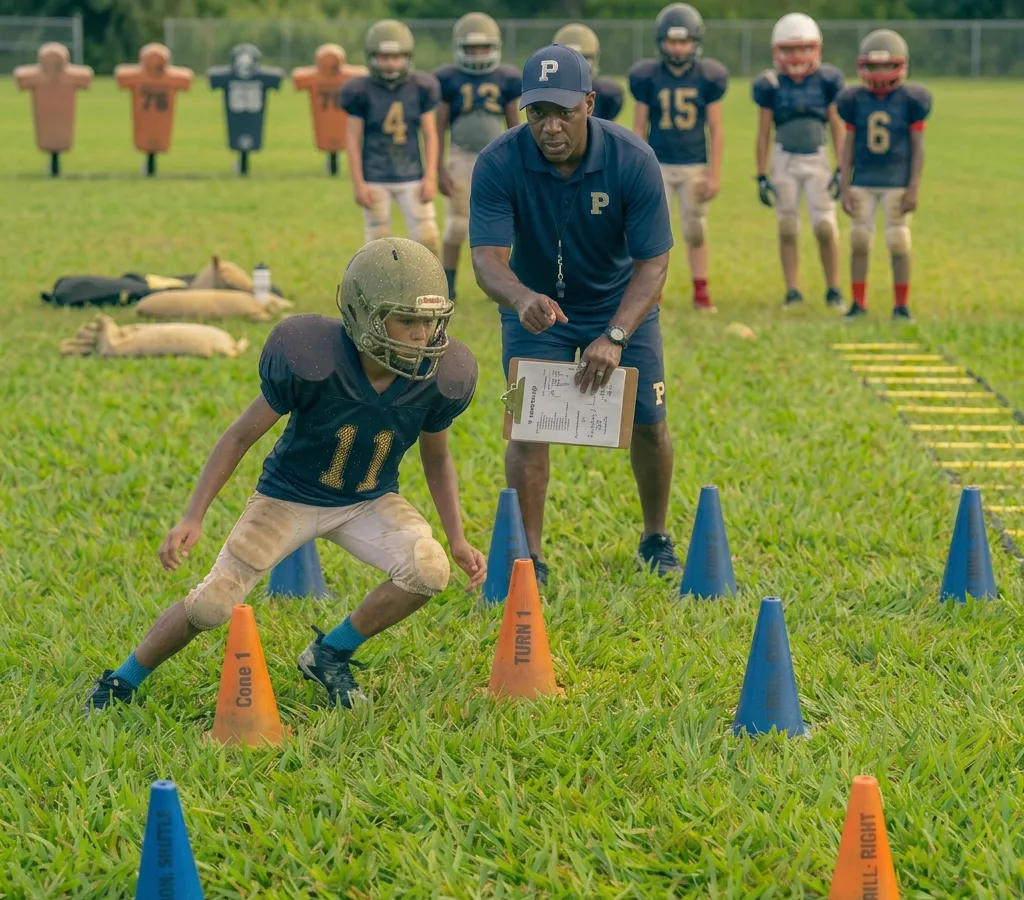
Purpose: Improve lateral movement, balance, and body control while staying in an athletic position.
Setup
- Place four cones in a box shape, about 5 yards apart.
How to Perform
- Start at one corner of the box in an athletic stance.
- Shuffle sideways to the next cone without crossing your feet.
- Continue around the box using controlled lateral movements.
- Stay low and maintain balance throughout the drill.
Focus On
- Lateral movement.
- Balance.
- Staying in a low athletic stance.
Common Mistake
Crossing your feet while shuffling, which reduces balance and makes it harder to react quickly.
Coaching Tip
Keep your hips low, chest up, and take short, controlled shuffle steps instead of long strides.
Best For
Defensive backs, linebackers, and players who need to improve side-to-side movement.
Game Application
The Lateral Box Drill helps defensive players stay in position, mirror receivers, and react more quickly when changing direction during coverage.
T Drill
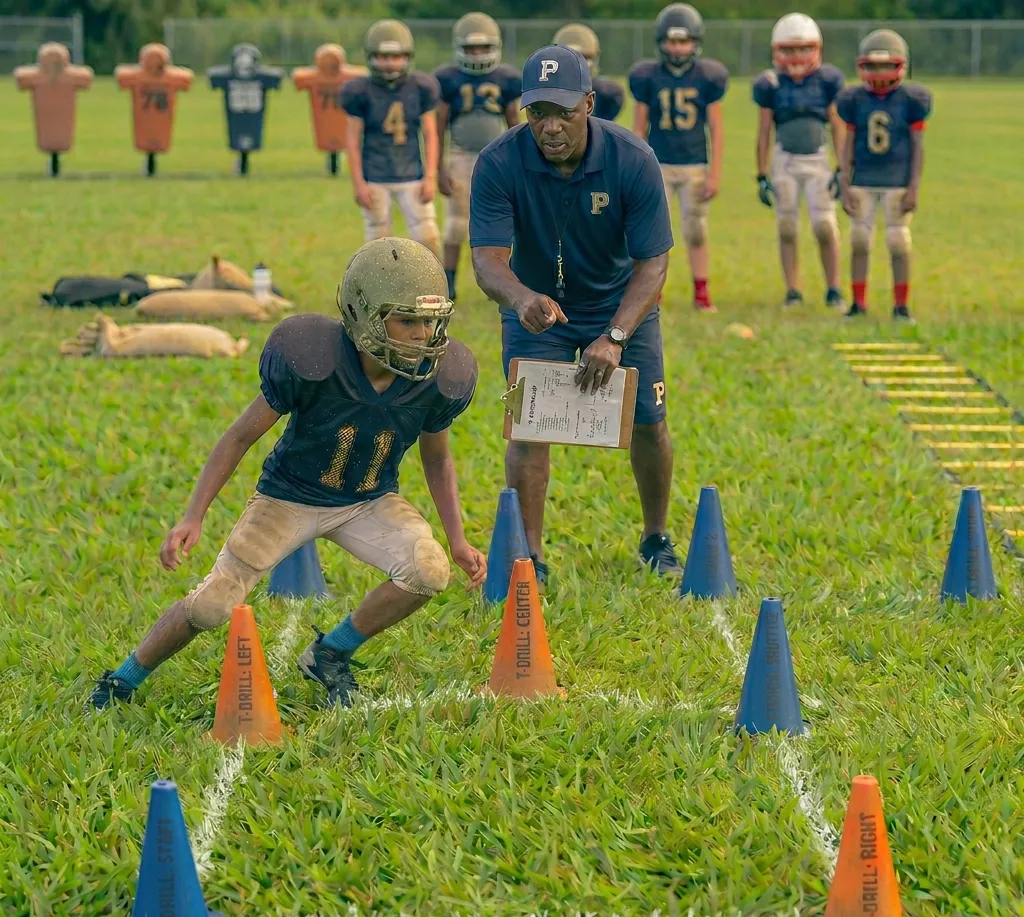
Purpose: Improve agility, acceleration, deceleration, lateral movement, and body control while changing direction.
Setup
- Set four cones in a “T” shape.
- Place the center cone 5–10 yards in front of the starting cone, with the left and right cones 5 yards apart.
How to Perform
- Sprint forward 5–10 yards to the center cone.
- Shuffle left to the outside cone.
- Shuffle across to the opposite cone.
- Shuffle back to the center cone.
- Backpedal to the starting position.
Focus On
- Agility.
- Body control.
- Smooth transitions between sprinting, shuffling, and backpedaling.
Common Mistake
Standing too tall or crossing your feet while shuffling, which reduces balance and slows direction changes.
Coaching Tip
Keep your hips low, chest up, and use short, controlled shuffle steps. Stay balanced throughout the drill instead of rushing through each movement.
Best For
Defensive backs, wide receivers, linebackers, and athletes preparing for agility testing.
Game Application
The T Drill develops the quick lateral movement, body control, and change-of-direction skills needed for pass coverage, route running, and reacting to plays in open space. It is also commonly included in football combine-style agility testing because it measures movement efficiency and overall athletic control.
Drill Comparison Table
| Drill Name | Best For | Difficulty | Position Use |
|---|---|---|---|
| 4-Corner Drill | Direction change | Easy | All positions |
| Zig Zag Drill | Sharp cuts | Medium | WR, RB |
| T Drill | Agility + movement | Medium | DB, WR |
| Box Drill | Lateral movement | Medium | DB, LB |
| Star Drill | Reaction | Hard | LB, RB |
Cone Drills for Youth Football
Cone drills are an excellent way for young football players to develop balance, coordination, agility, and body control before progressing to more advanced football skills. Because these drills focus on movement rather than contact, they are suitable for beginners learning proper athletic technique. Parents can also use these drills during at-home practice sessions to help young athletes build confidence.
According to USA Football’s Player Development Model, young athletes should first develop fundamental movement skills before progressing to faster or more complex football drills. This step-by-step approach helps build sound technique and prepares players for long-term development.
Youth cone drills help players:
- Build fundamental movement skills.
- Improve balance and coordination.
- Develop quicker footwork.
- Gain confidence changing direction.
- Prepare for more advanced football drills.
First Segment
Purpose: Build basic speed, balance, and stopping control.
Setup
- Place cones in a straight line about 5 yards apart.
How to Perform
- Sprint forward to the last cone.
- Stop under control.
- Run back to the starting cone.
- Repeat for several repetitions.
Focus On
- Speed.
- Balance.
- Controlled stops.
Coaching Tip
Teach young players to slow down under control instead of stopping suddenly or leaning backward.
Second Segment
Purpose: Improve coordination, reaction, and movement in different directions.
How to Perform
- Move forward through the cones.
- Backpedal to the next cone.
- Shuffle sideways between cones.
- Repeat the sequence while maintaining good balance.
Focus On
- Reaction.
- Coordination.
- Body control.
Coaching Tip
Encourage smooth, controlled movement before asking players to increase their speed. Good technique builds confidence and reduces bad movement habits.
Star Pattern
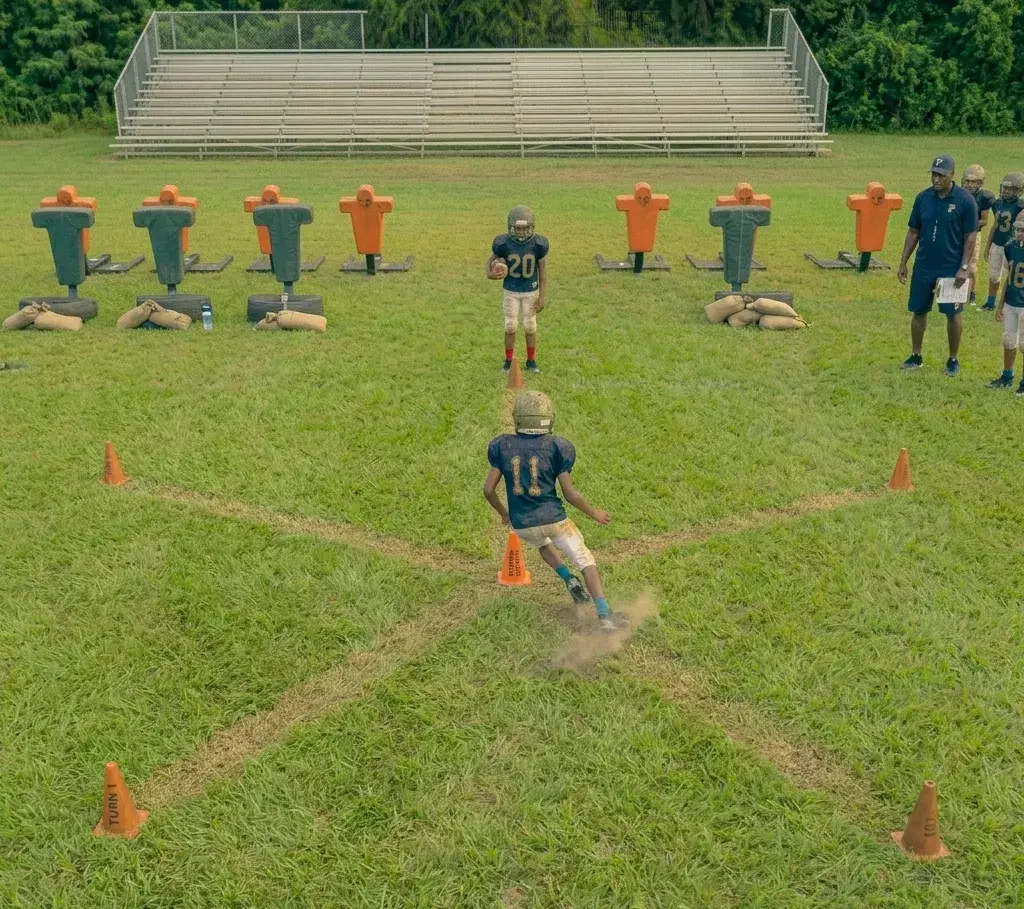
Purpose: Improve reaction time, acceleration, body control, and multi-directional movement.
Setup
- Place five cones in a star pattern, with each cone 3–5 yards from the center.
How to Perform
- Start at the center cone in an athletic stance.
- Explode toward each cone with quick, controlled acceleration before returning to the center.
- Repeat the movement to each remaining cone as quickly as possible.
- Stay balanced and under control throughout the drill.
Focus On
- Quick direction changes.
- Explosive acceleration.
- Maintaining balance during every movement.
Common Mistake
Running too fast and losing balance when returning to the center, which reduces control and slows the next movement.
Coaching Tip
Stay low, keep your eyes up, and push off explosively from each cone instead of taking extra steps.
Best For
Linebackers, running backs, and defensive players who need to react quickly in multiple directions.
Game Application
The Star Pattern helps players react faster to changing plays, close space efficiently, and make controlled cuts while pursuing the ball carrier or avoiding defenders.
Chair Pattern
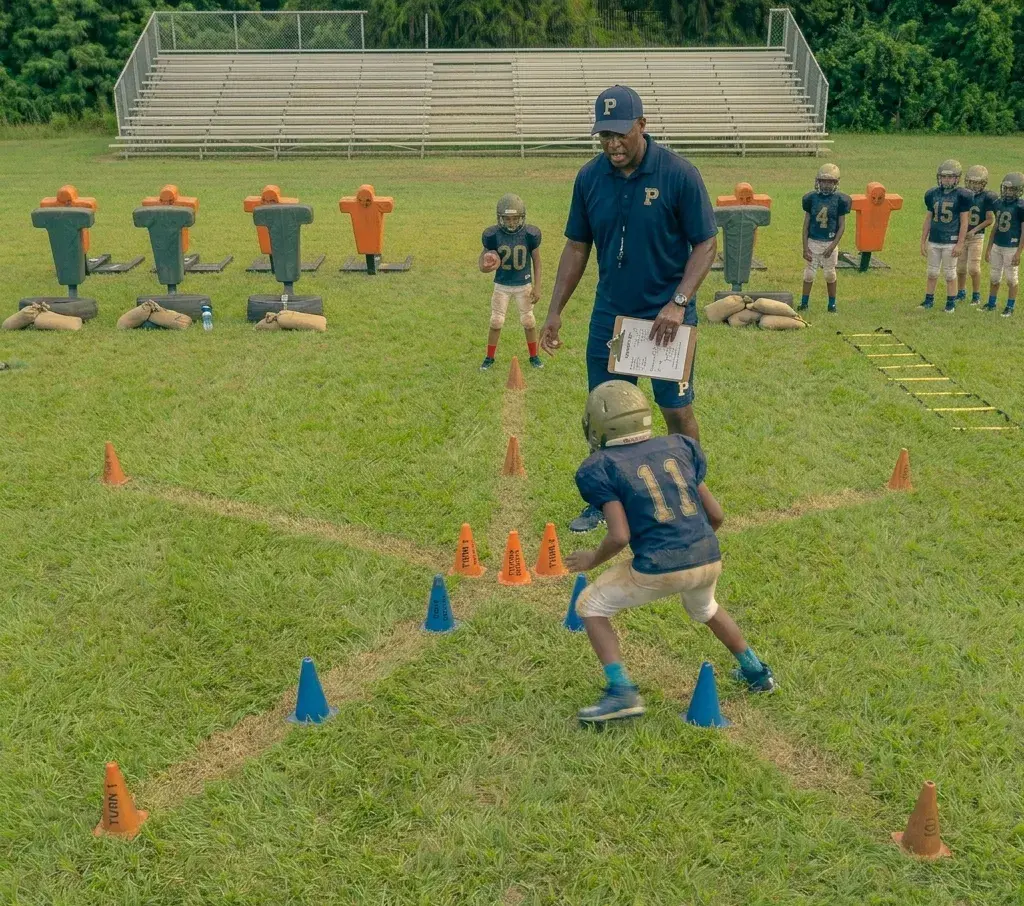
Purpose: Improve footwork, balance, and controlled changes of direction while maintaining speed.
Setup
- Place five cones in a chair-shaped pattern with 3–5 yards between each cone.
How to Perform
- Start at the first cone in an athletic stance.
- Follow the chair pattern using quick, controlled cuts around each cone.
- Stay balanced and accelerate smoothly after every change of direction.
- Complete the pattern without taking unnecessary steps.
Focus On
- Quick footwork.
- Sharp, controlled cuts.
- Maintaining balance throughout the drill.
Common Mistake
Taking wide turns around the cones, which slows movement and reduces control.
Coaching Tip
Plant your outside foot firmly, keep your hips low, and make sharp cuts instead of rounding each turn.
Best For
Running backs, wide receivers, and beginner players improving footwork and agility.
Game Application
The Chair Pattern helps players develop the quick footwork and body control needed to avoid defenders, run cleaner routes, and change direction more efficiently during games.
How to Set Up Cone Drills for Football
- Zig zag: 3–5 yards apart
- Square drills: 5 yards apart
- T drill: 5–10 yards
Use 4–6 cones. Also, make sure the area is clear and safe. Coaches can set up multiple stations during practice
Cone Drill Progression for Football Players
- Beginner: straight runs
- Intermediate: zig zag drills
- Advanced: reaction drills
This helps players improve step by step. Coaches can also use this to plan practice sessions.
Cone Drills for Football by Position
Different positions require different movement skills. Choosing the right cone drills helps players improve the techniques they use most during games.
Wide Receivers
Primary Focus: Route running, sharp cuts, and acceleration out of breaks.
Recommended Drills:
- Zig Zag Drill
- T Drill
- Foot Fire Drill
Why These Drills Help:
These drills improve route-running footwork, quicker cuts, and better separation from defenders.
Defensive Backs
Primary Focus: Backpedaling, lateral movement, and reacting to receivers.
Recommended Drills:
- Lateral Box Drill
- T Drill
- 4-Corner Drill
Why These Drills Help:
They improve balance, body control, and quick direction changes when covering receivers.
Running Backs
Primary Focus: Quick cuts, acceleration, and changing direction in traffic.
Recommended Drills:
- Zig Zag Drill
- Star Pattern
- Chair Pattern
Why These Drills Help:
These drills develop the footwork and body control needed to avoid defenders and accelerate through running lanes.
Linebackers
Primary Focus: Reaction, pursuit angles, and lateral movement.
Recommended Drills:
- Star Pattern
- Lateral Box Drill
- T Drill
Why These Drills Help:
These drills help linebackers react faster, stay balanced, and move efficiently in multiple directions during game situations.
Common Mistakes in Cone Drills
Even simple cone drills can become less effective if players develop poor movement habits. Focus on quality before speed and correct these common mistakes early. Many beginners focus only on accelerating through the drill but forget to decelerate under control before changing direction.
- Standing too upright instead of staying in an athletic stance.
- Taking long steps instead of quick, controlled footwork.
- Making wide turns around cones instead of planting and changing direction.
- Looking down at the cones instead of keeping your eyes forward.
- Rushing through the drill before mastering proper technique.
Coaching Tip: Slow the drill down if technique starts to break down. Players build better habits by repeating correct movements rather than moving as fast as possible.
Pro Tips for Better Results
To get the most from every cone drill session:
- Stay low during every cut and direction change.
- Keep your steps short, quick, and controlled.
- Focus on clean technique before increasing speed.
- Rest between sets so each repetition is performed with good quality.
- Increase difficulty gradually by adding reaction drills or reducing rest time as your movement improves.
Sample Cone Drill Workout PlanThis beginner-friendly workout develops agility, footwork, and body control in about 30 minutes.
| Time | Activity |
|---|---|
| 5–10 minutes | Dynamic warm-up and mobility exercises |
| 10 minutes | Basic cone drills such as the 4-Corner Drill and Foot Fire Drill |
| 10–15 minutes | Advanced drills like the T Drill, Zig Zag Drill, or Star Pattern |
| 5–10 minutes | Position-specific drills based on your playing position |
For even better results, combine this workout with your Football Speed Drills and Football Footwork Drills to build complete game-ready movement.
Keep in Mind
Cone drills improve movement skills, agility, and footwork, but they should be combined with strength training, position-specific practice, and game experience. Players develop best when cone drills are part of a complete football training program rather than the only type of practice.
How to Improve Speed and Agility with Cone Drills for Football
Improving speed and agility takes consistent practice and proper technique. Instead of trying to move as fast as possible from the first session, focus on building efficient movement patterns. As your balance and footwork improve, your speed will naturally increase. Good movement mechanics allow players to change direction efficiently while staying balanced.
To get better results from cone drills:
- Practice 2–3 times per week with at least one rest day between intense sessions.
- Master proper form before increasing your speed.
- Stay balanced by keeping your hips low and taking short, controlled steps.
- Gradually increase the speed and difficulty of each drill as your technique improves.
- Track your progress by completing drills with fewer mistakes and smoother direction changes.
Coach’s Insight: Many players try to sprint through cone drills too early. Players usually improve faster when they first develop clean footwork and body control, then gradually increase speed while maintaining good technique.
Consistency is more important than long workouts. Short, focused training sessions performed regularly will produce better long-term improvement than occasional high-intensity practices.
Training Reminder
Every player develops at a different pace. Focus on proper technique before increasing speed or drill difficulty. If a drill causes pain or discomfort, stop training and consult a qualified coach or healthcare professional before continuing.
Conclusion
Cone drills for football may look simple, but they build the movement skills that every player needs on the field. Better footwork, balance, body control, and quicker direction changes all start with consistent practice and proper technique.
From youth football training, one pattern appears repeatedly: players who master the basics before chasing speed usually develop cleaner movement and make fewer mistakes during games. That is why coaches often introduce cone drills early and continue using them throughout the season.
Start with the basic drills in this guide, focus on quality over speed, and gradually increase the challenge as your confidence grows. Whether you are a beginner player, a parent practicing at home, or a coach planning team sessions, consistent training with the right drills will help build a stronger foundation for every stage of football development.
To continue improving, explore our guides on Football Footwork Drills, Football Speed Drills, and Football Drills for Beginners to build a complete training routine.
🏈 Continue Building Your Football Skills
Cone drills are one part of becoming a better football player. To improve your overall performance, combine them with other beginner-friendly football training guides.
- Football Footwork Drills – Improve quick feet and balance.
- Football Speed Drills – Build acceleration and explosiveness.
- Football Balance Drills – Develop better body control.
- Football Drills for Beginners – Follow a complete beginner training plan.
Practice these skills consistently to become a faster, more confident, and better-prepared football player.
FAQS
What are cone drills for football?
Cone drills for football are training exercises that use cone layouts to improve agility, footwork, balance, reaction time, acceleration, and change of direction. They help players develop better movement mechanics that carry over to game situations.
What are the best cone drills for football players?
Some of the most effective cone drills include the 4-Corner Drill, Zig Zag Drill, Foot Fire Drill, Lateral Box Drill, T Drill, Star Pattern, and Chair Pattern. Each drill develops a different movement skill, so using a variety of drills creates a more complete training routine.
How often should football players practice cone drills?
Most players benefit from practicing cone drills 2–3 times per week. This provides enough repetition to improve movement skills while allowing time for recovery and other football training.
How many cones do I need for football cone drills?
Most cone drills require 3–6 cones. Simple drills may only need three or four cones, while more advanced patterns such as the Star Pattern use five or six.
How far apart should football cones be?
Cone spacing depends on the drill. Most beginner drills use cones placed 3–10 yards apart. Shorter distances emphasize footwork and quick reactions, while wider spacing develops acceleration and change of direction.
Which football positions benefit most from cone drills?
Every position can benefit from cone drills. Wide receivers improve route running, running backs develop sharper cuts, defensive backs improve coverage movement, linebackers react more quickly, and quarterbacks build better footwork in the pocket.
Are cone drills good for beginner football players?
Yes. Cone drills are one of the best ways for beginners to develop balance, coordination, body control, and proper movement before progressing to more advanced football skills.
Can kids practice cone drills safely?
Yes. Cone drills are suitable for youth players when they are age-appropriate and performed with proper technique. Young athletes should focus on controlled movement before trying to complete the drills at full speed.
Can I practice cone drills at home?
Yes. Many cone drills can be practiced in a backyard, driveway, park, or any open area with enough space to move safely. A football and a small set of training cones are usually all you need.
How long should a cone drill workout last?
A beginner cone drill workout typically lasts 20–30 minutes, including a warm-up, skill drills, and a cool-down. Short, focused sessions often produce better results than long workouts with poor technique.
Do cone drills make you faster?
Cone drills improve the movement skills that support game speed, including footwork, balance, acceleration, and change of direction. They work best when combined with sprint training, strength work, and regular football practice.
What mistakes should I avoid during cone drills?
The most common mistakes are standing too upright, taking long steps, looking down at the cones, making wide turns, and focusing on speed before mastering proper technique.
