



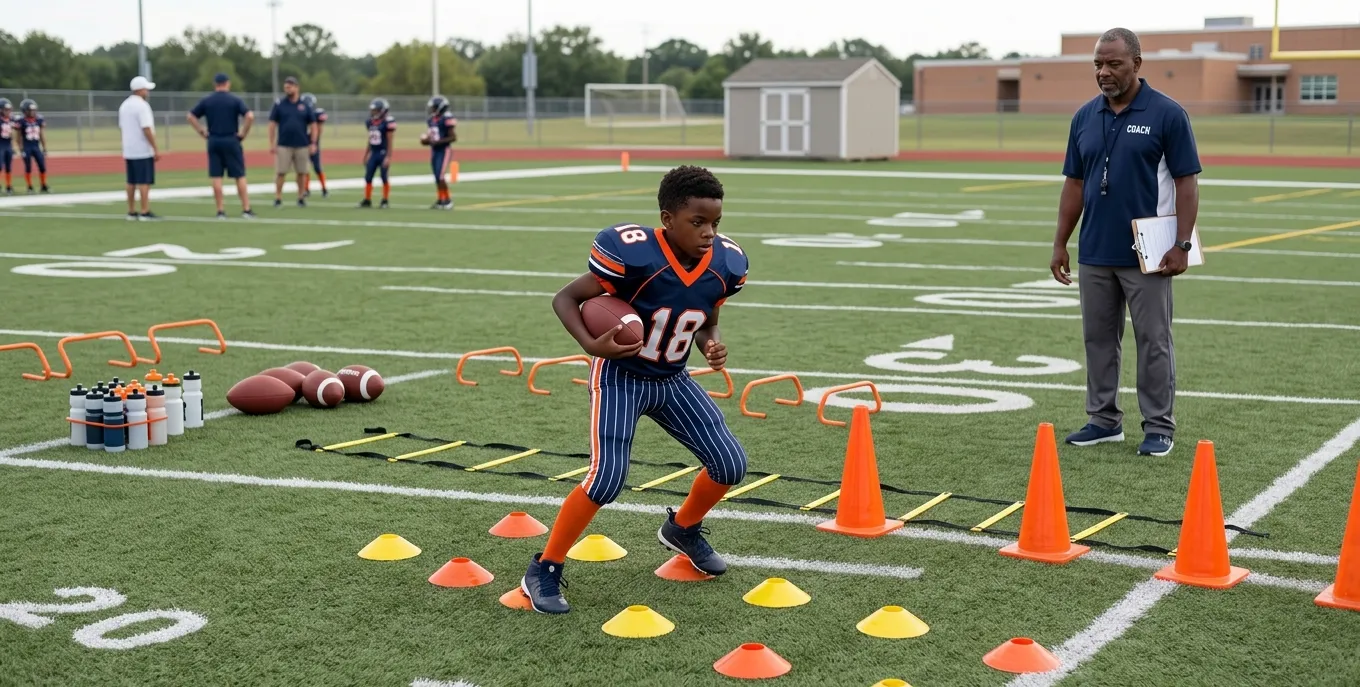
INTRODUCTION
A good first week football practice plan can make the difference between building confidence and feeling completely overwhelmed. Many beginners start football by copying advanced drills they see online. They try to learn everything at once, practice without a structure, and end up frustrated when their skills do not improve. If you are new to football, the biggest challenge is usually not effort. It is knowing what to practice first and how to build a solid foundation.
In beginner football training, players who focus on fundamentals during their first week often develop stronger habits and confidence than those who jump straight into advanced drills. Basic footwork, ball handling, passing, catching, and conditioning may seem simple, but these skills support everything you learn later. This guide provides a clear 7-day football practice plan so you can spend less time guessing, build confidence faster, and develop the skills needed for future training.
Quick Answer
A good first week football practice plan focuses on fundamentals, footwork, ball handling, passing, catching, and basic conditioning. Beginners should practice for about 30 minutes per day and focus on technique before speed. By the end of the week, players should feel more comfortable moving, handling the football, and completing basic football drills.
First Week Football Practice Plan for Beginners: A Simple 7-Day Training Schedule
Starting football can feel confusing. Many beginners are not sure what to practice first. They see advanced drills online and try to do everything at once. This often leads to poor technique and slow progress.
The good news is that your first week does not need to be complicated.
A good first week football practice plan should focus on basic skills, movement, and consistency. The goal is not to become a great player in seven days. The goal is to build a strong foundation that prepares you for future training.
This 7-day football practice plan is designed for beginners. Each day has a clear purpose and a simple goal.
What Should Beginners Focus on During Their First Week of Football?
During your first week, focus on the fundamentals. If you are completely new to the game, start with these essential football fundamentals drills before moving on to more advanced training methods.
This includes:
- Learning a proper football stance
- Handling the football correctly
- Improving footwork
- Practicing passing and catching
- Building basic conditioning
- Creating a regular practice habit
| Focus This Week | Can Wait Until Later |
|---|---|
| Proper Football Stance | Advanced Playbooks |
| Ball Security | Complex Route Combinations |
| Basic Footwork | Advanced Position Techniques |
| Catching Fundamentals | Game Strategy and Play Calling |
| Short Passing Accuracy | Advanced Passing Mechanics |
| Basic Conditioning | High-Volume Training Sessions |
Building Confidence Through Repetition
Many new players worry about making mistakes. During your first week, focus on repeating basic skills rather than learning advanced techniques. Confidence grows when simple movements become comfortable and consistent.
Before You Start This First Week Football Practice Plan
Before your first practice session, make sure you have a few basic items.
Equipment Checklist
- Football
- Athletic shoes or cleats
- Water bottle
- A few cones or markers
- Open practice space
Safety Tips
- Always warm up before training.
- Drink water during practice.
- Stop if you feel pain.
- Focus on good technique before speed.
- Take recovery seriously.
ADD DIRECTLY AFTER THE SAFETY TIPS SECTION
What If You Do Not Have Access to a Football Field?
Many beginners do not have access to a full football field. The good news is that most first-week drills can be done in a backyard, local park, driveway, or other open area. Focus on skill development rather than field size. A small space is enough for basic footwork, ball handling, passing, and conditioning drills.
You also do not need a coach during every practice session. Many beginner drills can be done on your own. If you have a football and a regular practice schedule, you can still make solid progress.
If your training area is limited, these small space football drills can help you continue building skills and confidence during your first week.
Beginner Workload Guidance
Do not worry about completing every drill perfectly. Your goal during the first week is to learn proper technique and build consistency.
If you start feeling tired:
- Reduce the number of repetitions.
- Slow down the drill.
- Take longer rest periods.
- Focus on technique instead of speed.
Quality practice is more important than longer practice sessions.
First Week Football Practice Plan Overview
| Day | Main Focus | Practice Time |
|---|---|---|
| Day 1 | Stance and Ball Handling | 30 Minutes |
| Day 2 | Footwork and Movement | 30 Minutes |
| Day 3 | Passing and Catching | 30 Minutes |
| Day 4 | Speed and Conditioning | 30 Minutes |
| Day 5 | Position Fundamentals | 30 Minutes |
| Day 6 | Skill Combination Practice | 30 Minutes |
| Day 7 | Progress Evaluation | 30 Minutes |

| Day | Main Skill | Primary Goal |
|---|---|---|
| Day 1 | Stance & Ball Handling | Learn football fundamentals |
| Day 2 | Footwork | Improve balance and movement |
| Day 3 | Passing & Catching | Build hand-eye coordination |
| Day 4 | Conditioning | Improve speed and endurance |
| Day 5 | Position Basics | Understand different football roles |
| Day 6 | Skill Combination | Apply multiple skills together |
| Day 7 | Progress Review | Measure improvement and identify weak areas |
Day 1: Learn the Athletic Stance and Ball Handling Fundamentals
| Activity | Time |
|---|---|
| Warm-Up | 5 Minutes |
| Athletic Stance Drill | 10 Minutes |
| Ball Security Drill | 10 Minutes |
| Cool Down | 5 Minutes |
Your first day should focus on learning how to move like a football player and how to control the football.
Warm-Up
Spend five minutes doing:
- Light jogging
- High knees
- Arm circles
- Dynamic stretches
Athletic Stance Drill
Stand with your feet shoulder-width apart.
Keep your knees slightly bent.
Stay balanced and ready to move in any direction.
Practice holding this position for several short sets.
Ball Security Drill

Hold the football tight against your body.
Keep the tip of the football covered.
Walk, jog, and change direction while maintaining control.
If you want more ways to improve ball control and reduce fumbles, practice these ball security and ball handling drills as part of your weekly training routine
Ball Carrying Practice
Carry the football in both arms during different sets.
Learn how to protect the ball while moving.
Day 1 Goal
By the end of the session, you should feel comfortable holding the football and maintaining a balanced athletic stance.
Day 2: Improve Footwork and Body Control
Good footwork helps players move faster and stay balanced. If you want more ways to improve movement, balance, and coordination, these football footwork drills can help you build a stronger foundation.
| Activity | Time |
|---|---|
| Warm-Up | 5 Minutes |
| Quick Feet Drill | 8 Minutes |
| Cone Shuffle Drill | 10 Minutes |
| Forward and Backpedal Drill | 7 Minutes |
Warm-Up
Repeat the same five-minute warm-up.
Quick Feet Drill
Move your feet as quickly as possible in place for 20 seconds.
Rest and repeat several times.
Cone Shuffle Drill
Place cones a few yards apart.
Shuffle side to side without crossing your feet.
Stay low and controlled.
Once you are comfortable with this exercise, try additional cone drills for football to improve agility, change of direction, and body control.
Forward and Backpedal Drill
Sprint forward.
Backpedal to the starting point.
Focus on balance and body control.
Day 2 Goal
Improve coordination and become more comfortable changing direction.
Day 3: Practice Passing and Catching Fundamentals
Football players need strong hand-eye coordination.
Today focuses on basic passing and catching skills.
| Activity | Time |
|---|---|
| Warm-Up | 5 Minutes |
| Wall Passing Drill | 10 Minutes |
| Catching Drill | 10 Minutes |
| Hand-Eye Coordination Drill | 5 Minutes |
Warm-Up
Complete your normal warm-up routine.
Wall Passing Drill
Throw the football against a wall.
Catch the rebound.
Focus on accuracy and control.
Basic Catching Drill
If you have a partner, practice short passes.
Keep your eyes on the ball.
Catch with your hands before bringing the ball to your body.
Hand-Eye Coordination Drill
Toss the football slightly into the air and catch it repeatedly.
Use both hands.
Stay focused on the ball throughout the drill.
Day 3 Goal
Develop confidence when throwing and catching the football.
Day 4: Build Football Conditioning and Speed
Football requires short bursts of speed and repeated effort. As your fitness improves, these football speed and agility drills for beginners can help you develop better movement, coordination, and overall athletic performance.
| Activity | Time |
|---|---|
| Warm-Up | 5 Minutes |
| Sprint Intervals | 10 Minutes |
| Shuttle Runs | 10 Minutes |
| Conditioning Finisher | 5 Minutes |
Warm-Up
Perform your standard warm-up.
Short Sprint Intervals
Sprint for 10 to 15 yards.
Walk back to recover.
Repeat several times.
Shuttle Runs

Set two markers.
Sprint from one marker to the other and back.
Focus on quick turns.
Conditioning Finisher
Perform short rounds of:
- Jumping jacks
- Bodyweight squats
- Mountain climbers
Keep the pace steady.
Day 4 Goal
Improve endurance and movement efficiency.
Day 5: Learn Position-Specific Fundamentals
This day helps beginners understand different football positions.

| Activity | Time |
|---|---|
| Warm-Up | 5 Minutes |
| Position Basics | 20 Minutes |
| Review and Practice | 5 Minutes |
Quarterback Basics
Practice grip and short passing mechanics.
Focus on accuracy rather than distance.
Running Back Basics
Work on ball security.
Practice quick cuts and direction changes.
Wide Receiver Basics
Practice catching from different angles.
Work on simple route running patterns.
Choosing the Right Position
Think about your strengths.
Players who enjoy throwing may prefer quarterback.
Fast players often enjoy receiver positions.
Strong runners may enjoy running back responsibilities.
Day 5 Goal
“Most beginners do not know their future position yet. The goal of Day 5 is exposure, not specialization.”
Gain a basic understanding of football positions and their core skills.
Day 6: Combine Your Skills Into One Practice Session
Now it is time to put everything together.
| Activity | Time |
|---|---|
| Warm-Up | 5 Minutes |
| Footwork Circuit | 8 Minutes |
| Ball Handling Circuit | 7 Minutes |
| Passing and Catching Circuit | 5 Minutes |
| Conditioning Circuit | 5 Minutes |
Warm-Up
Complete your usual warm-up.
Footwork Circuit
Perform:
- Quick feet
- Cone shuffles
- Backpedals
Ball Handling Circuit
Practice:
- Ball security
- Ball carrying
- Direction changes
Passing and Catching Circuit
Combine throwing and receiving drills.
Focus on consistency.
Conditioning Circuit
Finish with short sprints and shuttle runs.
Day 6 Goal
Perform multiple football skills within a single practice session.
Day 7: Test Your Progress and Review Week One
Today is about measuring improvement.
| Activity | Time |
|---|---|
| Ball Control Check | 5 Minutes |
| Footwork Check | 5 Minutes |
| Passing Accuracy Check | 10 Minutes |
| Conditioning Check | 10 Minutes |
Ball Control Check
Can you carry the football confidently while moving?
Footwork Check
Can you move through basic drills without losing balance?
Passing Accuracy Check
Can you consistently hit your target on short throws?
Conditioning Check
Can you complete several sprint repetitions without excessive fatigue?
End-of-Week Self Assessment
| Skill | Week 1 Target |
|---|---|
| Ball Security | Complete 10 controlled carries without losing the football |
| Catching | Catch 10 short passes consistently |
| Passing Accuracy | Hit a target on most short throws |
| Footwork | Complete cone drills with balance and control |
| Conditioning | Finish sprint intervals with good effort |
Players do not need to achieve every target perfectly. The scorecard is meant to measure improvement and identify areas that need more practice.
Ask yourself:
- Can I hold a proper football stance?
- Can I protect the football while moving?
- Can I perform basic footwork drills?
- Can I catch routine passes?
- Can I complete conditioning drills with good effort?
If you answered yes to most of these questions, your first week was successful.
Common First Week Football Practice Mistakes
Many beginners make the same mistakes.
Practicing Too Long
Long sessions often lead to poor technique and fatigue.
Short, focused sessions are more effective.
Skipping Warm-Ups
Cold muscles increase injury risk.
Always prepare your body before training.
Ignoring Recovery
Training is important, but recovery matters too.
Your body improves when it has time to recover.
Trying Advanced Skills Too Early
Master the basics first.
Advanced techniques become easier when fundamentals are strong.
Focusing on Speed Instead of Technique
Good technique should come before maximum effort.
Move correctly before trying to move faster.
Recovery Tips Between Practice Sessions
Recovery helps beginners stay consistent.
Hydration
Drink water throughout the day.
Sleep
Aim for quality sleep every night.
Stretching
Perform light stretching after training.
Rest
Give your muscles time to recover between sessions.
Avoid Overtraining During Week One
- More practice is not always better.
- Stop if technique starts breaking down.
- Focus on learning skills correctly.
A shorter practice with good technique is more valuable than a longer practice with poor technique.
What Results Should You Expect After Your First Week?
After completing this first week football practice plan, you should notice:
- Better football stance
- Improved ball control
- Better footwork
- Improved coordination
- Increased confidence
- Better conditioning
- A stronger understanding of football fundamentals
Most importantly, you should be ready to move into more advanced beginner training during week two.
Week 1 Success Formula
- Focus on technique.
- Practice consistently.
- Build good habits.
- Recover properly.
- Progress gradually.
What Should You Do After Completing Week One?
Once you finish your first week, continue building on the fundamentals.
Gradually increase practice intensity.
Add more football drills.
Spend extra time on the position that interests you most.
Keep practicing consistently and focus on small improvements each week.
Football development takes time, but a strong first week creates the foundation for long-term success.
| Skill Area | Expected Outcome |
|---|---|
| Ball Handling | Better football control |
| Footwork | Improved balance and coordination |
| Passing | Better accuracy on short throws |
| Catching | More consistent catches |
| Conditioning | Better stamina during practice |
| Confidence | Greater comfort with football basics |
Signs You Are Ready for Week Two
You may be ready to move into a more advanced training plan if:
- You can maintain a proper football stance.
- You can carry the football confidently.
- You can complete basic footwork drills without losing balance.
- You can catch routine passes consistently.
- You can finish your practice sessions without excessive fatigue.
These signs show that you have built a solid foundation during your first week.
CONCLUSION
Your first week in football is not about mastering every skill or finding your perfect position. It is about building habits, learning proper technique, and becoming comfortable with the basics. Players who stay consistent during their first week often develop more confidence and better movement patterns than players who constantly switch between random drills and training methods.
From a player development perspective, the strongest football foundations are usually built through simple and consistent practice. Focus on doing the basics well, follow the schedule, and measure progress one week at a time. If you can finish this first week football practice plan with better ball control, improved footwork, stronger conditioning, and more confidence than when you started, then you are already moving in the right direction and will be ready for the next stage of training.
