



Introduction
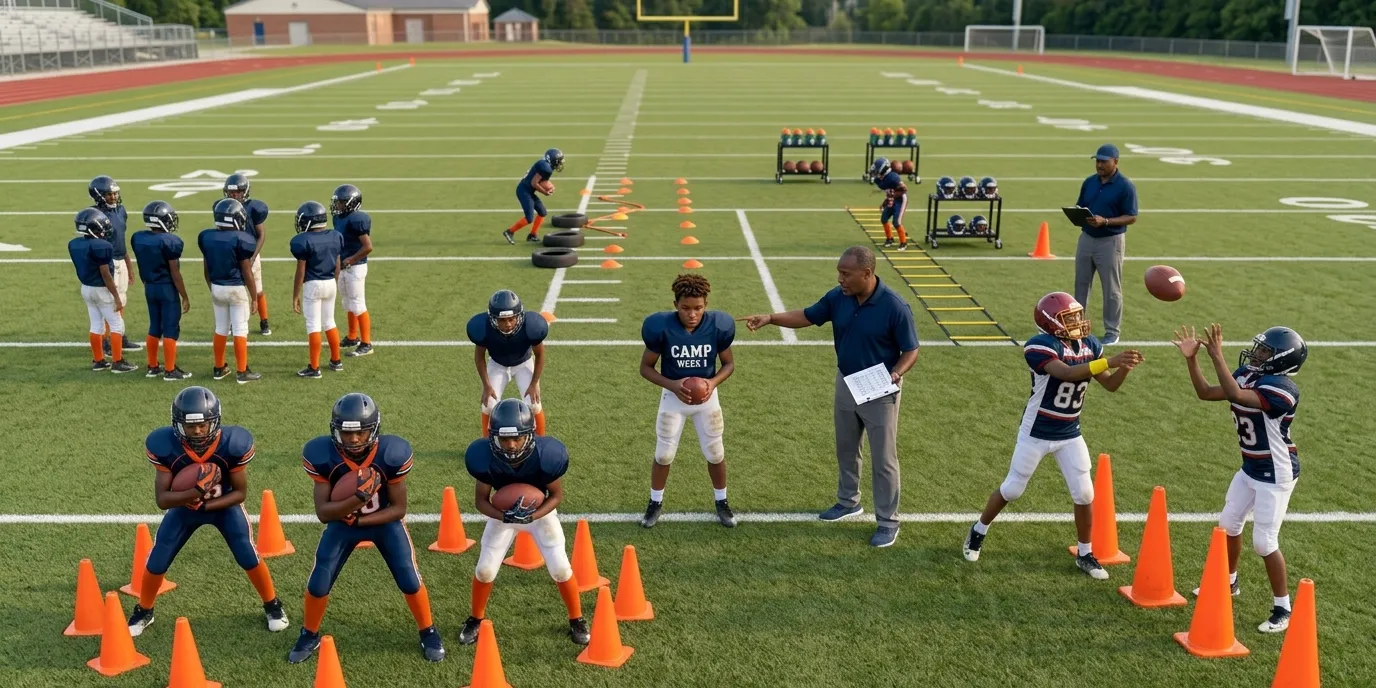
A well-structured youth football practice plan helps coaches turn limited practice time into real player development. Many youth coaches, parent coaches, and volunteers step onto the field with a list of drills but no clear schedule. Players wait in long lines, valuable practice time disappears, and coaches rush through important skills such as ball security, blocking, tackling, passing, and footwork. As a result, players stay busy but often make little progress.
Successful youth football coaches take a different approach. They organize every practice around clear goals, focused drills, and game-ready situations. Instead of trying to teach everything at once, they focus on football fundamentals and give players plenty of quality repetitions. This approach helps players develop skills, build confidence, and perform better during games. Coaches looking for structured skill development can also use football fundamentals drills to reinforce core techniques throughout the season.
If you are coaching a youth football team for the first time, these practice schedules can help you run organized and productive practices without making things overly complicated. New coaches can also benefit from learning a few football drills for beginners before building a complete practice schedule.
Key Takeaways
- A youth football practice plan should include warm-ups, skill development, team periods, and conditioning.
- Most youth teams benefit from 60 to 90-minute practices.
- The first practice should focus on evaluation and football fundamentals.
- Practice plans should be adjusted based on player age and skill level.
- Consistent repetition helps players improve faster.
What Should Be Included in a Youth Football Practice Plan?
A successful youth football practice plan follows a clear structure. Every segment should have a purpose. This helps players stay active and gives coaches enough time to teach important football skills.

Before building a youth football practice plan, coaches should decide what they want players to accomplish during that session. A practice with a clear objective is usually more productive than a practice that tries to cover too many skills at once.
Many volunteer and parent coaches make the mistake of teaching too many things during a single practice. Focusing on one primary goal helps players learn faster and keeps the practice organized.
| Practice Goal | Main Focus |
|---|---|
| Ball Security | Running backs and receivers |
| Passing Game | Quarterbacks and receivers |
| Tackling Technique | Defensive players |
| Blocking Fundamentals | Offensive line |
| Pursuit Angles | Defensive unit |
| Team Execution | Full team offense and defense |
Choose one primary goal and one secondary goal for each practice. This keeps coaches and players focused throughout the session.
Warm-Up and Movement Work
Every practice should begin with movement preparation. A proper warm-up prepares players for practice and helps reduce the risk of injury. Coaches should begin each session with dynamic stretching, light jogging, movement preparation, and football-specific activities. Using structured football warmup drills before practice can help players improve mobility, coordination, and overall readiness before moving into skill development drills.
Common warm-up activities include:
- Light jogging
- High knees
- Butt kicks
- Side shuffles
- Dynamic stretching
The goal is simple. Get players moving before football drills begin.
Individual Skill Development
After warming up, players should work on individual football skills.
Examples include:
- Ball security drills
- Passing drills
- Catching drills
- Stance and start drills
- Footwork drills
This is where players build strong fundamentals.
Position and Group Drills
Position drills help players improve skills that relate directly to their role on the field.
| Position Group | Main Practice Focus |
|---|---|
| Quarterbacks | Footwork and throwing |
| Running Backs | Ball security and vision |
| Wide Receivers | Routes and catching |
| Offensive Line | Blocking technique |
| Defensive Players | Tackling and pursuit |
Team Offense and Defense
Team periods allow players to apply individual skills in football situations.
Offensive periods may focus on:
- Formations
- Running plays
- Passing concepts
- Snap timing
Defensive periods may focus on:
- Alignment
- Pursuit angles
- Run defense
- Pass coverage
Special Teams and Conditioning
Special teams are often overlooked at the youth level. However, they can impact field position and game results.
Spend a few minutes practicing:
- Kickoff coverage
- Return responsibilities
- Basic special teams assignments
Conditioning should support football development rather than become the main focus of practice.
Recommended Practice Structure
| Practice Segment | Suggested Time |
|---|---|
| Warm-Up | 10% |
| Individual Skills | 25% |
| Position Drills | 20% |
| Team Offense and Defense | 35% |
| Special Teams and Conditioning | 10% |
A balanced youth football practice plan helps players improve while keeping practices organized and efficient.
30-Minute Youth Football Practice Plan for Limited Practice Time
Many youth teams have limited field access. A 30-minute practice requires coaches to focus on the most important football fundamentals.
| Activity | Time |
|---|---|
| Dynamic Warm-Up | 5 min |
| Ball Security and Footwork | 5 min |
| Position Drills | 7 min |
| Team Period | 10 min |
| Conditioning and Review | 3 min |
Why This Schedule Works
A short practice removes unnecessary downtime. Players stay active and receive a high number of repetitions.
This schedule works well for coaches with limited field time. It focuses on the most important football fundamentals and removes activities that do not directly support player development.
60-Minute Youth Football Practice Plan for Balanced Player Development
A 60-minute practice is one of the most common formats for youth football teams.
| Activity | Time |
|---|---|
| Warm-Up | 10 min |
| Individual Skills | 15 min |
| Position Drills | 10 min |
| Team Offense | 10 min |
| Team Defense | 10 min |
| Conditioning and Review | 5 min |
Coaching Priorities During a 60-Minute Practice
A 60-minute practice is often the best option for youth teams because it provides enough time to teach skills while keeping players focused and engaged.
Focus on quality rather than quantity. Players should leave practice with a better understanding of football fundamentals than when they arrived.
90-Minute Youth Football Practice Plan for Full-Team Preparation
A 90-minute practice gives coaches enough time to cover football fundamentals, team concepts, and game preparation in one session.
| Activity | Time |
|---|---|
| Dynamic Warm-Up | 10 min |
| Individual Skills | 20 min |
| Position Drills | 15 min |
| Team Offense | 15 min |
| Team Defense | 15 min |
| Special Teams | 10 min |
| Conditioning and Review | 5 min |
When to Use a 90-Minute Practice
A longer practice works best when:
- Preparing for a game
- Installing new plays
- Working with older youth players
- Reviewing offense and defense in the same session
Coaches should still keep players moving. Long lines and long speeches can waste valuable practice time.
First Practice of the Season Youth Football Plan

The first practice of the season should focus on evaluation, football fundamentals, safety expectations, and team organization. Coaches should avoid installing complex plays during the first session and instead focus on teaching basic skills and assessing player abilities. Using structured first day football practice drills can help coaches evaluate players more effectively while keeping practice organized.
Evaluate Players Before Teaching Schemes
Every player arrives with a different skill level.
During the first practice, watch:
- Speed
- Coordination
- Catching ability
- Throwing ability
- Football awareness
This helps coaches place players in positions where they can succeed.
Focus on Basic Fundamentals
The first practice should emphasize:
- Proper stance
- Ball security
- Basic footwork
- Catching technique
- Safe tackling fundamentals
Strong fundamentals create a foundation for future success.
Introduce Team Expectations
First-time coaches should keep the first practice simple. The goal is to build confidence, evaluate players, and establish a positive learning environment.
Players should understand:
- Practice rules
- Sportsmanship
- Effort expectations
- Team responsibilities
Clear expectations reduce problems later in the season.
Sample First-Practice Schedule
| Activity | Time |
|---|---|
| Team Introduction | 10 min |
| Warm-Up | 10 min |
| Player Evaluation Drills | 20 min |
| Fundamental Skill Stations | 20 min |
| Team Competition | 10 min |
| Review and Closing | 5 min |
Adjusting a Youth Football Practice Plan by Age Group

Not every age group should practice the same way. Younger players need more fun and repetition. Older players can handle more advanced concepts.
Ages 6–8
Focus on:
- Fun activities
- Basic movement skills
- Ball handling
- Simple football fundamentals
Keep instructions short and easy to understand.
Ages 9–10
Focus on:
- Football fundamentals
- Position introductions
- Basic offensive and defensive concepts
Players at this age can begin learning simple football strategies.
Ages 11–12
Focus on:
- Position development
- Team concepts
- Football IQ
- Situational football
Players can handle more detailed coaching.
Ages 13–14
Focus on:
- Advanced technique
- Game preparation
- Position-specific skills
- Competitive practice periods
These players are preparing for higher levels of football.
Age Group Comparison
| Age Group | Main Focus |
|---|---|
| 6–8 | Fun and fundamentals |
| 9–10 | Skill development |
| 11–12 | Team concepts |
| 13–14 | Advanced football skills |
Younger players usually learn best through repetition and simple instructions. Older players can spend more time on team concepts and game situations.
How Much Time Should Each Practice Segment Receive?
One of the biggest mistakes youth coaches make is spending too much time on one area while ignoring another.
The table below provides a balanced approach.
| Practice Segment | Recommended Percentage |
|---|---|
| Warm-Up | 10% |
| Individual Skills | 25% |
| Position Drills | 20% |
| Team Offense and Defense | 35% |
| Special Teams | 5% |
| Conditioning and Review | 5% |
This structure allows players to develop skills while preparing for game situations.
Youth Football Practice Planning Mistakes That Slow Player Development
Even a well-designed practice can become ineffective if coaches make common planning mistakes.
Spending More Time Talking Than Practicing
Players learn football by doing.
Keep explanations short and spend more time running drills.
Running Too Many Drills in One Session
Many new coaches believe more drills create better practices. In reality, players often improve faster when they repeat a smaller number of drills with proper coaching.
Some coaches try to cover everything in one practice.
This often leads to confusion.
It is better to master a few skills than rush through many drills.
Ignoring Special Teams
Special teams may not seem exciting, but they can change field position and impact games.
Spend at least a few minutes practicing special teams each week.
Using the Same Practice Plan Every Week
| Day | Primary Focus |
|---|---|
| Monday | Football fundamentals and conditioning |
| Tuesday | Offensive execution |
| Wednesday | Defensive execution |
| Thursday | Game situations and review |
Players need variety and progression.
Practice plans should evolve as players improve.
Focusing on Conditioning Over Fundamentals
Conditioning matters, but youth football practices should focus mainly on football skills.
Players improve faster when they spend more time developing football fundamentals.
Youth Football Practice Checklist for Coaches
A simple checklist helps coaches stay organized.
Before Practice
Having a written practice schedule prevents wasted time and helps assistant coaches understand their responsibilities.
- Review practice goals
- Prepare footballs and equipment
- Set up drill stations
- Confirm practice schedule
- Plan water breaks
During Practice
- Keep players active
- Limit waiting time
- Teach proper technique
- Monitor player safety
- Stay on schedule
After Practice
- Review player progress
- Note areas that need improvement
- Prepare the next practice plan
- Gather equipment
- Communicate with players and parents
Youth Football Practice Plan Template
Coaches can use the template below to build a custom youth football practice plan for their team. Adjust the time for each segment based on your players’ age, skill level, and practice goals.
| Practice Segment | Time | Notes |
|---|---|---|
| Warm-Up | ||
| Individual Skills | ||
| Position Drills | ||
| Team Offense | ||
| Team Defense | ||
| Special Teams | ||
| Conditioning | ||
| Review and Closing |
Conclusion
The most effective youth football practice plans are usually the simplest. Coaches do not need dozens of drills or complicated playbooks to help young athletes improve. Consistent work on football fundamentals, position skills, team execution, and game situations often leads to the biggest gains over the course of a season. When players receive quality repetitions and clear coaching, their confidence and performance tend to improve naturally.
Across successful youth football programs, organized practices consistently produce better player development than unstructured sessions. Whether you use a 30-minute, 60-minute, or 90-minute practice plan, focus on creating a schedule that matches your team’s age, skill level, and goals. By emphasizing fundamentals, keeping players active, and following a clear practice structure, coaches can build productive sessions that support long-term success on the football field.
