



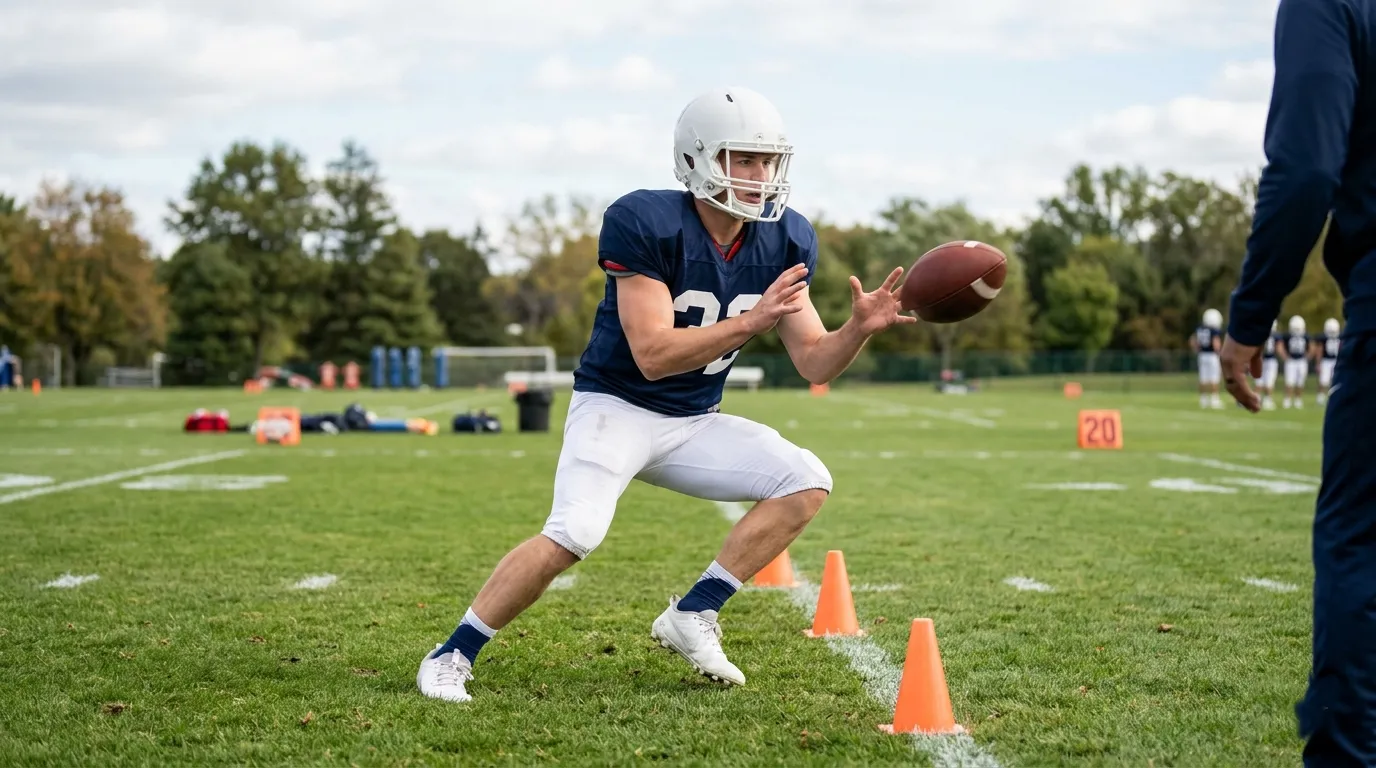
Football coordination drills are American football exercises that train players to control their eyes, hands, feet, balance, and reactions together during movement. For beginners and youth players, simple drills such as tennis ball reaction catches, cone shuffle catches, ladder-and-catch drills, mirror drills, and turn-and-locate catches can build coordination without requiring advanced equipment.
Football players often have to move their feet while watching another player, tracking the ball, or preparing to catch. These drills help connect those actions in a controlled practice setting.
The drills below are simple enough for beginners but can also be made harder as players improve.
Key Takeaways
- Football coordination connects the eyes, hands, feet, balance, and reactions.
- Hand-eye coordination is useful for catching, tracking the ball, and handling the football.
- Players should learn each movement under control before adding more speed.
- Adding random cues and football skills can make basic coordination drills more game-like.
What Are Football Coordination Drills?
Football coordination drills train two or more movement skills at the same time. For example, a player may shuffle between cones while watching a partner and catching a football. The feet control the movement, the eyes track the pass, and the hands finish the catch.
Coordination is related to footwork and agility, but they are not the same thing. Football footwork drills mainly teach better steps, stance, and movement patterns. Agility training focuses more on changing direction and reacting quickly. Coordination brings several actions together.
For American football players, this can include foot movement, ball tracking, catching, balance, timing, and reacting to a coach or another player. Research on motor competence also connects movement skills with areas such as locomotor control, object control, and stability.
Football Coordination vs. Agility vs. Footwork

| Training Type | Main Focus | Football Example |
|---|---|---|
| Coordination | Combining eyes, hands, feet, and body | Shuffle while tracking and catching a pass |
| Footwork | Controlling steps and foot placement | Backpedal or ladder foot pattern |
| Agility | Changing direction in response to movement or a cue | React and cut toward a new direction |
| Balance | Maintaining body control | Catching while controlling a single-leg position |
If changing direction and reacting to movement is your main goal, practice football agility drills before adding more complex coordination tasks.
Why Is Coordination Important in American Football?
Many football skills require several actions to happen together.
A wide receiver may run a route, turn the head, locate the football, adjust the body, and make a catch. A defensive back may backpedal, react to a receiver, turn, and track the ball. A running back needs clean footwork while receiving a handoff and protecting the football.
For beginners, coordination training creates a controlled setting where these actions can be practiced before drills become faster or more game-like.
Good coordination also supports balance and movement control. However, coordination drills should support football skill practice, not replace position coaching or game-based training.
4 Types of Coordination Football Players Need
1. Hand-Eye Coordination
Hand-eye coordination helps a player use visual information to guide the hands. It is especially useful when tracking and catching a football.
Receivers and defensive backs use it often, but quarterbacks, running backs, linebackers, and other positions can benefit from it as well. Beginners can start with short, controlled catches before adding movement or harder passes.
Players who struggle with tracking or securing the ball can first practice basic football catching drills, then add movement once their catching technique becomes consistent.
2. Foot-Body Coordination
The feet do not work alone. Players need to control their legs, hips, torso, and arms while moving.
Good foot-body coordination can help during shuffles, turns, backpedals, cuts, and other football movements. New players should learn these movements slowly before trying to perform them at full speed.
3. Balance and Body Control
Players often have to catch, turn, stop, or change direction from an uneven body position.
Balance drills teach players to stay under control while completing another task. The goal is not to stay perfectly still. The goal is to control the body while the task changes.
Players who need to build stability first can use simple football balance drills before combining balance with catches and reaction cues.
4. Reaction Coordination
Football is unpredictable. Players have to respond to movement, a pass, a coach’s signal, or another visual cue.
Reaction coordination drills add a signal that the player cannot fully predict. The player must see or hear the cue and then choose the correct movement.
For beginners, start with one or two possible reactions. More choices can be added as the player improves.
Equipment for Football Coordination Drills
Most beginner coordination drills need very little equipment.
| Equipment | Main Use |
|---|---|
| Football | Catching and ball handling |
| Cones | Movement and direction |
| Agility ladder | Foot placement and rhythm |
| Tennis ball | Hand-eye reaction |
| Reaction ball | Unpredictable visual reaction |
| Partner or coach | Passes and random cues |
You do not need every item. A football, a few cones, and a partner are enough for several drills. For players who want a less predictable visual challenge, a reaction ball drill can add random bounces that require quick tracking and movement.
10 Best Football Coordination Drills
Quick Football Coordination Drill Selection Guide
| Drill | Main Skill | Equipment | Difficulty | Best For |
|---|---|---|---|---|
| Ladder and Catch | Feet + hands | Ladder, football | Beginner | WR, DB |
| Tennis Ball Reaction Catch | Hand-eye reaction | Tennis ball | Beginner | All players |
| Cone Shuffle and Catch | Movement + catching | Cones, football | Beginner | WR, RB, DB |
| Mirror Reaction | Visual reaction | Partner | Beginner | DB, LB |
| Single-Leg Football Catch | Balance + catching | Football | Beginner | WR, RB |
| Backpedal to Catch | Tracking + foot control | Cones, football | Intermediate | DB |
| Quick Feet and Coach Command | Reaction + feet | Cones | Beginner | All players |
| Turn-and-Locate Ball | Ball tracking | Football | Intermediate | WR, DB |
| Handoff Coordination | Timing + ball control | Football | Beginner | QB, RB |
| Multi-Direction Catch | Full-body coordination | Cones, football | Intermediate | WR, DB |
1. Ladder and Catch Drill
Focus: Feet, eyes, and hands
Setup: Place an agility ladder on a flat training surface. Have a partner stand near the end with a football.
How to perform: Move through the ladder using a simple one-foot or two-foot pattern. Keep the steps controlled. As you leave the ladder, look up and receive a pass from your partner.
Reps: Start with 3 to 5 controlled repetitions.
Coaching cue: Do not stare at the ladder for the full rep. Build enough control to bring the eyes up before the catch.
2. Tennis Ball Reaction Catch

Focus: Hand-eye coordination and reaction
Setup: Stand a few yards from a partner. The partner holds one or two tennis balls.
How to perform: Stay in an athletic stance. The partner releases or tosses a ball without giving a long warning. React quickly and catch it before resetting.
Reps: Try 5 catches on each side.
Coaching cue: Track the ball with the eyes before reaching for it.
3. Cone Shuffle and Catch

Focus: Lateral movement, balance, and catching
Setup: Place two cones several yards apart. A partner stands in front with a football.
How to perform: Shuffle between the cones while keeping the chest under control. The partner gives a pass at a random point. Stop or adjust the feet, track the football, and complete the catch.
Reps: Perform 4 to 6 passes.
Coaching cue: Keep the feet active without crossing them during the basic shuffle.
4. Mirror Reaction Drill
Focus: Visual reaction and body control
Setup: Two players face each other with a few yards of space.
How to perform: One player becomes the leader. The leader moves left, right, forward, or backward. The second player mirrors the movement without knowing the next direction.
Reps: Work for 10 to 15 seconds, then switch roles.
Coaching cue: Watch the leader’s center body area instead of looking down at the feet.
5. Single-Leg Football Catch
Focus: Balance and hand-eye coordination
Setup: Stand on one leg while a partner holds a football a short distance away.
How to perform: Hold a controlled single-leg position while receiving an easy pass. Reset if balance is lost. Switch legs after several catches.
Reps: Try 3 to 5 catches on each leg.
Coaching cue: Start with easy passes. The goal is control, not difficult catches.
6. Backpedal to Catch Drill
Focus: Foot movement, body control, and ball tracking
Setup: Mark a short lane with cones. Have a partner stand in front with a football.
How to perform: Backpedal under control. On the partner’s signal, stop, turn, locate the pass, and make the catch.
Reps: Perform 4 to 6 repetitions.
Coaching cue: Get the body under control before reaching for the football.
7. Quick Feet and Coach Command
Focus: Foot coordination and reaction
Setup: Place three or four cones around the player. Give each cone a number or direction.
How to perform: Begin with quick, controlled foot movement in the center. The coach calls a direction or number. Move to the correct cone and return to the starting position.
Reps: Use 10 to 15-second rounds.
Coaching cue: Keep the signals random so the player has to react instead of memorizing a pattern.
8. Turn-and-Locate Ball Drill

Focus: Body rotation and visual tracking
Setup: The player begins facing away from the passer.
How to perform: On a signal, turn and find the football in the air. Adjust the body and hands to make the catch.
Reps: Complete 4 to 6 catches from different angles.
Coaching cue: Find the football with the eyes before throwing the hands toward it.
This drill can be useful for receivers and defensive backs because both positions often have to locate the ball after moving or turning.
9. Handoff Coordination Drill
Focus: Timing, hands, and ball control
Setup: Use a quarterback and running back or two players filling those roles.
How to perform: The running back approaches the handoff point with controlled steps. The quarterback places the football into the exchange area. The runner secures the ball before continuing forward.
Reps: Practice 5 to 8 exchanges from each direction.
Coaching cue: Get the exchange clean before increasing the speed of the rep.
10. Multi-Direction Catch Drill
Focus: Full-body coordination
Setup: Place cones in front, behind, and to each side of the player. A partner stands nearby with a football.
How to perform: The partner calls a direction. Move toward the correct cone, return to a balanced position, and react to a pass. Change the direction and timing between reps.
Reps: Perform 4 to 6 catches.
Coaching cue: Do not sacrifice body control just to move faster.
Best Coordination Drills by Football Position
Players do not need to perform every coordination drill. Coaches can choose exercises based on the movements and skills required by each position.
| Position | Main Coordination Focus | Useful Drills |
|---|---|---|
| Quarterback | Feet, hands, timing | Quick Feet, Handoff |
| Wide Receiver | Ball tracking, catching | Turn-and-Locate, Cone Shuffle and Catch |
| Running Back | Ball handling, balance | Handoff, Single-Leg Catch |
| Defensive Back | Reaction, movement, tracking | Mirror, Backpedal to Catch |
| Linebacker | Visual reaction, body control | Coach Command, Mirror |
These are starting points. Position-specific practice should still teach the main techniques required for each role.
How Often Should Football Players Practice Coordination Drills?
Coordination work does not need to take up an entire practice.
Beginners can add a few coordination exercises to a warm-up or skill period. Keep the early reps simple and controlled. Once the movement looks clean, add speed, a football, or an unpredictable signal.
Quality matters more than doing a large number of tired repetitions. If technique starts to break down, reset or move to another activity.
Common Football Coordination Drill Mistakes
A common mistake is trying to perform a new drill at full speed. Fast movement is less useful if the player cannot control the feet, eyes, and body together.
Other mistakes include:
- Looking down at the feet during the whole drill
- Using the same predictable signal every time
- Losing balance to finish the drill faster
- Adding too many tasks at once
- Training only the feet and ignoring the hands or eyes
- Using difficult combinations before learning the basic movement
Coaches can correct many of these problems by reducing speed or removing one part of the drill until the player regains control.
How to Progress Football Coordination Drills

Start with a simple movement that the player can perform correctly. The NSCA supports developing fundamental motor skills through progressive youth training before moving to more demanding sport-specific work.
| Level | What to Add | Example |
|---|---|---|
| 1. Learn | Basic controlled movement | Cone shuffle |
| 2. Speed | Slightly faster movement | Faster cone shuffle |
| 3. Football | Ball skill | Shuffle + catch |
| 4. Reaction | Random cue | Coach chooses direction |
| 5. Game-Like | Multiple actions | React, move, locate ball, catch |
New players who are still learning basic catching, footwork, throwing, and ball-security skills should start with football drills for beginners before using more complex coordination combinations.
For example, teach the cone shuffle first. Once the player controls the movement, add a football catch. Later, let the coach change the direction or timing of the pass.
The next level should add a useful football challenge rather than simply making the drill harder.
Continue Learning
Build your football coordination with these related training guides.
Football Footwork Drills
Improve foot control, movement patterns, balance, and cleaner steps for football.
Read the Guide →Football Agility Drills
Practice quick direction changes, reaction, and controlled movement on the field.
Read the Guide →Ladder Drill
Learn simple ladder patterns for better foot placement, rhythm, and coordination.
Learn the Drill →Reaction Ball Drill
Train visual tracking, quick reactions, and body control with unpredictable bounces.
Learn the Drill →Conclusion
Football coordination drills help players connect their eyes, hands, feet, balance, and reactions during movement. The best drills do more than make the feet move quickly. They ask the player to control the body while tracking a ball, reacting to a cue, or completing a football skill.
Start with simple, controlled repetitions. Add speed and reaction only after the movement is clean. Over time, the drills can become more game-like while still keeping good technique at the center of each rep.
Football Coordination Drills FAQs
What are the best coordination drills for football players?
The best football coordination drills include tennis ball reaction catches, cone shuffle catches, ladder-and-catch drills, mirror reaction drills, turn-and-locate catches, and handoff drills. Choose drills that combine two or more skills, such as foot movement, ball tracking, catching, balance, or reaction.
How can I improve hand-eye coordination for football?
Improve hand-eye coordination by practicing catches that require you to watch the ball and react with your hands. Start with tennis ball catches and short football passes. As control improves, add movement, different catching angles, or an unpredictable pass. Keep your eyes on the ball before reaching with your hands.
What coordination drills are good for beginner football players?
Good beginner football coordination drills include tennis ball catches, cone shuffle catches, simple mirror drills, controlled handoffs, and basic ladder-and-catch drills. Beginners should learn each movement at a controlled pace before adding faster reactions, harder passes, or more directions.
Do ladder drills improve football coordination?
Ladder drills can help with foot placement, rhythm, and foot-body coordination. However, ladder work alone does not train every part of football coordination. Adding a football catch, visual signal, or coach command can connect quick foot movement with the eyes, hands, and reactions.
What is the difference between ball tracking and hand-eye coordination?
Ball tracking is the ability to visually follow the football as it moves through the air. Hand-eye coordination is the ability to use that visual information to guide the hands and complete the catch. Football players often use both skills together, especially when catching while running, turning, or changing direction.
Conclusion
Football coordination drills help players connect their eyes, hands, feet, balance, and reactions during movement. The best drills do more than make the feet move quickly. They ask the player to control the body while tracking a ball, reacting to a cue, or completing a football skill.
Start with simple, controlled repetitions. Add speed and reaction only after the movement is clean. Over time, the drills can become more game-like while still keeping good technique at the center of each rep.
References
- National Strength and Conditioning Association (NSCA). Youth Training and Long-Term Athletic Development.
- Associations Between Motor Competence and Physical Activity, Physical Fitness and Psychosocial Characteristics in Adolescents: A Systematic Review and Meta-analysis
