



Quick Takeaway
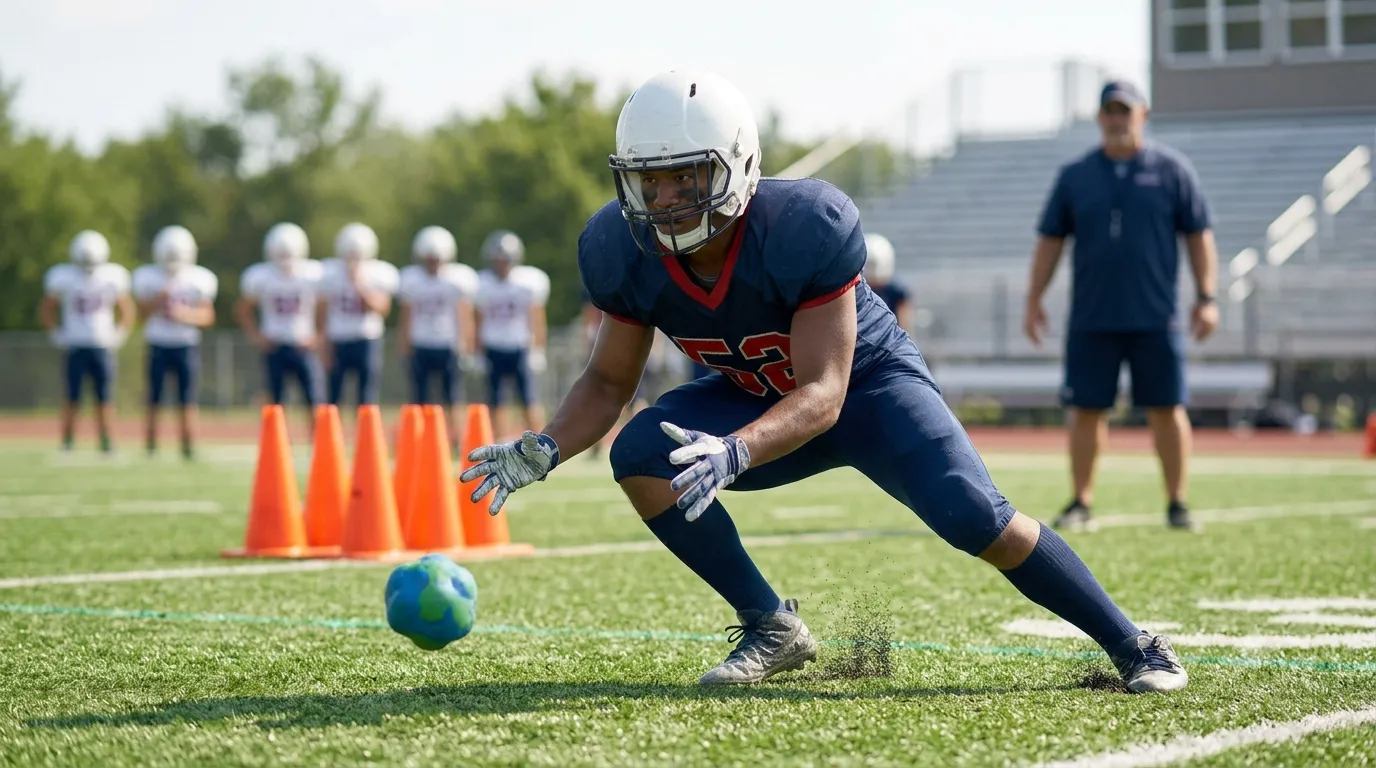
The Reaction Ball Drill helps football players improve reaction time, reflexes, hand-eye coordination, and quick decision-making. By reacting to the ball’s unpredictable bounce, players develop faster movement and better game awareness. It is an easy drill for beginners and requires very little equipment.
What Is the Reaction Ball Drill?
The Reaction Ball Drill is a football training exercise that uses a specially shaped reaction ball, which bounces in unpredictable directions. Players must react quickly, move into position, and catch the ball before it stops. This simple drill improves reaction speed, coordination, balance, and game-ready movement, making it valuable for players of all skill levels.
Many coaches now use short reaction drills as part of football skill development because they combine movement, visual tracking, and decision-making in a simple practice routine.
Why Football Players Should Use the Reaction Ball Drill?
Football players often have only a split second to react during a game. The USA Football Football Development Model explains that athletes develop better on-field skills through age-appropriate, step-by-step training that builds movement, vision, and decision-making before progressing to more advanced football techniques. The Reaction Ball Drill supports this approach by helping athletes recognize movement, react faster, and stay balanced under pressure. It helps build habits that improve performance for quarterbacks, receivers, running backs, linebackers, and defensive backs.
Benefits of the Reaction Ball Drill
The Reaction Ball Drill improves several skills that help football players react faster and perform better on the field.
Improves Reaction Time
The unpredictable bounce trains you to react quickly instead of guessing. This helps during passes, tackles, and loose-ball situations. The NSCA Essentials of Strength Training and Conditioning (5th Edition) explains that athletic performance improves when training develops movement skills, coordination, and sport-specific abilities through evidence-based practice.
Builds Hand-Eye Coordination
Tracking and catching the ball improves coordination, making it easier to catch passes and control the football.
Improves Footwork and Balance
Moving in different directions develops quicker footwork, better balance, and stronger body control.
Develops Faster Decision-Making
Every bounce is different, so you must process what you see and react immediately. This builds quicker decisions under pressure.
Supports Better Football Performance
The skills learned in this drill transfer to real game situations. Many football coaches use reaction drills to help players react more quickly during passes, defensive reads, and loose-ball situations.
Equipment Needed
You only need a few items to perform the Reaction Ball Drill.
- Reaction ball
- Flat training surface (grass, turf, or gym floor)
- Open practice area
- Training partner (optional)
- Cones for advanced variations (optional)
Coach’s Tip: If you do not have a reaction ball, you can start with a tennis ball. However, a reaction ball creates a more unpredictable bounce and provides a better training challenge.
How to Set Up the Reaction Ball Drill


Setting up the Reaction Ball Drill takes only a few minutes.
- Choose a flat and safe practice area with enough room to move.
- Stand in an athletic stance with your knees slightly bent and your eyes focused ahead.
- Hold the reaction ball at about chest height.
- If training with a partner, stand about 5–8 feet (1.5–2.5 m) apart.
- Make sure the area is clear of obstacles before starting.
A proper setup helps you move freely and react safely throughout the drill.
How to Perform the Reaction Ball Drill

Follow these simple steps to perform the Reaction Ball Drill correctly.
- Stand in an athletic stance with your knees slightly bent and your eyes on the ball.
- Drop or throw the reaction ball onto the ground in front of you.
- Watch the ball closely as it bounces in an unpredictable direction.
- Move quickly using short, controlled steps to reach the ball.
- Catch the ball before it stops or bounces away.
- Return to the starting position and repeat for the desired number of repetitions.
Beginner Recommendation: Perform 2–3 sets of 8–10 repetitions, resting for 30–60 seconds between sets.
Coaching Tips
Use these coaching tips to perform the Reaction Ball Drill more effectively.
- Stay on the balls of your feet because it helps you change direction more quickly after the ball bounces.
- Keep your knees bent and maintain an athletic stance because a lower center of gravity improves balance and allows faster movement in any direction.
- Watch the ball until the first bounce so you react to its actual movement instead of guessing.
- Use short, quick steps because crossing your feet reduces balance and slows your recovery.
- React naturally instead of trying to predict where the ball will bounce. This develops game-like reactions that transfer better to football.
- Increase the speed gradually as your coordination and technique improve to maintain good movement quality.
Common Mistakes
Avoid these common mistakes to perform the drill safely and effectively.
| Mistake | How to Fix It |
|---|---|
| Standing too upright | Stay in an athletic stance with your knees bent. |
| Guessing the bounce | React after the ball changes direction instead of predicting it. |
| Crossing your feet | Take short, controlled steps to stay balanced. |
| Looking away from the ball | Keep your eyes on the ball until you catch it. |
| Rushing every repetition | Focus on good technique before increasing speed. |
Reaction Ball Drill Variations

Once you master the basic drill, try these variations to increase the challenge and improve different football skills.
Solo Drop and Catch
Drop the reaction ball and catch it after the first bounce. This is the best starting point for beginners.
Wall Reaction Drill
Throw the reaction ball against a wall and react quickly to its unpredictable rebound. This variation improves reaction speed and hand-eye coordination.
Partner Toss Drill
Have a partner throw or bounce the ball in different directions while you react and catch it. This builds game-like reaction skills.
Shuffle and Catch
Shuffle and Catch improves lateral movement, footwork, and balance. It also works well alongside our Football Speed and Agility Drills for Beginners for a more complete training routine.
One-Hand Catch
Catch the reaction ball with one hand to improve grip strength, ball control, and coordination.
Best For
The Reaction Ball Drill can benefit players of all ages and skill levels.
| Player | Why It Helps |
|---|---|
| Beginners | Builds basic reaction time and coordination. |
| Youth Players | Develops athletic movement and body control. |
| Quarterbacks | Improves visual reaction and quick decision-making. |
| Running Backs | Helps with quick cuts and reacting to defenders. |
| Wide Receivers | Improves ball tracking and catching ability. |
| Defensive Backs | Builds faster reactions to passes and route changes. |
| Linebackers | Improves read-and-react skills during defensive plays. |
When Should You Add the Reaction Ball Drill to Your Football Workout?
The best time to perform the Reaction Ball Drill is after your dynamic warm-up and before position-specific drills. At this stage, your body is ready to move quickly while your reactions are still fresh. You can also use it at the end of an agility workout as a short reaction challenge.
Practicing this drill 2–3 times per week is enough for most beginners. As your reaction speed improves, you can increase the challenge by adding movement, changing the starting position, or using more advanced variations.
As your skills improve, continue challenging yourself with more advanced reaction drills to keep building faster reactions and better football movement.
🏈 Continue Your Football Training
Keep building your speed, footwork, and reaction skills with these beginner-friendly football drills.
Mirror Drill
Improve reactive movement, defensive footwork, and one-on-one agility.
T Drill
Develop faster lateral movement, balance, and change-of-direction speed.
Zig Zag Drill
Build sharper cuts, better body control, and more efficient footwork.
Box Drill
Improve multi-directional movement, coordination, and athletic balance.
FAQS
What is the Reaction Ball Drill?
The Reaction Ball Drill is a football training exercise that uses a specially shaped ball with an unpredictable bounce to improve reaction time, hand-eye coordination, and quick decision-making.
Does the Reaction Ball Drill improve football performance?
Yes. Regular practice helps players react faster to changing situations, improve ball tracking, and move more efficiently during passes, tackles, and defensive plays.
Which football positions benefit most from the Reaction Ball Drill?
Quarterbacks, wide receivers, running backs, defensive backs, and linebackers all benefit because the drill improves reaction speed, coordination, and body control.
How often should I practice the Reaction Ball Drill?
Most beginners can perform the drill 2–3 times per week after a dynamic warm-up as part of an agility or football skills workout.
What size reaction ball should beginners use?
A standard small reaction ball (about 2.5–3 inches) is suitable for most beginners because it is easy to grip while still providing an unpredictable bounce.
Can I do the Reaction Ball Drill without a partner?
Yes. You can practice by dropping the ball yourself or throwing it against a wall. Both methods improve reaction time and coordination.
Is the Reaction Ball Drill good for youth football players?
Yes. The Reaction Ball Drill is a safe, low-impact way for youth players to develop reaction time, coordination, and body control before progressing to more advanced football drills.
References
USA Football – https://fdm.usafootball.com/how-it-works
NSCA-https://www.nsca.com/certification/cscs/essentials-of-strength-training-and-conditioning-5th-edition
