



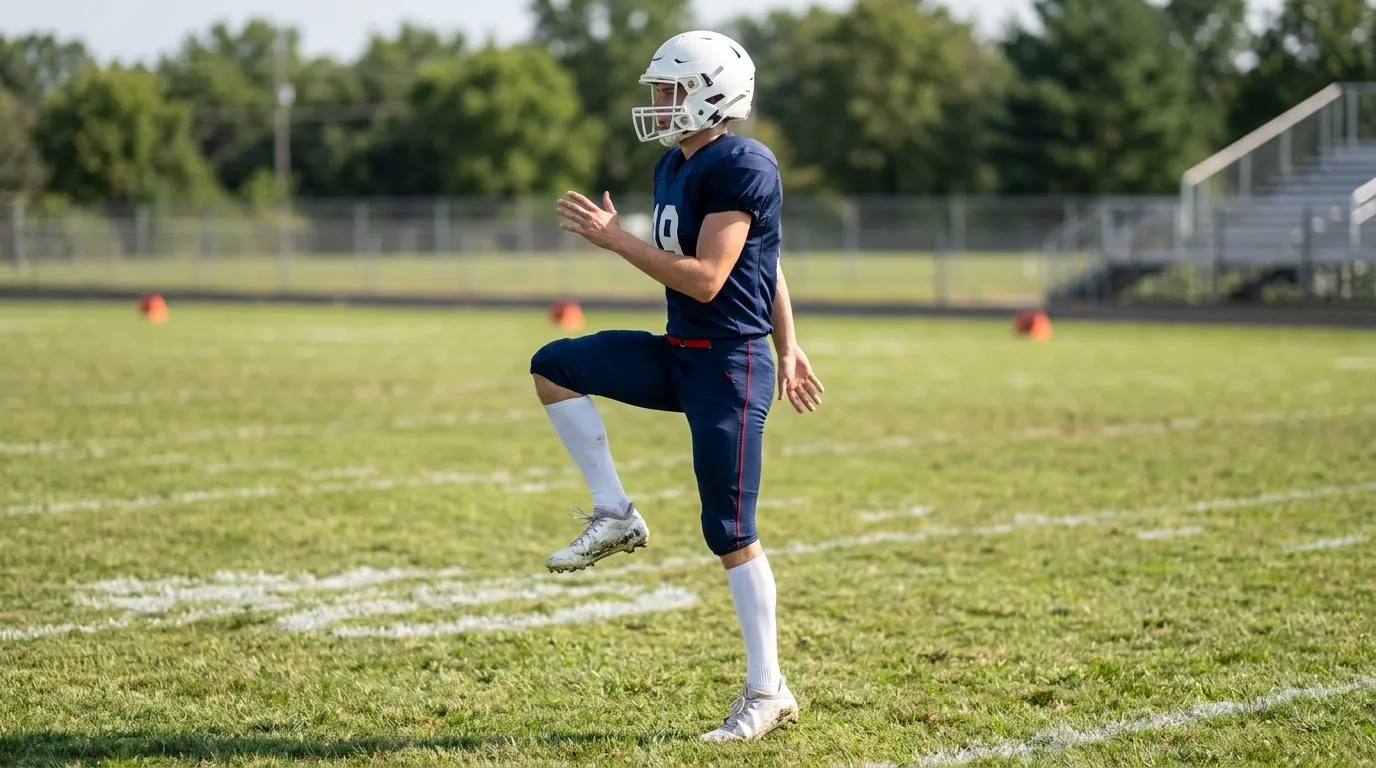
The A Skip Drill is a simple sprint drill that teaches better posture, knee drive, foot placement, and coordination. Football players can use it during a warm-up or before speed training.
The movement looks simple, but timing matters. You need to stay tall, lift the knee, keep the toes up, and bring the foot back toward the ground with control.
This guide explains how to do A-Skips step by step. You will also learn proper technique, common mistakes, beginner progressions, and how to use the drill in football training.
Quick Answer: What Is the A Skip Drill?
The A Skip Drill is a running drill that combines a skipping rhythm with controlled knee drive and arm action. It helps athletes practice sprint-related positions, foot placement, rhythm, and arm-leg coordination.
The goal is good movement, not maximum speed or skip height.
| A-Skip Basics | Details |
|---|---|
| Equipment | None required |
| Space | About 10–20 yards |
| Difficulty | Beginner-friendly |
| Main focus | Sprint mechanics and coordination |
| Best time | Warm-up or sprint preparation |
| Movement | Alternating forward skips |
What Does the A Skip Drill Train?
A-Skips teach several movements used during running and sprinting.
The drill mainly works on:
- Posture: You practice staying tall while moving.
- Knee drive: Each knee moves upward in a controlled way.
- Dorsiflexion: The toes stay pulled up toward the shin.
- Foot placement: The foot comes down close to underneath the body.
- Ground contact: Each contact should be quick and controlled.
- Arm action: The opposite arm and leg work together.
- Rhythm: Both sides repeat the same movement in a smooth pattern.
- Coordination: Your upper and lower body learn to work together.
Research also supports the use of A-Skips as a technical running drill. A 2025 study described the A-Skip as an exercise used to practice body position, foot contact, coordination, and the timing of the arms and legs. The researchers also studied A-Skip performance alongside 5-meter and 20-meter sprint performance.
A-Skips are a technique drill. They should not be treated as a race.
Why Football Players Use A-Skips
Football requires short bursts of running and acceleration. Good sprint movement can help a player move with better control during speed work.
A-Skips allow football players to practice basic sprint mechanics at a slower and easier pace. The drill can reinforce posture, knee action, ankle position, foot contact, and arm-leg coordination.
However, A-Skips alone do not make a player faster. They are one teaching drill that can be used as part of a larger speed program.
Evidence Note: A-Skips are best viewed as a technique drill, not a shortcut to faster sprint times. Recent research links running drills with movement mechanics and coordination, but the A-Skip should still be used as one part of a complete sprint training program.
A-Skips can also be combined with other football speed and agility drills when building a beginner training session.
A Skip Drill Setup
You do not need special equipment for A-Skips.
A flat grass field, turf area, or other safe training surface works well. You can use two cones to mark your start and finish points.
For beginners, a short distance is usually enough to learn the movement without losing technique.
Starting Position
Before you begin:
- Stand tall.
- Keep your head in a natural position.
- Look forward.
- Relax your shoulders.
- Keep your arms at your sides with the elbows bent naturally.
- Keep your core controlled.
- Prepare to move forward at a slow pace.
Do not lean far forward or backward.
How to Perform the A Skip Drill Step by Step

Learning each part of the movement makes the full drill much easier.
1. Start Tall
Stand with your body upright and relaxed.
Keep your chest controlled and eyes forward. Avoid bending at the waist.
2. Drive One Knee Up
Lift one knee in front of your body.
Bring the thigh up in a controlled way. Do not force the knee higher than you can comfortably control.
Your body should remain tall as the knee rises.
3. Keep the Ankle Dorsiflexed
As the knee rises, pull your toes toward your shin.
This position is called dorsiflexion.
Avoid pointing the toes toward the ground.
4. Add the Skip
Push lightly from the ground and add a small skip.
The skip should support the movement. It should not turn into a high jump.
Focus on control rather than height.
5. Bring the Foot Down
Bring the raised foot back toward the ground.
Aim to make contact close to underneath your body rather than reaching far forward with the lower leg.
Keep the contact light and controlled.
6. Use the Opposite Arm
Move the opposite arm with the raised leg.
If your right knee comes up, your left arm should move forward. Then switch sides.
Keep the arms moving mostly forward and backward rather than across your body.
7. Switch Sides and Find Your Rhythm
Repeat the same movement with the opposite leg.
Continue alternating sides as you travel forward.
Do not rush. Find a smooth rhythm that you can repeat without losing posture.
Coach’s cue:
Tall body → knee up → toe up → foot down → switch.
Coach’s Tip: Beginners often rush forward before they control the movement. Slow the drill down if your posture, knee drive, foot position, or opposite arm action starts to change. Build speed only after the pattern feels consistent.
Proper A Skip Technique
Correct A-Skip technique should look controlled from start to finish.
| Technique Point | What to Look For |
|---|---|
| Posture | Tall and balanced |
| Head | Neutral with eyes forward |
| Shoulders | Relaxed |
| Knee | Controlled upward drive |
| Ankle | Toes pulled toward the shin |
| Foot placement | Close to underneath the body |
| Ground contact | Quick and controlled |
| Arms | Opposite arm and leg |
| Rhythm | Smooth and repeatable |
| Direction | Gradual forward movement |
Do not worry about moving quickly when you first learn the drill. Good positions matter more than speed.
What Should a Correct A Skip Feel Like?
A good A-Skip should feel light, rhythmic, and controlled.
You should feel your knee rise without leaning backward. Your foot should return toward the ground without reaching far in front of you.
The arms and legs should move together in a natural opposite pattern.
You should also be able to repeat the same movement on both sides.
If you feel like you are jumping as high as possible or racing forward, slow down.
Common A Skip Mistakes and How to Fix Them
Small technique errors can change the purpose of the drill.

| Common Mistake | What Happens | Simple Fix |
|---|---|---|
| Leaning backward | Body moves behind the hips | Stay tall and keep your torso controlled |
| Knee stays too low | Knee action becomes limited | Lift the knee with control |
| Toes point down | Ankle loses the desired position | Pull the toes toward the shin |
| Foot reaches forward | Foot lands too far in front | Bring the foot down closer under the body |
| Skipping too high | Drill becomes more like jumping | Focus on rhythm instead of height |
| Arms cross the body | Upper body may rotate | Drive the arms forward and backward |
| Same arm and leg move together | Coordination breaks down | Use opposite arm and leg |
| Heavy ground contact | Movement becomes slow | Use lighter, quicker contacts |
| Moving too fast | Technique starts to break | Slow down and regain control |
If several mistakes happen at once, return to a slower version of the drill.
Beginner A Skip Progression
Some beginners find the A-Skip rhythm difficult at first. You do not need to learn the complete movement immediately.

Use this simple progression.
1. A-March
Start with an A-March.
Walk forward while lifting one knee at a time. Keep your toes up and use opposite arm action.
This removes the skipping part and makes it easier to learn the main positions.
Starting with an A-March also gives beginners a simpler way to practice the leg action before adding the timing and coordination of the skip.
2. Slow A-Skip
Next, add a small skip.
Move slowly. Focus on knee drive, ankle position, and coordination.
Do not worry about distance or speed yet.
3. Regular A-Skip
Once the slow version feels natural, perform regular A-Skips.
Keep the same posture and rhythm while moving forward.
4. A-Skip Into a Short Acceleration
More experienced beginners can perform a short set of A-Skips and then move into a controlled acceleration.
The transition should feel smooth.
Do this only after you can perform regular A-Skips without losing your technique.
Once the movement is controlled, you can pair A-Skips with simple football acceleration drills that teach players how to build speed over the first few steps.
Progress based on movement quality rather than how many sessions you have completed.
Coach’s Tip: Do not move a beginner to the next variation just because the previous set is finished. Look for tall posture, controlled knee action, toes up, and a steady rhythm on both sides first.
Recommended A Skip Sets, Distance, and Rest
There is no single distance or set count that every athlete must use.
For beginners, shorter sets make it easier to keep good technique.
A practical starting approach is:
| Level | Distance | Sets | Rest |
|---|---|---|---|
| Learning the drill | 10 yards | 2 | Walk back |
| Beginner | 10–15 yards | 2–3 | 30–45 seconds |
| Before sprint work | 10–20 yards | 2 | 30–60 seconds |
These are practical starting ranges rather than official testing standards.
Programming Note: There is no single A-Skip distance, set, or rest period that fits every athlete. Keep the distance short enough to maintain good technique, especially when teaching beginners.
Stop or shorten the set if your posture, rhythm, or coordination starts to break down.
Quality matters more than covering extra distance.
A Skip vs High Knees
A-Skips and high knees can look similar, but they are different drills.
| A-Skip | High Knees |
|---|---|
| Uses a clear skipping rhythm | Uses quicker alternating steps |
| More technique-focused | Simpler movement |
| Focuses on timing and coordination | Focuses on repeated knee action |
| Includes a distinct skip | Does not require the same skipping pattern |
| Usually moves forward gradually | Can be done in place or moving forward |
Beginners may find high knees easier. However, A-Skips give athletes more time to practice specific sprint positions and coordination.
A Skip vs B Skip
The A-Skip and B-Skip belong to the same family of running drills, but they are not the same movement.
An A-Skip focuses on knee drive, ankle position, rhythm, and bringing the foot back toward the ground.
A B-Skip starts with a similar knee action but adds more lower-leg extension before the foot returns toward the ground.
Which Should Beginners Learn First?
Learn the A-Skip first.
It has a simpler movement pattern and creates a base for learning the B-Skip later.
A beginner who cannot control the A-Skip will usually gain little from rushing into the more complex drill.
When Should You Do A Skips?
A-Skips fit best early in a training session when the athlete is fresh.
They can be used after general movement and dynamic mobility but before hard sprint work.
This fits the wider idea of a dynamic warm-up. The National Strength and Conditioning Association explains that dynamic warm-ups can use sport-specific movements to prepare athletes for the movement demands of practice and competition.
A simple order is:
Light warm-up → dynamic mobility → A-March → A-Skip → sprint drills → acceleration or speed work
For more ways to prepare players before practice, see these football warm-up drills for beginners.
Avoid using A-Skips as conditioning where the goal is to become tired.
The main goal is to practice clean movement.
Example Football Warm-Up Placement
A football player might use this simple order before a speed session:
- Light movement
- Dynamic mobility
- A-March
- A-Skips
- Short acceleration drills
The A-Skip prepares the athlete for faster movement without requiring full sprint speed.
Build Better Sprint Mechanics for Football
Use these beginner-friendly guides to improve sprint form, acceleration, warm-up quality, and overall speed training.
Sprint Mechanics for Football
Learn the basic posture, arm action, foot contact, and body positions used during football sprinting.
Read the guide → ACCELERATIONFootball Acceleration Drills
Practice simple drills that help beginners improve their first few steps and short-distance acceleration.
See the drills → SPEED & AGILITYFootball Speed and Agility Drills
Find beginner drills for speed, footwork, coordination, and change of direction on the football field.
Explore the drills → WARM-UPFootball Warm-Up Drills
Build a simple warm-up that prepares players for movement, sprinting, and football practice.
View warm-up drills →Frequently Asked Questions About A Skips
Are A-Skips good for beginners?
Yes. Beginners can use A-Skips, but some athletes may need to start with A-Marches first. Learn the posture, knee action, ankle position, and arm movement before increasing speed.
Should A-Skips be done fast or slow?
Start slowly. The main goal is correct technique and rhythm. You can increase the pace once you can repeat the movement without losing control.
How far should you do A-Skips?
Beginners can start with short distances such as 10–15 yards. Longer distances are not automatically better. Stop the set when technique starts to break down.
Are A-Skips a warm-up drill?
Yes. A-Skips are commonly used during dynamic warm-ups and sprint preparation. They work well before acceleration or speed training.
What is the difference between A-Skips and B-Skips?
A-Skips use knee drive and a controlled downward foot action. B-Skips build on that pattern by adding more lower-leg extension. Beginners should normally learn the A-Skip first.
What is the difference between A-Skips and high knees?
A-Skips use a distinct skipping rhythm and place more focus on coordination and technical positions. High knees use faster alternating steps and are usually easier to perform.
Final Takeaway
The A Skip Drill is a useful way to practice basic sprint positions without running at full speed.
Stay tall, drive the knee with control, keep the toes up, bring the foot down close to underneath your body, and use opposite arm action.
Beginners should focus on rhythm before speed. Start with an A-March if needed, then move to slow and regular A-Skips.
For football players, A-Skips fit well in a warm-up or sprint-preparation routine before acceleration and speed work.
References
- Peer-reviewed 2025 A-Skip/B-Skip research
- National Strength and Conditioning Association (NSCA). Introduction to Dynamic Warm-Up. Kinetic Select. https://www.nsca.com/education/articles/kinetic-select/introduction-to-dynamic-warm-up/
