



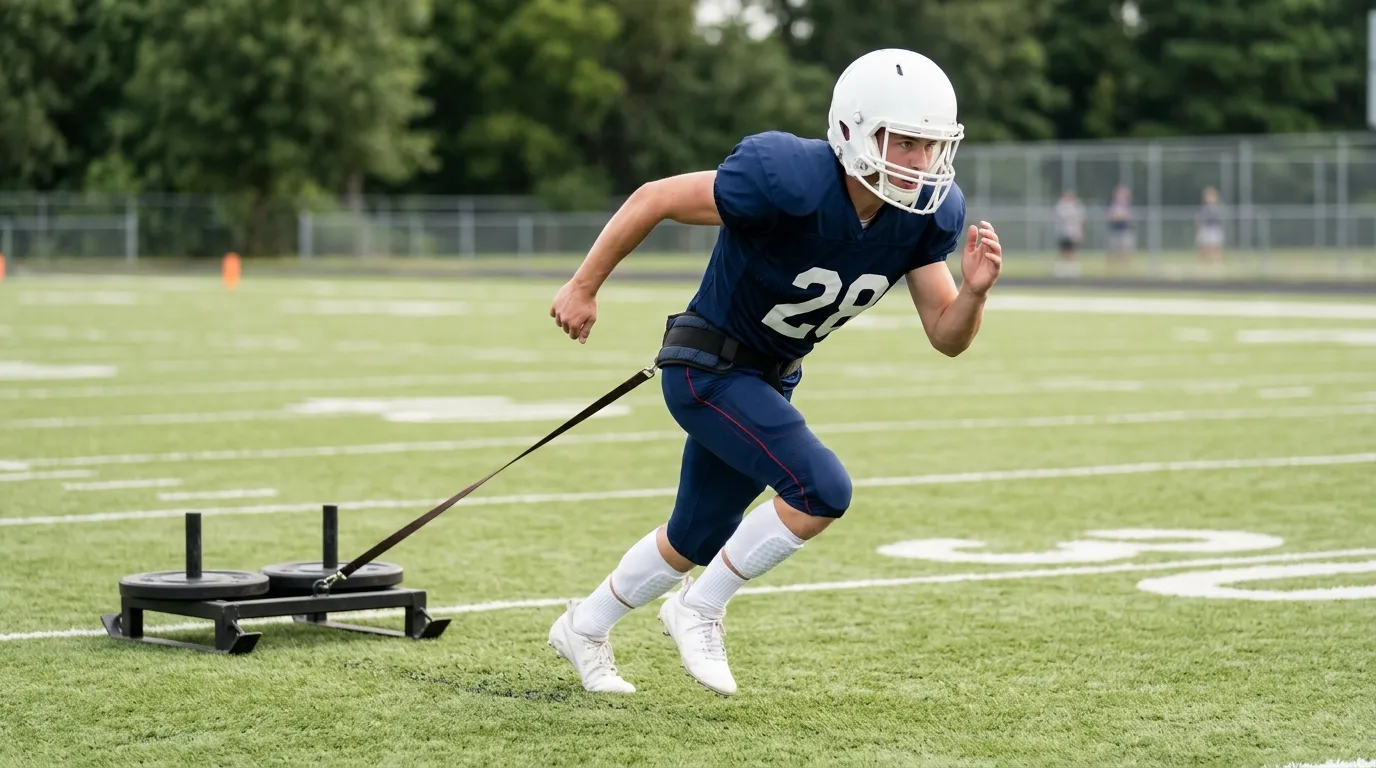
The Resisted Sprint Drill is a speed drill where a player sprints while working against added resistance. A sled, resistance band, or partner can provide the resistance.
For football players, the drill is mainly useful for short acceleration work. The goal is not to pull the heaviest load possible. The goal is to sprint against resistance while keeping good acceleration form.
Resisted Sprint Drill: Quick Answer
To perform the Resisted Sprint Drill, attach a sled or resistance band around the waist, take an athletic starting position, and accelerate forward for a short distance. Push hard through the ground, drive the arms, and keep the first steps quick and controlled.
Use enough resistance to challenge the sprint without turning it into a slow walk or march. Beginners should start with manageable resistance and focus on clean movement before adding more load.
The main goal is to train short acceleration while the athlete works against added resistance.
What Is a Resisted Sprint Drill?
A resisted sprint is a sprint performed against an outside force.
Instead of accelerating freely, the player must overcome resistance while moving forward. Common options include:
- weighted sled
- resistance band and partner
- towing harness
- parachute
- slight uphill slope
For this drill, a sled or resistance band is the easiest setup to understand and control.
Resisted sprint training is commonly used in field sports to train acceleration. For other methods that target the first steps and short bursts of speed, see our football acceleration drills. Research has found benefits for short sprint acceleration, although resisted sprinting should not be viewed as a full replacement for normal sprinting.
For football players, this makes the drill most useful for training the early part of a sprint rather than long-distance running.
Sled or Resistance Band? Choose Your Setup
You do not need several pieces of equipment. Choose one resistance method and perform the drill with good form.

Option 1: Sled and Harness
You need:
- sprint sled
- weights if needed
- waist belt or harness
- flat running surface
- marked sprint distance
Attach the sled behind the player. The line should have enough room to stay clear of the player’s feet.
A sled makes it easier to control and repeat the load. It is a good choice when proper sprint equipment is available.
Option 2: Resistance Band and Partner
You need:
- long resistance band
- training partner
- open running space
Place the band securely around the runner’s waist. The partner stands behind the runner and holds the band.
The partner should create steady resistance without pulling the runner backward or from side to side.
This version is useful when a sled is not available.
How to Set Up the Resisted Sprint Drill
A simple setup keeps the focus on acceleration.
- Find a flat and clear running area.
- Mark a starting point.
- Mark the end of the sprint.
- Attach the sled or resistance band around the waist.
- Start with manageable resistance.
- Check that the resistance will pull straight behind the runner.
- Take an athletic starting position facing the finish.
Make sure there is enough open space beyond the finish point so the player can slow down safely.
For a band setup, the partner must stay balanced and keep the band under control.
How to Perform the Resisted Sprint Drill Step by Step
Once the setup is ready, focus on the quality of each sprint.
- Take your starting position. Lean slightly forward and prepare to accelerate.
- Build light tension. The sled line or resistance band should be ready before the first step.
- Push into the ground. Drive out of the start instead of standing upright too early.
- Take quick early steps. Keep the first steps controlled while pushing the body forward.
- Drive the arms. Move the arms strongly as the legs work against the resistance.
- Keep accelerating. Do not turn the drill into a slow sled walk.
- Sprint through the finish. Avoid slowing down before the marked distance.
- Recover before the next rep. Each repetition should be performed with good speed and form.
The resistance should challenge the player, but the movement should still look like a sprint.
How Much Resistance Should You Use?
There is no single sled weight that is right for every player.
A 2025 systematic review and meta-analysis of resisted sprint training examined different loads using both percentage of body mass and velocity decrement. This supports using load as a training variable rather than assuming one resistance level is best for every athlete.
The right resistance can depend on:
- training experience
- body mass
- sled type
- surface
- friction
- sprint distance
- training goal
This is why copying one body-weight percentage from another athlete is not always a good choice.
For a beginner, the first goal should be simple: use a load that creates clear resistance without destroying sprint form.
More experienced coaches may use sprint speed and velocity decrement to select a more exact load.
How to Tell If the Resistance Is Too Heavy

Watch how the player moves during each sprint.
The resistance may be too heavy if:
- the sprint turns into a slow walk or march
- the player struggles to take quick, controlled steps
- body position changes too much
- normal arm action is lost
- the player cannot accelerate smoothly
- sprint quality drops from one rep to the next
If you notice these signs, reduce the resistance before the next rep.
Coach’s Tip: If the player looks like they are dragging the load instead of sprinting, reduce the resistance. The drill should still look like acceleration.
Heavy sled work can have a place in training for experienced athletes. However, heavier resistance is not automatically better for every player. Research suggests that the effect of different loads can depend on training level and the part of acceleration being trained.
For beginners, focus on controlled sprinting first. Increase the resistance only when the player can maintain good acceleration form.
Proper Technique While Sprinting Against Resistance
Added resistance should challenge acceleration without making the player forget basic sprint form.
World Rugby also recommends maintaining a sound acceleration technique during resisted sprint training rather than allowing the added resistance to change the movement pattern.
Focus on these cues:
Keep a Forward Acceleration Posture
The body should have a natural forward lean during the first part of the sprint.
Do not bend forward only from the waist. The body should stay controlled while moving forward.
Push Through the Ground
Think about pushing the ground away during the early steps.
Resisted sprinting increases the force demands of acceleration, so each step needs a strong push.
Drive the Arms
Use active arm action.
The arms should move naturally with the legs. Avoid short, weak arm movements when the resistance becomes harder.
Keep the Early Steps Quick
Keep the early steps quick and controlled. Avoid reaching far ahead just to move the resistance.
Do Not Stand Up Too Soon
Allow the body to rise as speed increases instead of becoming upright immediately after the first step.
If you need more help with running position, arm action, and early steps, review proper sprint mechanics before adding more resistance.
How Far Should You Sprint? Reps, Sets & Rest
Resisted sprint work should focus on quality rather than doing as many repetitions as possible.
For beginners, short distances make sense because the main goal is acceleration.
A simple starting format is:
| Training Variable | Beginner Starting Point |
|---|---|
| Sprint distance | 10–15 yards |
| Reps | 3–5 high-quality reps |
| Sets | 1–2 |
| Rest between reps | Enough to perform the next rep with good form and effort |
| Main goal | Fast, controlled acceleration |
These numbers are a simple beginner starting point, not a fixed rule for every player. The right distance, number of reps, and recovery time can change with the resistance used, training experience, and sprint quality.
For comparison, CoachUp recommends 10–20 yards for 4–6 partner-resisted sprint reps. Research on resisted sprint training also uses different loads, distances, and training volumes.
Take enough recovery to perform the next sprint with good form and effort. If sprint quality drops, extend the rest period or stop the set.
Beginner Progression: From Free Sprint to Resisted Sprint
Beginners do not need to start with a heavy sled.
Use a simple progression.
Stage 1: Learn Short Acceleration Without Resistance
Practice the start, first steps, body position, and arm action without a sled or band.
Stage 2: Add Light Resistance
Use a sled or partner-held band that creates resistance while still allowing the player to sprint naturally.
Stage 3: Keep the Same Sprint Pattern
Do not add more resistance until the player can repeat the drill with controlled technique.
Stage 4: Pair Resisted and Free Sprints
After resisted work, include normal short sprints without added resistance.
This keeps regular sprinting in the training plan.
Stage 5: Progress Slowly
Resistance, distance, or training volume can be adjusted as the player’s skill improves.
Do not increase everything at once.
Sled vs Band Resisted Sprints: Which Is Better for Beginners?

Both methods can work, but they have different strengths.
| Feature | Sled Sprint | Band + Partner Sprint |
|---|---|---|
| Equipment | Sled and harness | Band and partner |
| Load control | Easier to measure | Depends on band and partner |
| Partner required | No | Yes |
| Resistance feel | More consistent | Can change as band stretches |
| Setup cost | Higher | Lower |
| Good for beginners | Yes, with manageable load | Yes, with controlled resistance |
A sled is useful when you want more control over the external load.
A resistance band is a practical choice for players who do not have access to a sled.
Neither option is automatically better for every beginner. Pick the setup that allows safe, repeatable sprints with good form.
Should You Do a Normal Sprint After a Resisted Sprint?
Yes, normal sprinting should still have a place in the training plan.
Resisted and unresisted sprinting are related, but they are not the same training method.
A 2024 systematic review found that resisted sprint training produced a small improvement in acceleration, but it was not significantly better than equal-volume unresisted sprint training.
Another 2024 review found a significant improvement in 10-meter acceleration from resisted sprint training compared with normal sprinting. It did not find the same clear advantage for 20-meter sprint time or maximum velocity.
Newer research also suggests that load, training level, and the part of the sprint being trained can affect the result.
For a beginner football player, the practical lesson is simple:
Use resisted sprints as part of speed training, not as a complete replacement for normal sprints.
Should You Do a Normal Sprint After a Resisted Sprint?
Yes, normal sprinting should still have a place in the training plan.
Resisted and unresisted sprinting are related, but they are not the same training method.
A 2024 systematic review found that resisted sprint training produced a small improvement in acceleration, but it was not significantly better than equal-volume unresisted sprint training.
Another 2024 review found a significant improvement in 10-meter acceleration from resisted sprint training compared with normal sprinting. It did not find the same clear advantage for 20-meter sprint time or maximum velocity.
Newer research also suggests that load, training level, and the part of the sprint being trained can affect the result.
For a beginner football player, the practical lesson is simple:
Use resisted sprints as part of speed training, not as a complete replacement for normal sprints.
Common Resisted Sprint Mistakes and How to Fix Them
| Mistake | What Happens | Simple Fix |
|---|---|---|
| Using too much resistance | Sprint becomes slow and forced | Reduce the load |
| Standing upright too early | Early acceleration position is lost | Stay controlled through the first steps |
| Reaching too far with each step | Sprint rhythm can break down | Use quick, controlled early steps |
| Weak arm action | Whole movement becomes less active | Drive the arms with the legs |
| Pulling the band unevenly | Runner moves off line | Partner stays directly behind |
| Taking very short rest | Sprint quality falls | Recover before the next rep |
| Doing only resisted sprints | Normal sprint practice is reduced | Include unresisted sprint work |
The goal is a good sprint against resistance, not simply moving a heavy object.
Where Does the Resisted Sprint Drill Fit in a Football Workout?
Do resisted sprint work while the player is still fresh enough to sprint with good form.
A simple session may look like this:
Dynamic warm-up → sprint preparation → resisted sprints → normal short sprints → other football training
Avoid saving high-quality sprint work for the end of a tiring conditioning session.
Once fatigue changes sprint technique, the player is no longer practicing the same movement at the same quality.
Resisted sprinting can also fit beside other football acceleration drills when the goal is improving the first part of the sprint. Beginners who want a broader training routine can also use these football speed and agility drills to combine straight-line speed with controlled movement work.
No Sled or Band? Try Another Form of Resistance
A sled and band are not the only ways to add resistance.
Other options include:
- slight uphill sprint
- partner resistance
- sprint parachute
- weighted vest
Each method changes resistance in a different way.
A slight hill is one of the simplest options when sled equipment is not available. However, the slope should not be so steep that it changes normal running mechanics.
If you want to use an incline instead of external equipment, see our Hill Sprint Drill guide for the full setup and technique.
Frequently Asked Questions
Are resisted sprints good for football?
They can be useful for football speed training, especially when the goal is short acceleration. Research supports resisted sprint training as one method for improving acceleration, but it should be combined with normal sprint practice.
How long should a resisted sprint be?
Beginners can start with short acceleration distances such as 10–15 yards. The right distance depends on the training goal, resistance, experience, and ability to maintain good sprint form.
How heavy should a sled be for resisted sprints?
There is no single sled weight that works for every athlete. Surface friction, body mass, training level, and sprint goal all affect the load. Beginners should start with resistance they can sprint against without a clear breakdown in technique.
Can beginners do resisted sprints?
Yes, but beginners should first learn basic acceleration technique. Start with manageable resistance and short distances. Increase the training demand only after the player can repeat the drill with good form.
Are sled sprints better than normal sprints?
Not in every situation. Research shows that both resisted and unresisted sprint training can improve sprint performance. Resisted sprinting may be especially useful for short acceleration, while normal sprinting should remain part of the training plan.
Can I use a resistance band instead of a sled?
Yes. A partner-held resistance band is a practical alternative. The partner should provide controlled resistance from directly behind the runner and avoid pulling the athlete off line.
Final Coaching Tip
Treat the Resisted Sprint Drill as a sprint drill, not a test of how much weight a player can move.
Start with clean acceleration. Add enough resistance to challenge the player. Reduce the load if sprint mechanics start to break down.
For beginners, consistent high-quality reps are more useful than chasing a heavier sled.
References
- Aldrich, E. K., Sullivan, K., Wingo, J. E., et al. (2024). The Effect of Resisted Sprint Training on Acceleration: A Systematic Review and Meta-Analysis. International Journal of Exercise Science, 17(6), 986–1002. DOI: 10.70252/VKAV1115.
- Myrvang, S., & van den Tillaar, R. (2024). The Longitudinal Effects of Resisted and Assisted Sprint Training on Sprint Kinematics, Acceleration, and Maximum Velocity: A Systematic Review and Meta-analysis. Sports Medicine – Open, 10, 110. DOI: 10.1186/s40798-024-00777-7.
- Xu, K., Jukic, I., Cross, M. R., et al. (2025). Effects of Resisted-Sprint Training on Sprint Performance and Mechanics: A Systematic Review and Meta-Analysis Focusing on Load Magnitude. Scandinavian Journal of Medicine & Science in Sports, 35(12), e70182. DOI: 10.1111/sms.70182.
- World Rugby. Resisted Sprint Training. Conditioning for Rugby: General Conditioning.
