



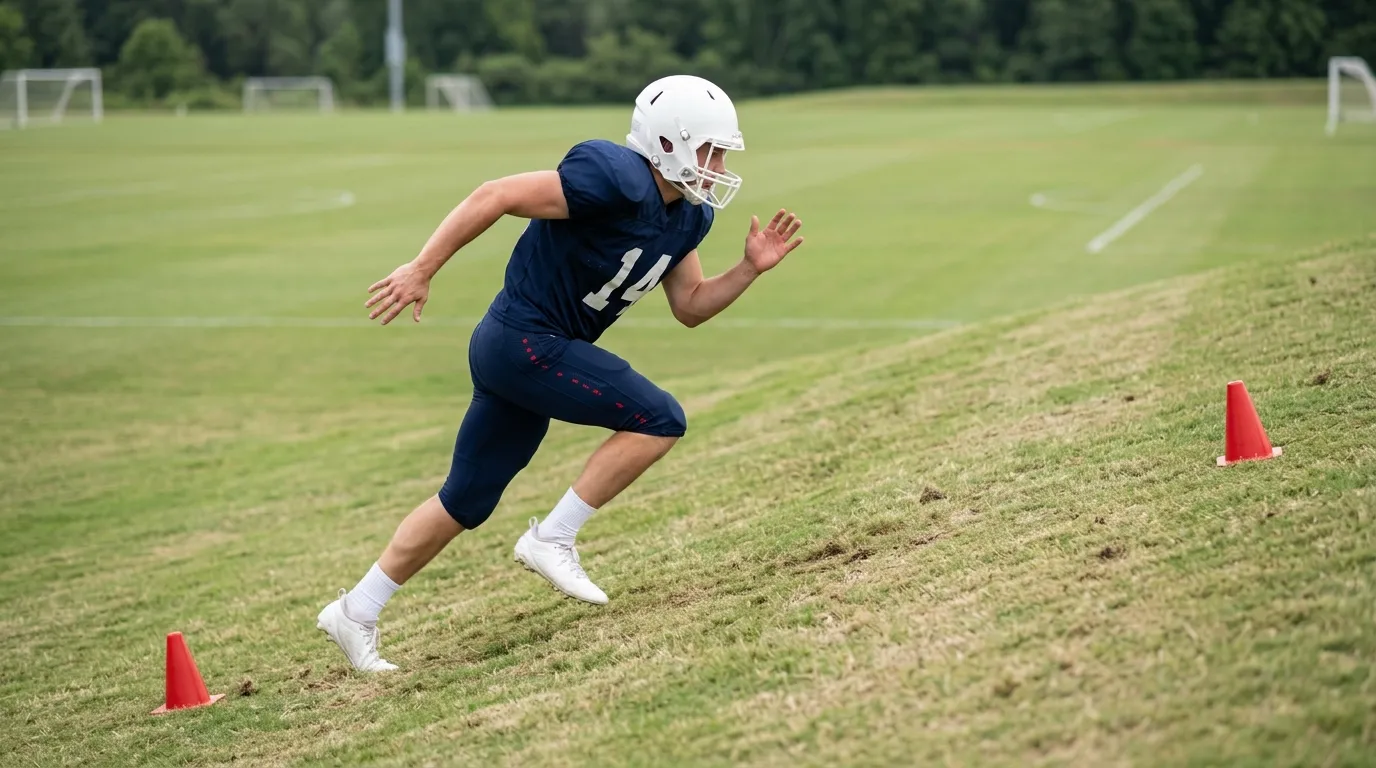
The Hill Sprint Drill is a short uphill sprint used to train acceleration. A football player starts at the bottom of a safe hill, sprints uphill for a short distance, then walks back to recover.
For beginners, short reps are better than long uphill runs because the goal is fast, clean acceleration. Use a moderate slope, keep good sprint form, and stop the set if speed or technique starts to drop.
What Is the Hill Sprint Drill?
The Hill Sprint Drill is a resisted sprint exercise. The hill adds resistance because the athlete must run uphill against gravity.
This makes the drill useful for short acceleration work. Football players often need to accelerate from a stance, after a cut, or into open space. These football acceleration drills can help beginners train the same first-step skill in different ways.
Hill angle matters. Research shows that uphill slope changes sprint speed and running mechanics. Different slopes can also create different movement patterns. A study published in the Journal of Sports Sciences found that different uphill slopes change sprint mechanics, with steeper and moderate slopes showing features linked to different stages of flat-ground acceleration.
For that reason, a steeper hill is not always a better hill.
Benefits of Hill Sprints for Football Players
Hill sprints can support football speed training when they are used for the right goal.
Train Short Acceleration
Football includes many short bursts of movement. A player may need to move quickly off the line, after a read, or after changing direction.
Running uphill adds resistance during those early acceleration steps. Garage Strength also uses hill sprinting as acceleration work for football athletes.
Reinforce Acceleration Mechanics
A good hill sprint can encourage:
- A forward body angle
- Active arm drive
- Strong knee movement
- A firm push into the ground
- Controlled body position
These actions are also part of normal acceleration. Good uphill sprinting still depends on proper body position, arm action, and leg movement. Learn these basics in our sprint mechanics for football guide.
Add Resistance Without Extra Equipment
The slope creates resistance on its own. You do not need a sled or resistance band for the basic drill.
As the slope gets steeper, sprint speed usually falls. This is one reason hill angle should match the training goal.
Keep the Focus on Sprint Quality
Short hill sprints can be done early in a speed session while the player is fresh.
This helps the athlete focus on fast, controlled reps instead of simply getting tired.
Equipment Needed
You need:
- A safe hill with a firm surface
- Two cones or field markers
- Training shoes or cleats with good grip
- A stopwatch if you want to time reps
The hill should also have enough space after the finish point for the player to slow down safely.
How to Choose the Right Hill
Choose the hill before deciding how hard the workout will be.
Use a Moderate Slope
The hill should be steep enough to add resistance but not so steep that the athlete has to climb instead of sprint. Research on uphill sprinting shows that hill angle changes sprint mechanics. Steeper slopes share some movement features with early acceleration, while moderate slopes show features closer to later acceleration. This is why the hill should match the goal of the drill instead of simply being as steep as possible.
A running-focused hill workout from The Morning Shakeout uses about a 4–8% incline for longer repeats. However, that is a running workout, not a fixed football rule.
For beginner football players, the better test is simple: can the player still sprint with controlled form?
Check the Surface
Choose a surface that is:
- Firm
- Even
- Clear of holes
- Free from loose rocks
- Not wet or slippery
Grass can work well if it gives the player enough grip.
Check the Finish Area
Leave enough space to run through the finish marker and slow down.
Do not place the finish near a road, wall, drop, fence, or another unsafe area.
Hill Sprint Drill Setup

Use this simple setup:
- Place one cone at the bottom of the hill.
- Mark a short sprint distance uphill.
- Place the second cone at the finish point.
- Check the full running path.
- Leave space after the finish cone to slow down.
- Complete a warm-up before the first fast sprint.
For beginners, start with a short distance. The drill should feel like acceleration training, not a long conditioning run. Complete a proper football warm-up before starting fast hill sprints.
How to Do the Hill Sprint Drill
Follow these steps:
- Start in a balanced sprint stance. Set up at the first cone and get ready to accelerate.
- Lean forward naturally. Keep the body in a good position to move uphill.
- Push into the ground. Drive uphill instead of reaching far forward with each step.
- Use active arm action. Let the arms work in rhythm with the legs.
- Take quick, controlled steps. Keep the movement smooth.
- Sprint through the finish marker. Do not stop directly at the cone.
- Slow down under control.
- Walk back down the hill. Recover before starting the next rep.
Garage Strength also uses walk-back recovery between its football hill sprints.
Each rep should look fast and controlled. Do not keep adding reps after technique starts to break down.
Recommended Distance, Reps and Rest
There is no single hill sprint distance or rep count that fits every football player.
Age, training history, hill angle, surface, and the rest of the training session all affect the workload.
For a beginner football player, this is a simple starting guide:
| Training Factor | Beginner Starting Point |
|---|---|
| Sprint distance | About 10–20 yards |
| Reps | 4–6 quality sprints |
| Sets | 1 set to start |
| Recovery | Walk back, then add rest if needed |
| Main goal | Fast reps with good form |
These numbers are a practical starting point, not a fixed rule for every athlete.
Football hill-sprint workouts can use different distances based on the training goal. For example, Garage Strength shows roughly 40-yard hill sprints in one football workout and also discusses 10–30 meter hill sprints in its football speed training guide. Beginners should start shorter and increase the workload only while sprint quality stays high.
How Much Rest Between Hill Sprints?
Rest long enough to keep sprint quality high.
Walking back may provide enough recovery after a short rep. However, take extra rest if the next sprint is clearly slower or technique starts to change.
Do not shorten rest just to make the workout harder. The main goal here is quality acceleration.
How Often Should Beginners Do Hill Sprints?
A beginner can start with one hill sprint session per week when it fits the full training plan.
Football practice, strength work, games, and other sprint sessions also add training stress. More hill sessions are not always better.
Proper Hill Sprint Technique

Use these technique points to keep each hill sprint fast and controlled:
- Keep a natural forward body angle. Lean forward as you accelerate uphill, but do not bend sharply at the waist. Keep your torso controlled.
- Push into the ground. Drive through each step instead of reaching far forward with your foot. Use quick, controlled steps as you move uphill.
- Drive your arms naturally. Move your arms in rhythm with your legs. Keep your shoulders relaxed and avoid swinging your arms across your body.
- Keep your head in a natural position. Look along the running path without lifting your chin too high or looking down at your feet.
- Maintain a smooth sprint rhythm. The movement should still look and feel like sprinting. If the hill forces slow, climbing-style steps, choose an easier slope.
- Keep your form through the finish. Run through the finish marker before slowing down under control. Stop the rep if fatigue causes your sprint technique to break down.
Beginner Hill Sprint Progression

Beginners should learn the Hill Sprint Drill in simple stages. Focus on good technique before adding more work.
- Learn the starting position. Practice a balanced sprint stance and the first few acceleration steps on flat ground.
- Start with short hill sprints. Use a moderate hill and perform a few short, controlled reps. Focus on body position, arm action, and quick steps.
- Add repetitions gradually. Once each sprint looks controlled, add a small number of reps. Do not add extra reps if speed or technique starts to drop.
- Build consistent sprint quality. Try to keep the same good form from the first rep to the last. Take more recovery if needed.
- Add a football-specific start. After learning the basic hill sprint, start from a football stance or add one simple movement before accelerating uphill.
Increase one training factor at a time. Avoid increasing the distance, hill steepness, and number of reps at the same time.
Common Hill Sprint Mistakes
Avoid these common mistakes to keep hill sprints safe and focused on good acceleration.
| Common Mistake | Why It Is a Problem | How to Fix It |
|---|---|---|
| Using a hill that is too steep | The sprint can turn into slow climbing and change normal sprint form. | Choose a moderate slope that allows a smooth sprint rhythm. |
| Taking steps that are too long | Reaching too far forward can slow the steps and reduce control. | Push into the ground and use quick, natural steps. |
| Standing upright too early | This can reduce the forward position used during early acceleration. | Keep a natural forward body angle during the first steps. |
| Using poor arm action | Weak or uncontrolled arm movement can affect sprint rhythm. | Drive the arms naturally and keep the shoulders relaxed. |
| Doing too many reps | Fatigue can reduce speed and cause technique to break down. | Stop the set or take more recovery when sprint quality drops. |
| Sprinting back down the hill | It adds extra fatigue and makes the return harder to control. | Walk back down and use the return as recovery. |
| Ignoring the running surface | Wet grass, holes, or loose ground can increase the risk of slipping. | Check the full sprint path before starting the drill. |
Hill Sprint Drill Variations
Learn the basic straight sprint before using harder versions.
Short Acceleration Hill Sprint
Sprint a short distance uphill from a normal sprint stance.
This is the best starting version for most beginners.
Stance-to-Hill Sprint
Start from a football stance and accelerate uphill.
This adds a football-specific starting position while keeping the main movement simple.
Shuffle-to-Hill Sprint
Take a few controlled lateral shuffle steps, plant, and accelerate uphill.
Garage Strength also uses a side-shuffle and cut before an uphill sprint as supplemental football speed work.
Beginners should learn straight hill sprints before adding this variation.
Hill Sprints vs Flat Sprints for Football
| Hill Sprints | Flat Sprints |
|---|---|
| Slope adds resistance | No hill resistance |
| Sprint speed is lower | Higher speeds are possible |
| Strong focus on short acceleration | Can train acceleration and faster sprinting |
| Requires a suitable hill | Requires safe flat space |
| Gradient changes running mechanics | Closer to sprinting on a level football field |
Hill sprints should support flat sprint training, not replace it. while a complete football speed and agility training plan should also include flat acceleration, footwork, and direction-change work.
A football player still needs to practice sprinting on flat ground because that is where normal game movement takes place.
Where Hill Sprints Fit in Football Training
Do hill sprints after the warm-up and before hard conditioning.
A simple session can follow this order:
Warm-up → Sprint technique work → Hill sprints → Other football drills or strength work
Speed work is easier to perform well while the player is still fresh.
Avoid saving fast hill sprints for the end of a tiring conditioning workout.
Who Should Use the Hill Sprint Drill?
The Hill Sprint Drill can be used by football players who need to work on short acceleration.
This may include:
- Running backs
- Wide receivers
- Defensive backs
- Linebackers
- Defensive ends
- Quarterbacks
- Other positions that use short bursts of speed
However, hill sprinting is a general acceleration drill. It is not limited to one football position.
Hill Sprint Safety Tips
Warm up before sprinting.
Check the hill for holes, wet spots, loose stones, or poor grip. Use a slope that lets the athlete sprint under control.
Leave enough space after the finish cone to slow down safely.
Walk back down instead of racing downhill.
Stop the session if the athlete can no longer maintain good sprint form. Increase the workload in small steps over time.
Continue Learning
Keep building your football speed with these related guides:
- Football Acceleration Drills – Learn drills that help improve the first few steps and short-distance acceleration.
- Sprint Mechanics for Football – Learn proper body position, arm action, and leg movement for better sprint technique.
- Football Speed and Agility Drills for Beginners – Explore beginner-friendly drills for speed, acceleration, footwork, and change of direction.
Frequently Asked Questions
Are hill sprints good for football players?
Yes. Hill sprints can be useful for football players who are training short acceleration. The slope adds resistance while the athlete works on the early steps of a sprint.
Do hill sprints help acceleration?
Uphill sprinting can be used as a resisted acceleration method. Research shows that slope changes sprint mechanics, so the hill angle and training plan both matter.
How long should hill sprints be for football?
For beginner acceleration work, about 10–20 yards is a simple starting range. Keep the distance short enough to maintain speed and good technique.
How many hill sprints should a beginner do?
Start with about 4–6 quality reps. Add more work only when the player can keep similar speed and technique from the first sprint to the last.
How steep should a hill be for sprinting?
Use a moderate slope that allows a normal sprint rhythm. A hill that is too steep can change the movement too much.
Should you sprint back down the hill?
No. Walk back down under control. The return can be used as part of the recovery period.
Are hill sprints better than flat sprints?
Neither is better for every goal. Hill sprints add resistance and work well for short acceleration. Flat sprints allow higher running speeds and more closely match sprinting on a football field. A football speed program can use both.
References
- Okudaira M, Willwacher S, Kawama R, Ota K, Tanigawa S. Sprinting kinematics and inter-limb coordination patterns at varying slope inclinations. Journal of Sports Sciences.
