



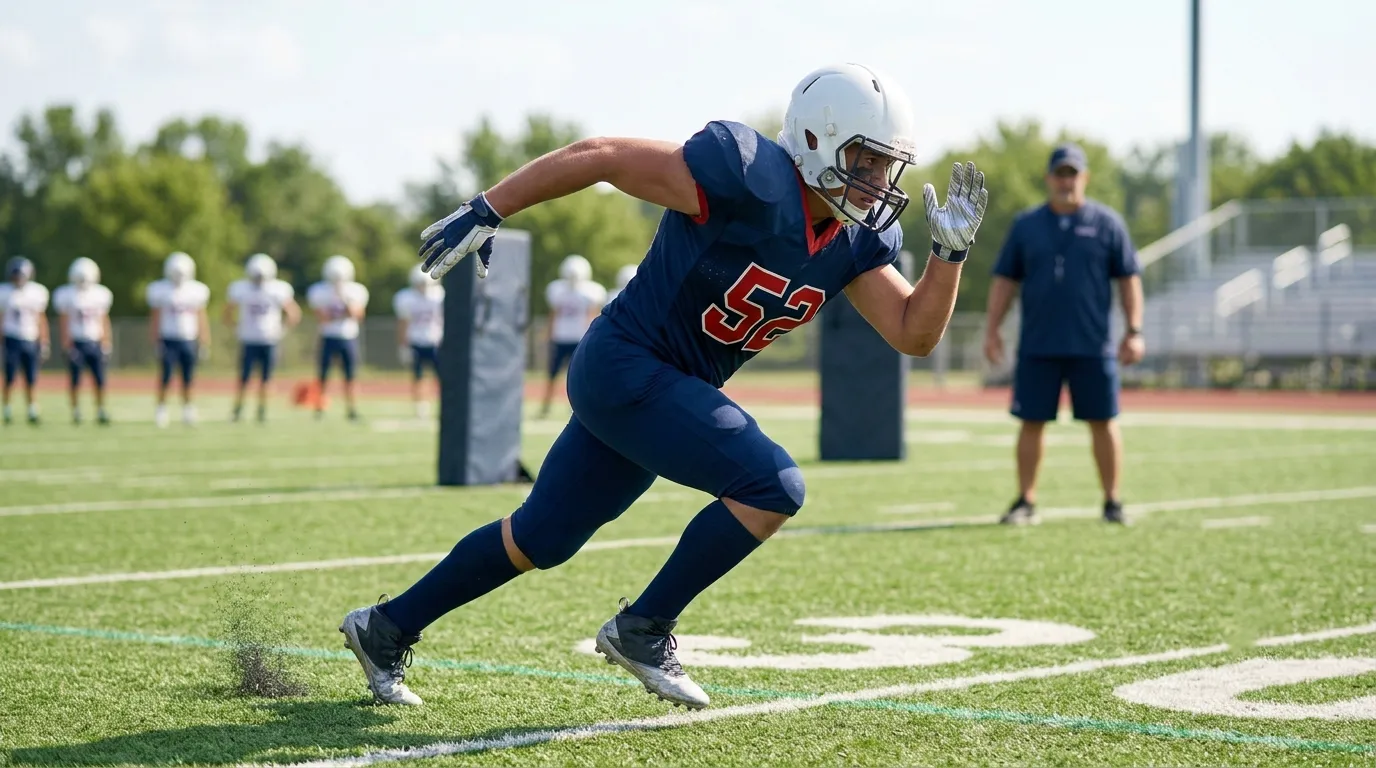
Sprint mechanics for football are the running techniques that help players accelerate faster, move more efficiently, and reach top speed with better control. Good sprint mechanics include proper body position, arm action, knee drive, foot placement, and stride rhythm. I have found that learning these basics before sprinting at full speed helps beginners build better habits, reduce wasted movement, and perform more confidently during games and practice.
Key Takeaways
- Good sprint mechanics help you accelerate faster and run more efficiently.
- Proper body position, arm action, and knee drive create better sprint technique.
- Learning mechanics before sprinting at full speed builds stronger movement habits.
- Sprint drills reinforce correct technique and improve football performance.
- Practice sprint mechanics 2–3 times per week after a dynamic warm-up.
- Every football position benefits from better sprint mechanics and acceleration.
What Are Sprint Mechanics in Football?
Sprint mechanics in football are the movement techniques that help players accelerate faster, run more efficiently, and maintain better control during a sprint. They include body position, forward lean, arm action, knee drive, foot strike, ground contact, and stride rhythm. When these movements work together, players generate more force with each step, waste less energy, and improve both acceleration and top-end speed on the field.
Many beginners think sprinting faster is only about running harder, but I have seen that proper technique makes the biggest difference. Sprint mechanics teach how to move correctly, while sprint drills like Wall Drills, A-Skips, and Falling Starts help reinforce those movement patterns through practice. This step-by-step learning approach also aligns with the USA Football Football Development Model, which encourages coaches to teach movement skills through progressive skill development before advancing to more complex football techniques.
Why Good Sprint Mechanics Matter
Good sprint mechanics help football players move faster, accelerate more efficiently, and stay balanced during every play. When your body position, arm action, and foot placement work together, you can produce more force with each step while using less energy. This improves first-step quickness, running efficiency, and overall athletic performance.
From my experience, players with good sprint mechanics often improve more consistently than those who only focus on running harder. Better technique also reduces common movement errors that can slow you down or place extra stress on your hips, knees, and hamstrings. Learning the fundamentals early gives you a stronger foundation for speed training and game-day performance. you can also visit our Football Footwork drills guide
Coach’s Tip: Speed comes from efficient movement, not just maximum effort. Master your technique first, then increase your sprint intensity.
Key Elements of Proper Sprint Mechanics

Good sprint mechanics come from several movement skills working together. Focus on these fundamentals every time you sprint:
- Body Position: Maintain a slight forward lean without bending at the waist.
- Head and Eyes: Keep your head neutral and look straight ahead.
- Arm Action: Drive your arms forward and backward, not across your body.
- Knee Drive: Lift your knees naturally to create a stronger, more powerful stride.
- Hip Extension: Push through the ground to generate force with each step.
- Foot Strike: Land on the balls of your feet directly under your body.
- Ground Contact: Spend as little time on the ground as possible before pushing off.
- Stride Frequency: Focus on quick, controlled steps instead of reaching farther.
- Stride Length: Let your stride length increase naturally as your speed improves.
When these elements work together, you accelerate more efficiently, run with better balance, and create the movement patterns needed for faster football performance.
Best Sprint Mechanics Drills for Football players
Sprint mechanics drills teach your body how to move correctly before you sprint at full speed. Each drill focuses on a specific part of your running technique, such as body position, arm action, knee drive, or force application. Research published in the Journal of Applied Physiology suggests that faster running speeds depend more on applying greater force into the ground than simply moving your legs faster. That is why many sprint mechanics drills focus on body position, force application, and efficient movement patterns.
Start with slow, controlled repetitions and focus on quality instead of speed. As your technique improves, gradually increase your intensity while maintaining proper form. The drills below are beginner friendly and can be added to most football speed training sessions after a dynamic warm-up.
Wall Drill

The Wall Drill teaches proper body lean, force application, and knee drive, making it one of the best sprint mechanics drills for beginners. It helps players learn how to push backward into the ground instead of reaching forward with their feet, which improves acceleration and sprint posture.
How to do it:
- Stand facing a wall with your hands at shoulder height.
- Lean forward until your body forms a straight line from head to heel.
- Drive one knee up while the opposite leg stays extended.
- Switch legs in a slow, controlled rhythm without losing your body position.
Coach’s Tip: Push the ground behind you instead of lifting your body upward.
Common Mistake: Standing too upright, which reduces forward force and slows acceleration.
Recommended Reps: 2–3 sets of 10–12 repetitions per leg.
A-Skip Drill

The A-Skip Drill develops coordination, knee drive, arm action, and sprint rhythm. It teaches players how to lift each knee with control while maintaining proper posture and smooth arm movement. This drill builds movement quality before adding more speed.
How to do it:
- Stand tall with your eyes looking forward.
- Drive one knee to hip height while swinging the opposite arm.
- Skip forward in a smooth rhythm, landing softly on the balls of your feet.
- Continue for 10–20 yards while keeping your movements controlled.
Coach’s Tip: Stay relaxed and focus on rhythm instead of moving as fast as possible.
Common Mistake: Leaning backward or lifting the knees too high, which disrupts balance and timing.
Recommended Reps: 2–3 sets over 10–20 yards.
B-Skip Drill
The B-Skip Drill builds on the A-Skip by teaching better leg extension, foot strike, and sprint timing. It helps players develop smoother running mechanics while improving coordination and ground contact during acceleration.
How to do it:
- Start with a normal A-Skip movement.
- Extend your raised leg forward before pulling it back down under your body.
- Land softly on the balls of your feet.
- Continue moving forward with a steady rhythm and coordinated arm action.
Coach’s Tip: Pull your foot down quickly instead of reaching forward with your leg.
Common Mistake: Overextending the leg, which can slow your sprint rhythm.
Recommended Reps: 2–3 sets over 10–20 yards.
Arm Action Drill
The Arm Action Drill improves upper-body coordination and helps create a faster, more efficient sprint rhythm. Strong arm movement supports quicker leg turnover and better balance during acceleration.
How to do it:
- Stand in an athletic stance with your elbows bent at about 90 degrees.
- Drive one arm forward while pulling the other back.
- Keep your hands relaxed and swing from shoulder to hip.
- Perform the movement quickly without twisting your shoulders.
Coach’s Tip: Your arms should move straight forward and backward, never across your chest.
Common Mistake: Swinging the arms side to side, which wastes energy and reduces sprint efficiency.
Recommended Reps: 2–3 sets of 15–20 seconds.
High Knees Drill
The High Knees Drill improves knee drive, sprint rhythm, and coordination while reinforcing proper posture. It also prepares your body for faster acceleration by promoting quick ground contact and active leg movement.
How to do it:
- Stand tall with your eyes looking forward.
- Drive each knee toward hip height while pumping your arms naturally.
- Land lightly on the balls of your feet.
- Move forward with quick, controlled steps instead of long strides.
Coach’s Tip: Keep your movements fast and controlled while maintaining an upright posture.
Common Mistake: Leaning backward or stomping heavily on the ground, which slows your movement.
Recommended Reps: 2–3 sets over 15–20 yards.
Use High Knees as part of your football warm-up drills before sprint training.
Power Skip Drill
The Power Skip Drill improves explosive force, hip extension, and coordination. It teaches players to push powerfully into the ground, which helps develop stronger acceleration and more explosive sprint mechanics. Pair this drill with football balance drills to improve body control during explosive movement.
How to do it:
- Stand tall with your feet shoulder-width apart.
- Skip forward while driving one knee upward and pushing forcefully off the opposite leg.
- Swing your opposite arm naturally with each skip.
- Land softly and repeat with the other leg in a smooth rhythm.
Coach’s Tip: Focus on pushing through the ground instead of trying to jump as high as possible.
Common Mistake: Landing with stiff legs or rushing through the movement.
Recommended Reps: 2–3 sets over 15–20 yards.
Falling Starts

This teach proper body lean and explosive first-step acceleration. This drill helps players learn how to move forward efficiently instead of standing upright too early during a sprint.
How to do it:
- Stand tall with your feet hip-width apart.
- Lean your whole body forward until you begin to lose balance.
- As you start to fall, explode forward with a powerful first step.
- Accelerate for 10–15 yards while maintaining good sprint form.
Coach’s Tip: Keep your body in a straight line as you lean forward. Let gravity help you start the sprint.
Common Mistake: Bending at the waist instead of leaning with your entire body.
Recommended Reps: 4–6 repetitions over 10–15 yards.
Straight Leg Bounds
Straight Leg Bounds improve sprint rhythm, ground contact, and lower-body stiffness. This drill helps players develop efficient force transfer while maintaining proper posture during faster running.
How to do it:
- Stand tall with your legs almost straight.
- Bound forward using short, quick contacts with the ground.
- Swing your arms naturally to maintain rhythm.
- Keep your chest up and land lightly on the balls of your feet.
Coach’s Tip: Stay relaxed and aim for quick, springy contacts instead of long jumps.
Common Mistake: Bending the knees too much, which reduces the drill’s purpose and changes your running mechanics.
Recommended Reps: 2–3 sets over 15–20 yards.
Coach’s Tip: Don’t try to master every drill in one session. I recommend starting with the Wall Drill, A-Skip, and Falling Starts because they teach the core movement patterns used in football sprinting. Once your technique becomes consistent, gradually add the remaining drills to improve coordination, force production, and overall sprint efficiency.
Common Sprint Mechanics Mistakes
Even good athletes can develop poor sprint habits if they focus only on speed instead of technique.
| Mistake | Why It Hurts Performance | How to Fix It |
|---|---|---|
| Standing too upright | Reduces forward drive | Maintain a slight forward lean during acceleration. |
| Overstriding | Slows sprint rhythm and braking occurs | Land with your foot under your body. |
| Swinging arms across the body | Wastes energy and affects balance | Drive your arms straight forward and backward. |
| Looking down while sprinting | Changes posture and body alignment | Keep your head neutral and eyes forward. |
| Spending too much time on the ground | Reduces acceleration | Focus on quick, powerful ground contact. |
Coach’s Tip: Don’t try to fix every mistake at once. Improve one movement pattern at a time until it becomes natural.
When Should You Practice Sprint Mechanics?
Sprint mechanics should be practiced after a dynamic warm-up and before high-speed sprint training. At this point, your muscles are prepared for movement, but your body is still fresh enough to learn proper technique. Practicing while tired often leads to poor movement habits.
For most beginners, two or three sessions per week are enough to improve sprint mechanics. Keep each session short, focus on quality over quantity, and allow enough recovery between speed workouts.
Beginner Sprint Mechanics Routine
This simple routine helps beginners practice proper sprint mechanics without making workouts too long.
| Exercise | Sets | Distance / Reps |
|---|---|---|
| Wall Drill | 2–3 | 10 reps per leg |
| A-Skip | 2 | 15–20 yards |
| B-Skip | 2 | 15–20 yards |
| High Knees | 2 | 15–20 yards |
| Falling Starts | 4–6 | 10–15 yards |
| Straight Leg Bounds | 2 | 15–20 yards |
Perform this routine after your dynamic warm-up and before your main speed workout. As your technique improves, gradually increase your sprint intensity while maintaining proper form.
How Sprint Mechanics Help Different Football Positions
Although every player benefits from good sprint mechanics, each position uses them in different ways.
| Position | Main Benefit |
|---|---|
| Quarterback | Faster pocket movement and rollouts |
| Running Back | Quicker first step and explosive acceleration |
| Wide Receiver | Better release speed and route acceleration |
| Defensive Back | Faster recovery speed and coverage movement |
| Linebacker | Improved closing speed and pursuit angles |
Conclusion
Good sprint mechanics are the foundation of faster acceleration, better running efficiency, and improved football performance. By learning proper body position, arm action, knee drive, and foot placement before chasing maximum speed, you build movement habits that carry over into every practice and game. Start with the basic drills, focus on quality over speed, and improve one skill at a time. With consistent practice and sound coaching principles, you’ll develop stronger sprint mechanics that help you move faster and play with more confidence.
Frequently Asked Questions
What is the best sprint mechanics drill for football beginners?
The Wall Drill is one of the best starting drills because it teaches proper body lean, knee drive, and force application. Once you can maintain good posture and movement control, add A-Skips, High Knees, and Falling Starts to build better acceleration and sprint technique.
How often should I practice sprint mechanics?
Most beginners see steady improvement by practicing sprint mechanics 2–3 times per week after a dynamic warm-up. Keep each session focused on quality rather than volume, and allow at least one day of recovery between intense speed workouts.
Can sprint mechanics make me run faster?
Yes. Better sprint mechanics improve how efficiently you apply force into the ground, helping you accelerate faster and waste less energy. While strength and conditioning also matter, good running technique creates the foundation for long-term speed development.
What’s the difference between sprint mechanics and sprint drills?
Sprint mechanics explain how to run correctly, including body position, arm action, knee drive, and foot placement. Sprint drills are the exercises you use to practice and reinforce those movement patterns until they become natural.
What are the most common sprint mechanics mistakes?
The most common mistakes include standing too upright, overstriding, swinging the arms across the body, looking down while sprinting, and spending too much time on the ground. Correcting these habits early improves acceleration and overall running efficiency.
Should football players sprint every day?
No. Sprint training places a high demand on your muscles and nervous system. Most football players benefit from 2–3 quality sprint sessions per week, combined with strength training, recovery, and football skill practice.
How This Article Was Created
This article was developed using trusted football coaching resources, sports performance research, and sprint biomechanics principles from recognized organizations, including USA Football, NSCA, ACSM, and peer-reviewed research. It was also informed by an analysis of current search results and competitor content to identify search intent, topic gaps, and beginner questions. Every section was written in original language with semantic SEO best practices, practical coaching guidance, and beginner-friendly explanations to provide accurate, helpful information. This guide is intended for educational purposes and should not replace professional coaching or medical advice for injuries.
References
- USA Football. Football Development Model: How It Works. https://fdm.usafootball.com/how-it-works/
- Clark, K. P. The Need for Speed: Improving Sprinting Performance in Football Players. National Strength and Conditioning Association (NSCA). https://www.nsca.com/education/articles/nsca-coach/the-need-for-speedimproving-sprinting-performance-in-football-players
- Weyand, P. G., Sternlight, D. B., Bellizzi, M. J., & Wright, S. Faster Top Running Speeds Are Achieved with Greater Ground Forces, Not More Rapid Leg Movements. Journal of Applied Physiology, 89(5), 1991–1999. https://journals.physiology.org/doi/full/10.1152/jappl.2000.89.5.1991
