



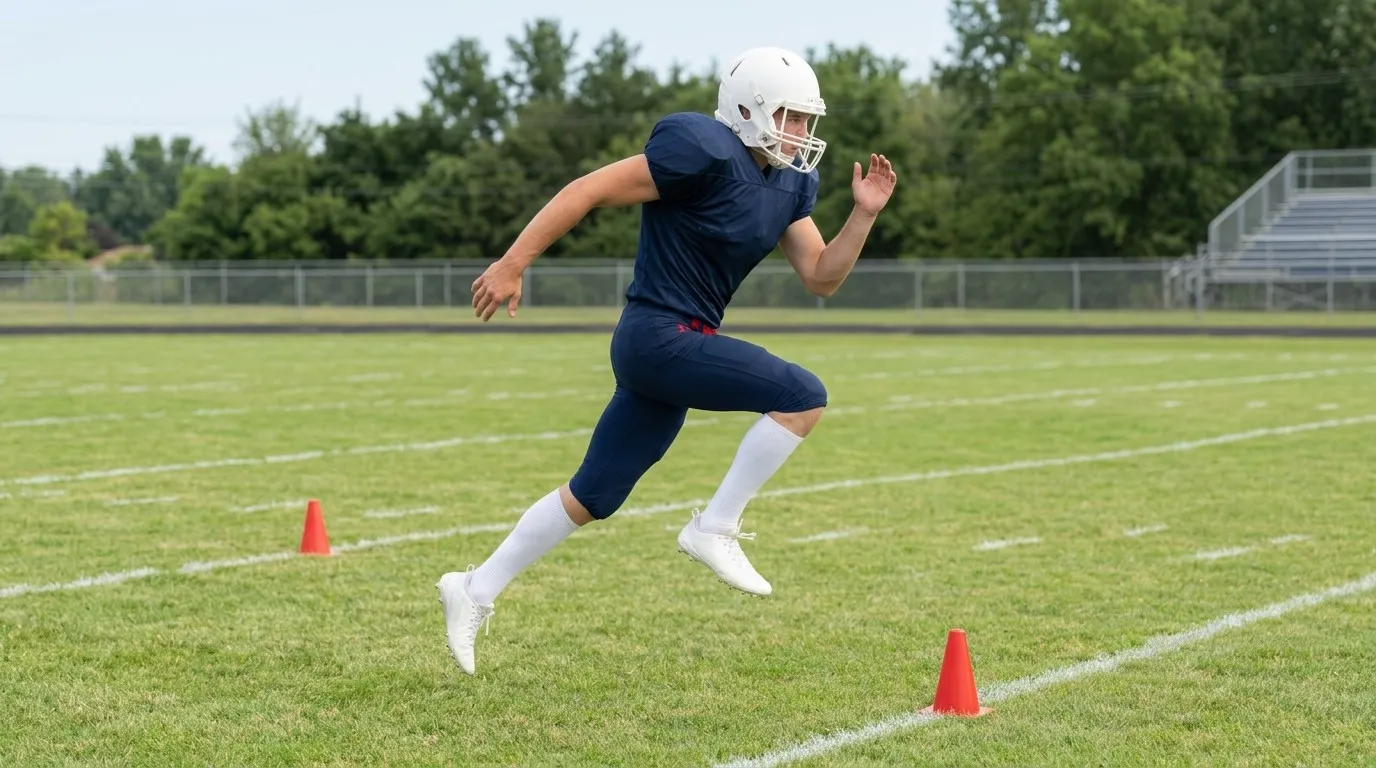
The Bounding Drill is a plyometric exercise that uses long, controlled steps to move forward. Each bound starts with a strong push from one leg, followed by knee drive and a controlled landing on the opposite leg.
For football players, bounding can help train horizontal force, leg coordination, and sprint-related movement. It works best as part of speed training rather than as a replacement for actual sprinting.
What Is the Bounding Drill?
The Bounding Drill looks like an exaggerated running motion. Instead of taking normal running steps, you push harder into the ground and travel farther with each step.
The legs alternate on every bound. If you push from your right leg, you move forward and land on your left. You then push from the left leg and continue the same pattern.
Bounding is a horizontal plyometric exercise. The goal is to move forward with force and control, not simply jump as high as possible.
This movement shares some features with sprinting, including alternating leg action, ground contact, knee drive, and forward force. However, bounding uses longer flight phases and more exaggerated steps than normal sprinting.
Bounding Drill Quick Setup
| Setup | Recommendation |
|---|---|
| Equipment | 2 cones |
| Space | Open grass or turf |
| Beginner distance | 10–15 yards |
| Players | 1 or more |
| Main focus | Horizontal force and coordination |
| Difficulty | Beginner to intermediate |
| Best time | After warm-up, before hard conditioning |
Place two cones in a straight line. Beginners can start with about 10 yards between them. Give yourself extra space after the finish cone so you do not have to stop suddenly.
Use a flat surface with good traction.
How to Perform the Bounding Drill
Follow these steps slowly when learning the movement.
- Start tall. Stand with your chest up, eyes forward, and arms relaxed.
- Move forward. Take a few light steps if needed to build a natural rhythm.
- Push through one leg. Apply force into the ground and move your body forward.
- Drive the opposite knee. Bring the free knee forward as you leave the ground.
- Use your arms. Drive the opposite arm forward, similar to natural sprinting.
- Land under control. Contact the ground on the opposite foot without reaching too far in front of your body.
- Push into the next bound. Continue forward without stopping between contacts.
- Alternate your legs. Keep the right-left-right-left pattern until you reach the finish cone.
Start with smaller bounds. Increase the distance only when you can keep good posture, rhythm, and landing control.

Key Coaching Cues
Use these simple cues:
- Push, do not reach.
- Drive the knee forward.
- Use strong but natural arm action.
- Keep your chest controlled.
- Move forward, not straight up.
- Keep each landing stable.
- Maintain a smooth right-left rhythm.
Coach’s Tip: Do not try to make every bound as long as possible. A shorter, controlled bound is better than a long step that causes you to lose balance. For more guidance on posture, arm drive, and foot contact, see our guide to sprint mechanics for football
Bounding Drill Reps, Sets and Rest
Bounding is an explosive drill. Quality matters more than doing a large number of repetitions.
| Level | Distance | Sets | Rest |
|---|---|---|---|
| New beginner | 8–10 yards | 2 | 60–90 sec |
| Beginner | 10–15 yards | 2–3 | 60–120 sec |
| Developing athlete | 15–20 yards | 2–3 | 90–120 sec |
Another option is to count individual bounds instead of distance. For example, a beginner can perform 6–8 controlled bounds per set.
These are starting guidelines, not fixed rules. Age, training experience, surface, and technique can change how much work is suitable.
Stop the set if your posture, landing, or rhythm starts to break down.
Benefits of Bounding for Football Players
The Bounding Drill can support several qualities used in football speed training:
- Builds horizontal force: Trains players to push into the ground and move the body forward with force. A 2026 systematic review found that horizontal multi-step jumps, including bounding, had their strongest relationship with sprint performance during the acceleration phase.
- Develops explosive leg action: Uses the hips, knees, and ankles together during each push-off.
- Improves coordination: Trains opposite arm and leg action similar to the pattern used during sprinting.
- Trains controlled ground contacts: Helps players land with control and move smoothly into the next bound.
- Supports sprint training: Reinforces forceful, coordinated movement that can complement acceleration and sprint practice.
Bounding should support actual sprint training, not replace it.
Common Bounding Drill Mistakes
| Mistake | What Happens | Simple Fix |
|---|---|---|
| Reaching too far forward | The foot lands too far ahead | Push behind you instead of reaching |
| Jumping too high | Too much movement goes upward | Focus on moving forward |
| Poor landing control | Balance is lost after contact | Use shorter bounds |
| Weak arm drive | Lower and upper body lose rhythm | Drive the opposite arm forward |
| Stiff movement | The drill becomes slow and forced | Relax and use a natural rhythm |
| Trying to cover maximum distance | Technique starts to break down | Focus on quality before distance |

Avoid Overstriding
Overstriding is one of the most common mistakes.
It happens when the athlete reaches the foot too far forward in an attempt to make the bound longer. This can create a braking action instead of helping the body continue forward.
Think about pushing the ground behind you, rather than reaching for more distance in front of you.
Beginner Bounding Drill Progression
Full bounding can be hard for a new athlete. Learn the movement in stages.
Stage 1: March With Knee Drive
Walk forward while lifting each knee with control.
Focus on tall posture and opposite arm action.

Stage 2: Power Skips
Add a stronger push from the ground while keeping the movement controlled. Practice the A-Skip Drill to develop knee drive, arm action, and coordination before moving to full bounds.
Power skips help prepare your body for the stronger push-off used during bounding.
Stage 3: Short Controlled Bounds
Begin alternating from one leg to the other.
Keep the bounds short. Focus on balance and smooth landings.
Stage 4: Full Bounding Drill
Gradually increase the forward distance of each bound.
Keep your knee drive, arm action, and posture consistent.
Stage 5: Bound-to-Sprint
Perform a short series of bounds and then transition into a controlled acceleration.
For example:
10 yards bounding → 10 yards acceleration
Do not rush into this stage. First make sure you can bound with good control.
Once you can transition smoothly from bounding into running, try these football acceleration drills to practice short, controlled sprints.
Bounding Drill Variations
Once the basic Bounding Drill feels comfortable, different variations can change the training focus.
Bounding for Distance
Try to cover more forward distance with each controlled bound.
Do not reach the foot far ahead just to increase distance. The extra distance should come mainly from a stronger push.
Speed Bounds
Use quicker alternating bounds with a stronger focus on rhythm and forward speed.
This version requires good coordination and should come after the athlete learns basic bounding technique.
Single-Leg Bounds
Perform repeated forward bounds using the same leg.
Single-leg bounding places greater demands on balance and control. It is more advanced than regular alternate-leg bounding and is not the best starting option for most beginners.
Bounding vs A-Skip
Bounding and the A-Skip are both used in sprint training, but they have different purposes.
| A-Skip | Bounding |
|---|---|
| Smaller movement | Larger forward movement |
| Strong rhythm focus | Strong force focus |
| Lower intensity | Higher intensity |
| Useful for learning sprint positions | Useful for horizontal plyometric work |
| Easier for most beginners | More demanding |
An A-Skip Drill can be a useful step before learning full bounding because it teaches rhythm, knee action, and opposite arm movement.
How to Use Bounding in Football Training
Bounding works best when the player is fresh.
A simple football speed session could follow this order:
Dynamic warm-up → A-Skips → Bounding Drill → Acceleration sprints
Performing bounding before hard conditioning helps the player focus on clean movement instead of fighting fatigue.
For beginners, bounding does not need to be included in every workout. Start with a small amount and watch how well the athlete controls each contact.
Bounding can also fit well before short acceleration work because both activities involve producing force while moving forward.
Bounding focuses on forward movement. For cutting, balance, and controlled changes of direction, explore our football agility drills
Does Bounding Help Improve Sprint Speed?
Bounding may support sprint performance by training horizontal force, coordination, and repeated ground contacts. These qualities are especially useful during acceleration.
A 2026 systematic review of 19 studies found that horizontal multi-step jumps had the strongest and most consistent links with sprint acceleration. Training studies also generally reported greater benefits for short-distance acceleration than for maximal-speed sprinting.
However, results are not always the same. A 2025 study of young female football players found no significant within-group sprint improvements after six weeks of bounding training. This suggests that bounding should support a wider speed program rather than replace sprint practice.
Research on young sprinters found improvements in 5-meter and 10-meter sprint performance after alternate-leg horizontal bounding. However, results can vary between athletes and different types of bounding.
For football players, bounding is best used as a supporting speed drill. Combine it with acceleration work and actual sprinting rather than using it as a replacement for sprint practice.
To practice running at higher speeds after a controlled build-up, learn the Flying Sprint Drill .
Bounding Drill Safety for Beginners
Bounding places more stress on the legs than simple running drills.
Warm up before you start. Use a flat surface with good traction. Begin with short, controlled bounds before trying to cover more distance.
Beginners should first be able to land with control and maintain good balance.
Stop the drill if you feel pain or if your landings become uncontrolled. Athletes returning from a lower-body injury should follow guidance from a qualified medical or sports professional before adding demanding plyometric drills.
Frequently Asked Questions
Is bounding a plyometric drill?
Yes. Bounding is a horizontal plyometric exercise. It uses repeated explosive pushes and landings while moving forward.
What muscles does the Bounding Drill work?
Bounding mainly uses the glutes, quadriceps, hamstrings, calves, and muscles around the hips. The core and upper body also help control posture and arm action.
How many bounds should a beginner do?
A beginner can start with about 6–8 controlled bounds per set or use a short distance such as 8–10 yards. Start with two sets and focus on technique.
How far should you bound?
Beginners do not need to chase maximum distance. Start with short, comfortable bounds. Increase the distance only when you can maintain good posture, rhythm, and landing control.
Is the Bounding Drill good for football players?
It can be useful within a football speed program. Bounding trains horizontal force, coordination, repeated ground contacts, and explosive leg action. It should be combined with actual sprinting and other football-specific movement drills.
Continue Learning
Continue Learning
Build better sprint technique with these beginner-friendly football drills. Start with basic movement skills, then move on to acceleration and faster running.
A-Skip Drill
Learn knee drive, arm action, and running rhythm before moving into more demanding sprint drills.
Learn the A-Skip →Sprint Mechanics for Football
Learn proper body position, foot contact, and arm movement to build better running technique.
Improve Your Technique →Football Acceleration Drills
Practice short sprints, controlled starts, and forward acceleration for football training.
Explore Acceleration Drills →Flying Sprint Drill
Learn how to build up speed, maintain fast running form, and slow down safely.
Learn the Flying Sprint →References
- Johansen, B., Neville, J., & van den Tillaar, R. (2025). Comparison of Training Effects of Bounding and Single Leg Jumps for Speed on Sprint and Jump Kinematics in Young Female Football Players. Journal of Functional Morphology and Kinesiology, 10(4), 468.
- Johansen, B., & van den Tillaar, R. (2026). Relationship and Training Effects of Horizontal Multi-Step Jumps on Sprint Performance: A Systematic Review. Journal of Functional Morphology and Kinesiology, 11(1), 95.
- Johansen, B., & van den Tillaar, R. (2026). Relationship and Training Effects of Horizontal Multi-Step Jumps on Sprint Performance: A Systematic Review. Journal of Functional Morphology and Kinesiology, 11(1), 95.
