



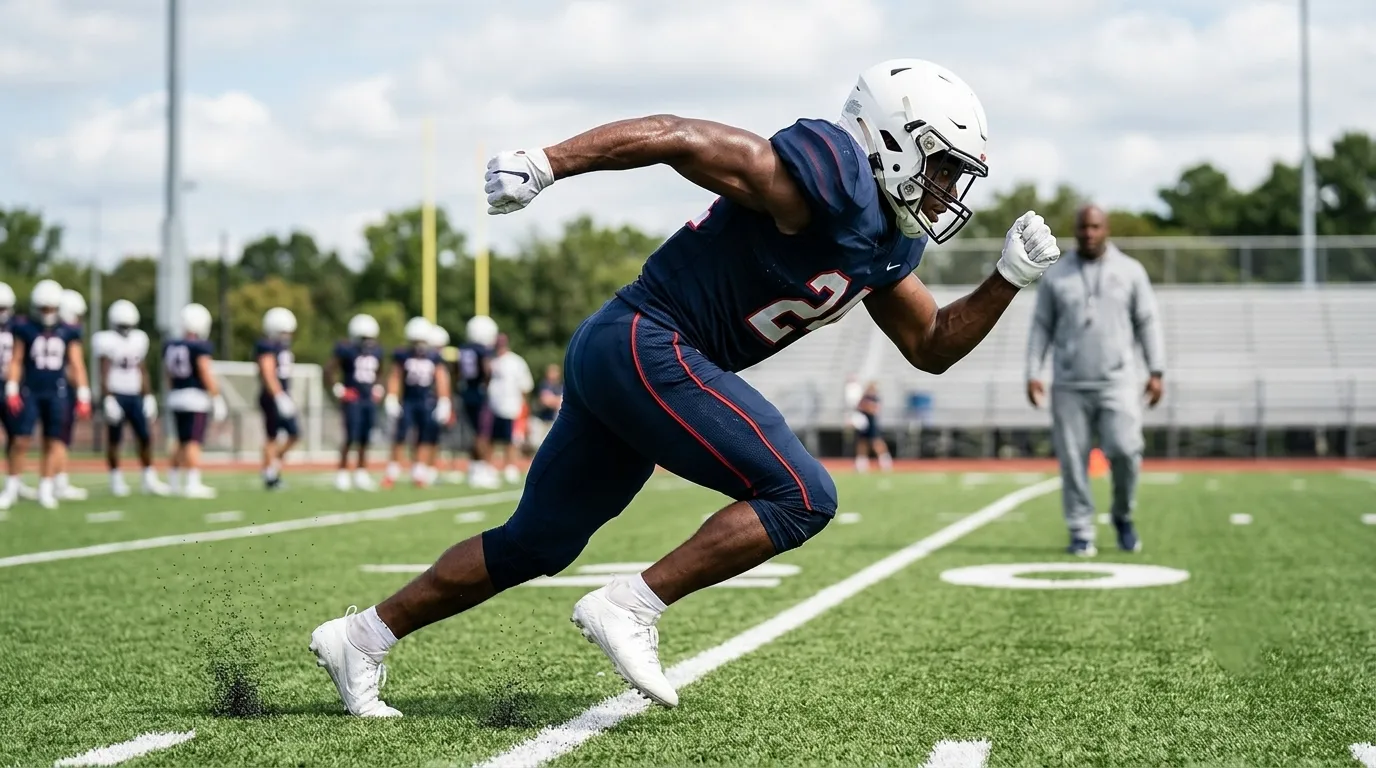
Football acceleration drills help players explode off the line, improve first-step quickness, and reach top speed faster over the first 5 to 10 yards. These drills focus on sprint mechanics, body position, arm drive, and force production to build faster starts for every position. Whether you are a beginner, youth player, or coach, adding acceleration drills to your weekly training can improve game performance and overall athletic movement.
Key Takeaways
- Football acceleration drills improve your first-step speed and explosive starts.
- The first 5 to 10 yards are more important than maximum sprint speed in most football plays.
- Good sprint mechanics, including forward lean, shin angle, and arm drive, help players accelerate more efficiently.
- Beginners should learn proper technique before adding resistance or advanced drills.
- Quarterbacks, running backs, wide receivers, linebackers, defensive backs, and linemen all benefit from acceleration training.
- Practicing acceleration drills two to three times per week is enough for most beginners.
- Consistent training, proper recovery, and gradual progress produce better long-term results.
What Are Football Acceleration Drills?
Football acceleration drills are exercises that help players reach speed quickly during the first few steps of a play. They focus on explosive starts, first-step quickness, and short-distance speed rather than maximum sprint speed.
In American football, acceleration matters because many plays happen over short distances. Running backs need to hit gaps fast, wide receivers need quick separation, defensive backs need to close space, and linebackers must react and move without delay. Better acceleration can help players gain an early advantage before a play fully develops.
These drills also improve body control, reaction time, and movement efficiency during football-specific situations. Beginners should first learn proper Sprint Mechanics for Football before progressing to resisted sprints, sled work, or reactive acceleration drills
A good football acceleration program should progress step by step. USA Football promotes structured athlete development, while NSCA training principles also support learning proper movement technique before increasing speed or resistance. This approach helps players build better habits and improve acceleration safely over time.
Acceleration vs Top Speed in Football
Many players think acceleration and top speed are the same, but they develop different parts of running performance. Acceleration is how quickly you build speed from a standing or slow position, while top speed is the fastest pace you can reach after building momentum.
In American football, acceleration is usually more valuable because most plays happen over the first 5 to 10 yards. A wide receiver needs a fast release off the line, a running back must reach the running lane quickly, and a defender has only a few steps to react before the play changes. Players rarely have enough distance to reach their maximum sprint speed during a game.

| Acceleration | Top Speed |
|---|---|
| Builds speed during the first 5–10 yards | Maximum running speed after accelerating |
| Starts from a still or slow position | Reached after building momentum |
| Most important for football | More important for long sprints |
| Focuses on explosive force | Focuses on maintaining speed |
| Uses a forward body lean | Uses a more upright sprint posture |
For most football players, improving acceleration should come before training maximum speed. Once you can explode off the line with good technique, it becomes easier to develop faster sprinting over longer distances.
Why Football Acceleration Matters

Every football play starts with movement. Players who can accelerate quickly often gain an advantage before their opponent has time to react. A faster first step can create more space, improve timing, and increase confidence during both practice and games.
Acceleration is valuable at every position on the field.
- Quarterbacks can escape pressure and extend plays.
- Running backs reach open gaps before they close.
- Wide receivers create separation at the beginning of routes.
- Tight ends get into their routes and blocks more quickly.
- Linebackers react faster to the run or pass.
- Defensive backs close space and recover more efficiently.
- Defensive linemen explode off the line to pressure the quarterback.
- Offensive linemen establish stronger blocking position immediately after the snap.
Acceleration training also improves reaction time, balance, coordination, and movement efficiency. Instead of taking wasted steps, players learn to move with purpose and apply force in the right direction. Over time, this leads to better football performance and more consistent movement under game pressure. These improvements become even more effective when combined with football agility drills and football footwork drills.
Sprint Mechanics Every Player Should Learn

Good acceleration starts with proper sprint mechanics. Before trying advanced acceleration drills, players should learn how to move efficiently during the first few steps of a sprint. Small technique improvements often produce better results than simply trying to run harder.
Focus on these four fundamentals:
- Forward Body Lean: Lean slightly forward from your ankles during the drive phase. This helps direct force forward instead of upward.
- Proper Shin Angle: Your front shin should point in the direction you want to accelerate. This creates a stronger push into the ground.
- Powerful Arm Drive: Drive your arms straight forward and backward to improve balance, rhythm, and stride frequency.
- Short, Powerful Steps: Push the ground away with quick, controlled steps instead of taking long strides too early.
Mastering these basics helps improve first-step quickness, horizontal force production, and overall acceleration.
Coach’s Tip: These acceleration drills become much more effective when your sprint technique is correct. If you want a complete guide to body position, arm action, knee drive, and sprint form, read our Sprint Mechanics for Football guide before progressing to advanced speed training.
Common Sprint Form Mistakes
Many players lose speed because of small technique errors rather than a lack of athletic ability. Correcting these mistakes can improve acceleration without changing your workout.
Watch for these common sprint form mistakes:
- Standing upright too early instead of staying low during the drive phase.
- Taking long first strides instead of short, explosive steps.
- Swinging the arms across the body instead of driving them forward and backward.
- Looking down instead of keeping your head in a neutral position.
- Skipping a proper dynamic warm-up before sprint training.
- Rushing through drills instead of focusing on clean technique.
Coach’s Tip: Build good movement habits first, then increase speed and intensity. According to USA Football and the NSCA, proper technique should always come before more advanced sprint training or resisted acceleration drills.

Quick Drill Selection
Not every player needs the same acceleration drill. Choose the drills that match your current goal, then build your training plan as your technique improves.
| If You Want To… | Best Drill |
|---|---|
| Learn proper acceleration mechanics | Wall Drill |
| Improve first-step quickness | Falling Starts |
| Build explosive starts | Three-Point Starts |
| Increase horizontal force | Resisted Band Sprint |
| Improve reaction speed | Ball Drop Sprint |
| Train from a football stance | Two-Point Starts |
| Develop game-like acceleration | Partner Chase Drill |
| Improve burst after the snap | Snap Reaction Sprint |
Coach’s Tip: If you’re new to acceleration training, start with the Wall Drill, Two-Point Starts, and Three-Point Starts. Once your technique becomes consistent, gradually add resisted and reactive drills.
Equipment Needed
Most football acceleration drills require only basic training equipment. Cones, a resistance band, a speed sled, a football, and an open practice area are enough for most beginner workouts. Players can also perform several drills using only body weight and proper sprint technique.
10 Best Football Acceleration Drills to Improve First-Step Speed
1. Two-Point Starts
Best For: Wide Receivers, Defensive Backs, Linebackers, Beginners
Primary Skill: Explosive first-step speed
Difficulty: Beginner
Equipment: Optional cones
Why It Works
The Two-Point Start develops explosive acceleration from an athletic football stance. It teaches players to produce force quickly, improve reaction after the snap, and stay low during the first few steps. This drill closely matches the starting position used by many football skill positions.
How to Perform
- Stand in an athletic stance with one foot slightly ahead of the other.
- Keep your knees bent and your weight balanced.
- Lean your body slightly forward.
- Explode forward on the coach’s signal.
- Sprint for 10 yards before slowing down under control.
Coach’s Tip: Drive your arms aggressively and keep your first three steps short and powerful.
Common Mistake: Standing upright immediately after starting, which reduces acceleration.
Recommended Reps: 5–6 quality sprints with full recovery between repetitions.
2. Three-Point Starts
Best For: Offensive Linemen, Defensive Linemen, Running Backs, Linebackers
Primary Skill: Explosive drive off the line
Difficulty: Intermediate
Equipment: None
Why It Works
The Three-Point Start teaches players how to generate explosive power from a football stance commonly used at the line of scrimmage. It improves first-step quickness, lower-body force production, and acceleration over the first 5 to 10 yards while reinforcing proper body position during the drive phase.
How to Perform
- Begin in a balanced three-point stance.
- Keep your hips slightly above your shoulders.
- Place most of your weight over your front leg.
- Explode forward on the start signal.
- Stay low and drive hard for the first 10 yards.
Coach’s Tip: Push the ground backward with every step instead of trying to stand upright too quickly.
Common Mistake: Popping up during the first two or three steps, which reduces forward momentum.
Recommended Reps: 4–6 repetitions with complete recovery between sprints.
3. Resisted Band Sprint
Best For: Running Backs, Wide Receivers, Linebackers, Defensive Backs
Primary Skill: Horizontal force production and explosive acceleration
Difficulty: Intermediate
Equipment: Resistance band and a training partner
Why It Works
The Resisted Band Sprint helps players generate more force during the drive phase while maintaining proper acceleration mechanics. The light resistance encourages powerful leg drive and stronger first steps without changing natural sprint movement. This drill is ideal for improving burst over the first 10 to 15 yards.
How to Perform
- Attach a resistance band around your waist.
- Have a partner stand behind you while holding the band.
- Lean slightly forward into an athletic position.
- Explode forward and sprint for 10–15 yards.
- Walk back and recover fully before repeating.
Coach’s Tip: Use light resistance so your sprint mechanics stay natural. If the resistance changes your running form, reduce the tension.
Once you can perform this drill with good technique, combine it with football speed and agility drills to develop more complete on-field movement.
Common Mistake: Using too much resistance, which shortens your stride and slows acceleration.
Recommended Reps: 4–6 sprints over 10–15 yards.
4. Sled Sprint
Best For: Running Backs, Linebackers, Defensive Linemen, Offensive Linemen
Primary Skill: Explosive power and first-step strength
Difficulty: Intermediate
Equipment: Speed sled with light weight
Why It Works
The Sled Sprint develops explosive lower-body strength while reinforcing proper body position during acceleration. Pulling a lightly loaded sled increases horizontal force production and helps players drive powerfully through the first few strides. It is widely used during football speed and strength training.
How to Perform
- Attach a speed sled using a waist harness.
- Choose a light weight that allows normal sprint mechanics.
- Start in an athletic stance.
- Drive forward aggressively for 10–20 yards.
- Rest completely before your next repetition.
Coach’s Tip: Stay low during the drive phase and push the ground behind you with every step.
Common Mistake: Loading the sled too heavily, which causes poor posture and slow movement.
Recommended Reps: 4–6 sprints over 10–20 yards.
5. Partner Chase Drill
Best For: Running Backs, Wide Receivers, Defensive Backs, Linebackers
Primary Skill: Reactive acceleration and closing speed
Difficulty: Intermediate
Equipment: Cones (optional)
Why It Works
Football players rarely sprint on a planned signal during a game. The Partner Chase Drill improves reaction time, first-step quickness, and competitive acceleration by forcing players to react to another athlete’s movement instead of anticipating the start.
Players who want to improve reaction speed even further should also practice the Reaction Ball Drill.
How to Perform
- Two players stand side by side in an athletic stance.
- One player becomes the leader while the other is the chaser.
- On the coach’s signal, the leader sprints forward for 10–15 yards.
- The chaser reacts immediately and tries to catch the leader before the finish line.
- Switch roles after each repetition.
Coach’s Tip: React to your partner’s movement instead of guessing the start. A quick reaction is more valuable than taking a false first step.
Common Mistake: Anticipating the start instead of reacting to movement.
Recommended Reps: 4–6 repetitions for each player.
6. Ball Drop Sprint
Best For: Wide Receivers, Defensive Backs, Linebackers
Primary Skill: Reaction speed and explosive first-step acceleration
Difficulty: Intermediate
Equipment: Football or tennis ball
Why It Works
The Ball Drop Sprint trains players to react instantly to a visual cue. Instead of starting on a countdown, athletes must recognize the falling ball and accelerate immediately. This improves reaction time and game-like decision-making.
How to Perform
- Stand in an athletic stance facing a partner.
- The partner holds a football or tennis ball at shoulder height.
- Sprint as soon as the ball is released.
- Catch the ball before it reaches the ground if possible.
- Return to the starting position and repeat.
Coach’s Tip: Keep your eyes on the ball while staying relaxed before the release.
Common Mistake: Leaning forward too early and losing balance before the ball drops.
Recommended Reps: 5–8 repetitions with full recovery.
7. Mirror Reaction Sprint
Best For: Defensive Backs, Linebackers, Running Backs
Primary Skill: Lateral reaction and explosive acceleration
Difficulty: Advanced Beginner
Equipment: Cones (optional)
Why It Works
The Mirror Reaction Sprint improves the ability to react, change direction, and accelerate under control. Players must read another athlete’s movement before exploding into a sprint, making this drill useful for football situations that require quick decisions.
How to Perform
- Two players stand facing each other about three yards apart.
- One player becomes the leader.
- The leader makes quick lateral movements for 3–5 seconds.
- On the coach’s signal, both players sprint forward for 10 yards.
- Switch leader and follower after each repetition.
Coach’s Tip: Stay balanced during the mirror phase so you can accelerate immediately when the sprint begins.
Common Mistake: Crossing your feet while shuffling, which slows your reaction and acceleration.
Recommended Reps: 4–6 repetitions for each player.
8. Reactive Gate Sprint
Best For: Wide Receivers, Defensive Backs, Running Backs
Primary Skill: Decision-making and explosive acceleration
Difficulty: Intermediate
Equipment: 4–6 cones
Why It Works
The Reactive Gate Sprint teaches players to recognize a visual signal before accelerating. Instead of knowing the running direction in advance, athletes must react quickly and explode through the correct gate. This drill improves reaction time, first-step speed, and game awareness.
How to Perform
- Set up four cones to create two sprint gates about 10 yards away.
- Stand in an athletic stance facing the gates.
- A coach points to the left or right gate at the start.
- React immediately and sprint through the selected gate.
- Walk back and repeat.
Coach’s Tip: Keep your weight balanced before the signal so you can change direction without wasting your first step.
Common Mistake: Guessing the direction before the coach gives the signal.
Recommended Reps: 5–8 repetitions.
9. Position Release Sprint
Best For: Wide Receivers, Running Backs, Defensive Backs
Primary Skill: Game-specific acceleration
Difficulty: Intermediate
Equipment: Football field markers or cones
Why It Works
The Position Release Sprint simulates the explosive movement players use immediately after the snap. Instead of performing a straight sprint, athletes accelerate from the same stance and movement pattern used during games. This improves football-specific speed while reinforcing proper acceleration mechanics.
How to Perform
- Begin in the stance used for your position.
- React to the coach’s signal.
- Accelerate for 10–15 yards using game-like movement.
- Slow down under control before returning to the start.
- Repeat while maintaining good technique.
Coach’s Tip: Match the movement to your position. For example, wide receivers should focus on a quick release, while running backs should explode through an imaginary running lane.
Common Mistake: Practicing every repetition with the same start instead of using position-specific movement.
Recommended Reps: 5–6 repetitions.
10. Snap Reaction Sprint
Best For: All Football Positions
Primary Skill: First-step reaction after the snap
Difficulty: Intermediate
Equipment: Football or whistle
Why It Works
The Snap Reaction Sprint develops one of the most important football skills reacting instantly to the snap. Players learn to recognize an external signal, explode off the line, and accelerate without hesitation. This drill combines reaction time, sprint mechanics, and explosive first-step speed in one movement. This drill works well as part of a complete football drills for beginners program.
How to Perform
- Start in your normal football stance.
- Use a football snap, whistle, or verbal command as the start signal.
- React immediately and sprint for 10–15 yards.
- Stay low during the drive phase before gradually rising into a sprint.
- Recover fully before repeating.
Coach’s Tip: Focus on reacting to the signal instead of anticipating it. Consistent reaction time is more valuable than guessing the start.
Common Mistake: Leaving early or taking a false first step before the signal.
Recommended Reps: 5–8 quality sprints with full recovery.
Which Football Acceleration Drill Should You Choose?
Beginners should first build good sprint mechanics before progressing to drills that use resistance or reaction. As your technique improves, you can combine different drills to develop explosive first-step speed and game-like acceleration.
| Training Goal | Best Drill |
|---|---|
| Learn acceleration mechanics | Wall Drill |
| Improve first-step quickness | Two-Point Starts |
| Explode off the line | Three-Point Starts |
| Build lower-body power | Sled Sprint |
| Increase horizontal force | Resisted Band Sprint |
| Improve reaction speed | Ball Drop Sprint |
| Train for game situations | Position Release Sprint |
| Improve snap reaction | Snap Reaction Sprint |
Football acceleration drills should be performed near the beginning of your workout after a dynamic warm-up, when your muscles are fresh. Most beginners should train acceleration two or three times each week and allow full recovery between sprints to maintain proper technique.
How to Measure Your Acceleration Progress
Tracking your progress helps you see whether your training is working. Instead of relying on how fast you feel, measure your improvement using simple football tests.
- 5-Yard Sprint: Measures first-step explosion and short-distance acceleration.
- 10-Yard Sprint: Shows how quickly you build speed after the start.
- Reaction Time: Record how quickly you respond to a snap, whistle, or visual signal.
- Video Review: Record your sprint to check body position, first-step length, and posture.
- Training Log: Write down your sprint times, drill repetitions, and weekly progress.
Check your performance every two to four weeks under the same conditions for the most accurate results.
Safety Tip: Always perform a dynamic warm-up before acceleration training and stop the session if your sprint technique starts to break down. Quality repetitions are more valuable than extra sprints performed with poor form.
Frequently Asked Questions
What are football acceleration drills?
Football acceleration drills are exercises that improve explosive starts, first-step quickness, and short-distance speed. They help players accelerate faster during the first 5 to 10 yards of a play.
How often should I practice football acceleration drills?
Most beginners should perform acceleration drills two or three times per week. Allow at least one day of recovery between speed sessions to maintain good sprint quality.
Which football acceleration drill is best for beginners?
The Wall Drill and Two-Point Starts are excellent beginner drills because they teach proper body position and first-step mechanics before progressing to more advanced exercises.
Are sled sprints better than hill sprints?
Both drills are effective. Sled sprints improve horizontal force production, while hill sprints naturally encourage a powerful forward lean and strong leg drive. Many players benefit from using both during different training sessions.
Can youth football players perform acceleration drills?
Yes. Youth players should begin with simple technique-based drills such as the Wall Drill and Two-Point Starts before progressing to resisted or reactive drills under proper coaching.
How long does it take to improve acceleration?
With consistent practice, many players notice better sprint mechanics and quicker starts within four to six weeks, although progress depends on training quality, recovery, and experience.
Do acceleration drills improve overall football speed?
Yes. Better acceleration helps players reach higher speed more quickly, making them more effective during short football plays where explosive movement is most important.
Should acceleration drills be done before or after practice?
Acceleration drills are best performed near the beginning of a workout, after a proper dynamic warm-up, when your body is fresh and able to produce maximum effort.
Conclusion
Football acceleration drills help players develop explosive first-step speed, better sprint mechanics, and more efficient movement during game situations. Whether you are a beginner, youth athlete, or coach, practicing the right drills consistently can improve your acceleration over the first 5 to 10 yards, where many football plays are won.
Start with the basic drills, master proper technique, and gradually progress to resisted and reactive exercises. Track your progress regularly, recover between sessions, and focus on quality instead of quantity. With patience and consistent practice, you can build faster starts and become a more explosive football player on the field.
References
USA Football. Football Development Model: How It Works.
National Strength and Conditioning Association (NSCA). The Need for Speed: Improving Sprinting Performance in Football Players.
