



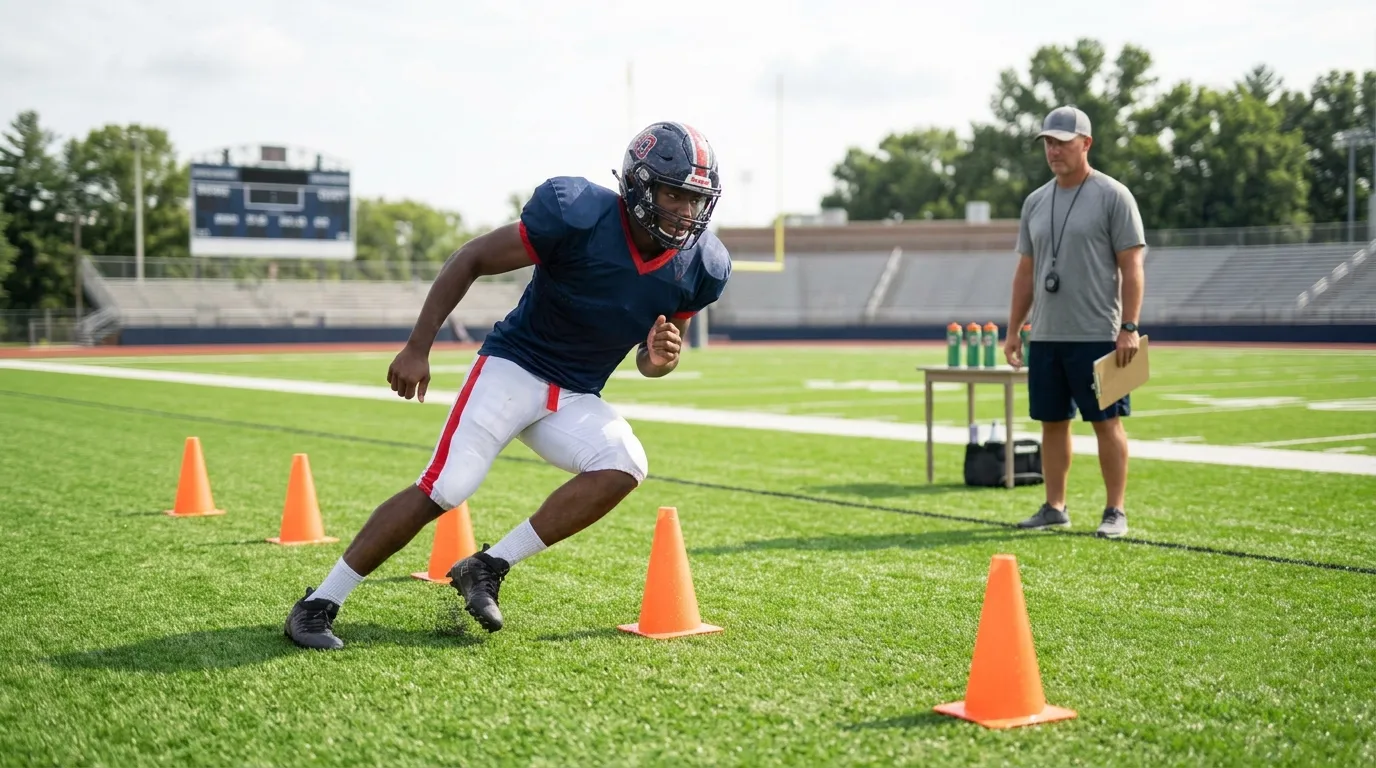
The Zig Zag Drill is a simple football agility drill that teaches players how to slow down, change direction, and accelerate toward the next cone with control. Players move through a staggered cone pattern, making a series of angled cuts while maintaining balance and good body position.
For beginners, the goal is not to race through the cones as fast as possible. The focus is on controlled footwork, clean cuts, and accelerating out of each direction change. These movement skills can help running backs, wide receivers, defensive backs, and other football players move more efficiently on the field.
Quick Takeaways
| Item | Quick answer |
|---|---|
| Main goal | Planned change of direction and acceleration |
| Equipment | 6 cones |
| Beginner spacing | About 4–6 yards |
| Key technique | Decelerate, plant outside foot, cut, accelerate |
| Intensity | Controlled-fast before all-out speed |
| Best for | WRs, RBs, DBs and beginner football players |
What Is the Zig Zag Drill?
The Zig Zag Drill is a football agility drill that uses cones arranged in an alternating pattern. Players move diagonally from one cone to the next, control their speed before each turn, plant the outside foot, change direction, and accelerate toward the next cone.
Unlike straight-line sprint drills, the Zig Zag Drill trains players to redirect their movement while maintaining balance and body control. This movement pattern is useful in football, where players often need to slow down, cut, and accelerate again during a play.
For beginners, the focus should be on clean movement rather than maximum speed. Running backs and wide receivers can use the drill to practise sharper cuts, while linebackers and defensive backs can work on controlled changes of direction and pursuit movement. Once the technique becomes consistent, players can gradually perform the drill at a faster pace.
Quick Answer: The Zig Zag Drill is a football agility drill that develops change of direction, footwork, balance, and body control through a series of controlled cuts around cones.
Benefits of the Zig Zag Drill
- Improves change of direction: Players practice controlling their approach, making a clean cut, and redirecting toward the next cone.
- Develops quick footwork and coordination: Short, controlled steps help players move more efficiently through each direction change.
- Builds balance and body control: Lowering the hips and maintaining a stable athletic position helps players stay balanced while cutting.
- Trains deceleration and re-acceleration: Players learn to control their speed before a cut and accelerate again after changing direction.
- Develops sharper cutting technique: Repeated angled cuts help players practise planting, redirecting, and moving out of each turn without rounding the cone.
- Supports football-specific movement: The drill can help players practise movement patterns used during route breaks, open-field cuts, pursuit, and coverage.
Which Version of the Zig Zag Drill Is This?
This guide uses a beginner football Zig Zag Drill with six cones arranged in an alternating staggered pattern. Players approach each cone at an angle, control their speed, plant and cut, then accelerate toward the next cone. Other coaching versions may use different spacing, cone numbers, or defensive movements.
Equipment Needed
One reason coaches like the Zig Zag Drill is that it requires very little equipment.
| Equipment | Purpose |
|---|---|
| Training cones | Create the zig-zag running pattern |
| Football cleats | Provide grip during direction changes |
| Flat practice area | Gives players a safe training surface |
| Stopwatch (optional) | Track improvement over time |
| Football (optional) | Add difficulty for advanced variations |
If you are practising at home, you can replace cones with small markers, water bottles, or other safe objects that are easy to see.
Before starting the drill, check that the training surface is flat and free from holes or slippery areas. A safe practice area allows players to focus on movement quality instead of worrying about losing their footing.
How to Set Up the Zig Zag Drill

How to Set Up the Zig Zag Drill
For this beginner version, use six cones arranged in a clear alternating zig-zag pattern.
- Place the first cone at the starting point.
- Place the second cone 4–6 yards ahead and to one side.
- Place the third cone 4–6 yards ahead and to the opposite side.
- Continue alternating left and right until all six cones form a clear zig-zag path.
- Aim for an approach angle of about 45 degrees between cones rather than placing them in a straight line.
- Leave a few yards of open space beyond the sixth cone so the player can accelerate through the finish instead of stopping suddenly.
Keep the spacing consistent when first learning the drill. Players should have enough room to accelerate between cones while still needing to slow down and make a controlled direction change.
Beginner Tip: Walk through the cone pattern once before increasing speed. Focus on learning the route and making controlled cuts before performing faster repetitions.
Who Should Use the Zig Zag Drill?
Quick Answer:
The Zig Zag Drill is best for beginner, youth, and experienced football players who want to improve agility, footwork, balance, and change-of-direction skills. It benefits nearly every position, including quarterbacks, running backs, wide receivers, linebackers, and defensive backs.
How to Perform the Zig Zag Drill

How to Perform the Zig Zag Drill
Once the six cones are set, focus on controlled movement rather than trying to complete the drill as fast as possible.
1. Start in an Athletic Stance
Stand just before the first cone with your feet about shoulder-width apart. Bend your knees slightly, keep your hips controlled, and look toward the first target cone.
2. Accelerate Toward the First Cone
Push off and accelerate diagonally toward the first target cone. Use natural arm action and stay balanced as you approach the direction change.
3. Decelerate Before the Cut
Begin slowing down before reaching the cone instead of waiting until the final step. Use shorter, controlled steps and lower your hips so your body is prepared to change direction. The NSCA uses a similar approach in its Run and Cut drill, where the athlete decelerates before the cut and then immediately accelerates in the new direction.
4. Plant and Change Direction
Plant the outside foot close to the cone with the knee slightly bent. Keep your body under control and redirect toward the next cone without making a wide, rounded turn.
5. Accelerate Out of the Cut
Push away from the planted foot and take quick steps toward the next cone. Let your arms drive naturally as you regain speed in the new direction.
6. Repeat and Finish
Repeat the same pattern at each cone: approach, decelerate, plant, redirect, and accelerate. After changing direction at the sixth cone, continue accelerating for a few yards through the finish instead of stopping immediately.
Coach’s Tip: Do not attack each cone at a speed you cannot control. Clean cuts and good body position come first. Increase your pace only when you can repeat the movement with consistent technique.
Coaching Tips
Use these coaching cues to improve your technique and get better results.
- Stay low throughout the drill.
- Keep your eyes forward instead of looking at the cones.
- Take short, quick steps between each cone.
- Plant your outside foot for stronger direction changes.
- Use your arms to maintain balance and generate power.
- Accelerate after every cut instead of slowing down.
- Prioritize smooth movement before maximum speed.
Common Mistakes to Avoid
Avoid these mistakes to perform the drill safely and effectively.
- Standing too upright while changing direction.
- Looking down at the cones instead of ahead.
- Taking long steps that reduce control.
- Crossing your feet during cuts.
- Rounding the cones instead of making sharp turns.
- Sacrificing technique to finish faster.
Coach’s Tip: Slow down if your technique starts to break. Proper movement is more important than speed.
Recommended Zig Zag Drill Reps, Sets & Rest
| Level | Reps | Sets | Rest | Intensity |
|---|---|---|---|---|
| Beginner | 3–4 quality runs | 2 | Full recovery | Controlled |
| Developing | 4–5 | 2–3 | Enough to maintain technique | Fast |
| Reactive | 3–5 | 2 | Full recovery | Cue-based |
When learning the drill, use a controlled pace before progressing to full-speed repetitions. The NSCA recommends performing new agility drills at slower speeds until the athlete has developed consistent technique.
Zig Zag Drill Variations
Once you master the basic drill, try these variations to increase the challenge.
Beginner Zig Zag
Jog through the cones to learn proper foot placement and balance.
Sprint Zig Zag
Complete the drill at a faster pace while maintaining good technique.
Ball Carry Zig Zag
Carry a football while weaving through the cones to improve ball security and coordination.
Reactive Zig Zag
Have a coach call out the next direction or use a visual cue to improve reaction speed and decision-making. Once players can perform the basic pattern with good control, the drill can progress to a reactive version using simple visual or verbal cues. The NSCA recommends progressing basic change-of-direction drills toward more unpredictable, reactive tasks after athletes develop proficiency.
Ready for a bigger challenge? Try the 5-10-5 Shuttle Drill or L Drill to develop faster change of direction.
When Should You Add the Zig Zag Drill to Your Workout?
The Zig Zag Drill is best performed after a dynamic warm-up and before strength training or conditioning. Practising it while you are fresh helps improve footwork, agility, balance, and change-of-direction technique with better control and movement quality.
Best Football Positions for the Zig Zag Drill
Although every player can benefit from this drill, it is especially useful for positions that rely on quick footwork and fast direction changes.
| Position | How the Drill Helps |
|---|---|
| Quarterback | Improves pocket movement and footwork. |
| Running Back | Develops quicker cuts and better open-field movement. |
| Wide Receiver | Builds sharper route running and body control. |
| Tight End | Improves balance when changing direction. |
| Linebacker | Enhances pursuit angles and lateral movement. |
| Defensive Back | Develops faster reactions and coverage footwork. |
Explore more position-specific training in our Football Drills for Beginners guide.
Football Speed and Agility Drills
Build faster footwork, acceleration, and better change-of-direction skills.
Read More →Football Footwork Drills
Improve balance, coordination, and quick feet with beginner-friendly drills.
Read More →Cone Drills for Football
Practice more cone drills to improve agility, body control, and movement.
Read More →5-10-5 Shuttle Drill
Develop explosive acceleration, deceleration, and lateral quickness.
Read More →L Drill (3 Cone Drill)
Build sharper cuts, balance, and change-of-direction for game situations.
Read More →Ladder Drill
Increase foot speed, coordination, and lower-body control with ladder drills.
Read More →Frequently Asked Questions
Is the Zig Zag Drill good for beginners?
Yes. The Zig Zag Drill is one of the best agility drills for beginners because it is easy to learn and requires only a few cones. Start at a controlled pace and focus on proper technique before increasing your speed.
Does the Zig Zag Drill improve speed?
Not directly. The Zig Zag Drill mainly improves agility, footwork, balance, and change of direction. For better straight-line speed, combine it with Acceleration Drills and sprint training.
How many cones do I need for the Zig Zag Drill?
Most beginners only need 5 to 8 cones. Place them 4–6 yards (3.5–5.5 metres) apart in a zig-zag pattern to create enough space for controlled direction changes.
How many sets and repetitions should beginners do?
Start with 3–5 sets and complete the drill 2–3 times per set. Rest for 30–60 seconds between sets and focus on clean, controlled movements.
How often should I practise the Zig Zag Drill?
Practice the drill 2–3 times per week as part of your football speed and agility training. This gives your body enough time to recover while improving footwork and movement efficiency.
What is the biggest mistake beginners make?
The most common mistake is trying to move too fast too soon. Many beginners take long steps or stand too upright, which reduces balance and makes direction changes slower. Focus on staying low, planting your outside foot, and making controlled cuts before increasing your speed.
Which drill should I learn after the Zig Zag Drill?
Once you can perform the Zig Zag Drill with good technique, progress to more advanced agility drills such as the 5-10-5 Shuttle Drill, L Drill, or T Drill. These drills build faster change of direction, acceleration, and game-ready movement.
Can I practice the Zig Zag Drill at home?
Yes. You only need a flat, open space and a few cones or markers. Many players practise this drill in a backyard, driveway, or park to improve footwork and change of direction. Keep the area safe and free of obstacles before starting.
References
- National Strength and Conditioning Association (NSCA). Run and Cut. Kinetic Select, October 2021. NSCA – Run and Cut
- National Strength and Conditioning Association (NSCA). Intensity and Volume by Drill Type. Kinetic Select, June 2017. NSCA – Intensity and Volume by Drill Type
- National Strength and Conditioning Association (NSCA). Change of Direction Speed Drill Adaptation. NSCA – Change of Direction Speed Drill Adaptation
