



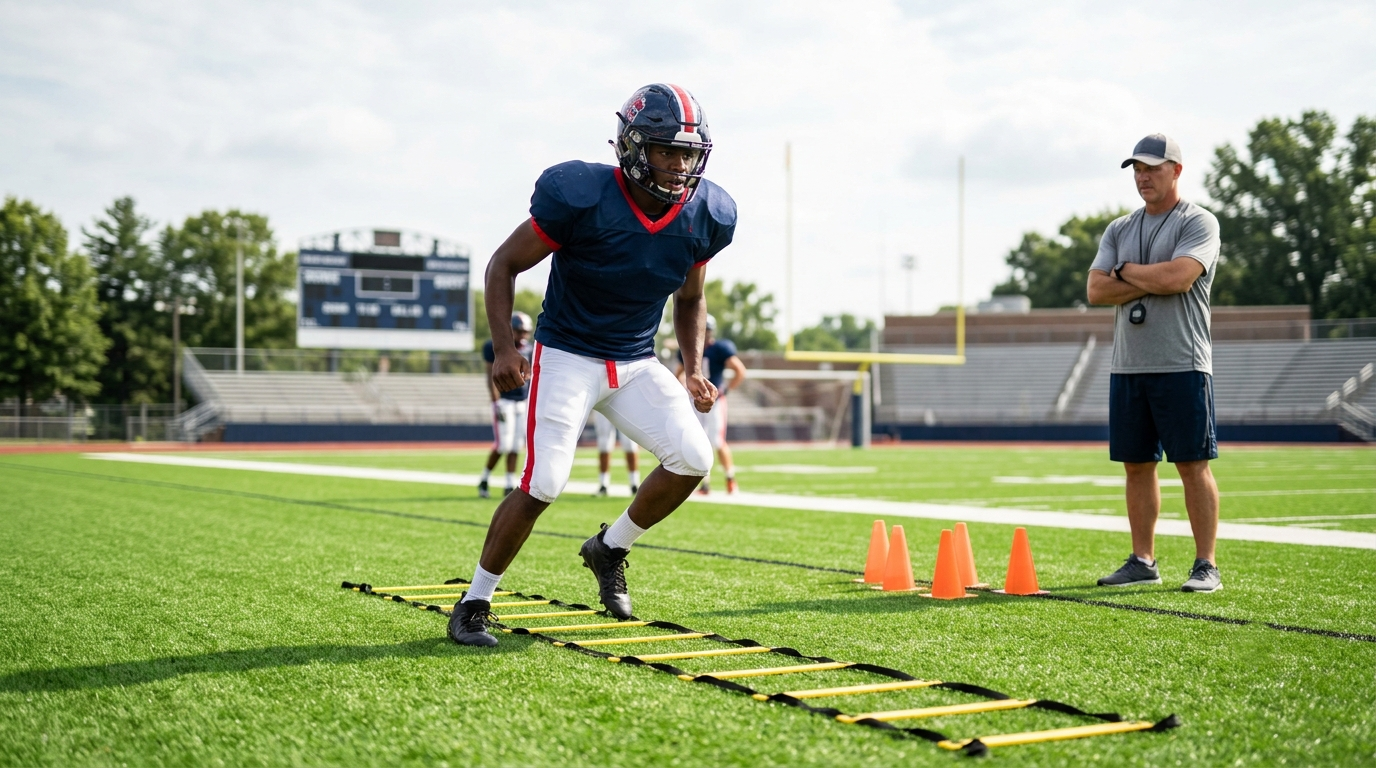
A ladder drill is one of the best football footwork exercises for beginners. It helps improve quick feet, coordination, balance, and body control. While it won’t directly increase your top sprint speed, it builds the movement skills needed for better agility and faster changes of direction on the football field. For even better results, combine ladder drills with Football Footwork Drills, Football Agility Drills, and Acceleration Drills.
In this guide, you’ll learn the benefits of ladder drills, how to perform them correctly, beginner-friendly variations, and coaching tips to improve your footwork safely.
Quick Takeaways
| Category | Details |
|---|---|
| Best For | Improving foot speed, agility, coordination, and quick feet |
| Skill Level | Beginner to Advanced |
| Equipment | Agility ladder (speed ladder) |
| Setup | Place the agility ladder on a flat surface with enough space to start and finish each repetition safely. |
| Duration | 10–15 minutes |
| Reps | 2–3 rounds for each drill variation |
| Rest | 30–60 seconds between rounds |
| Works Best With | Sprint drills, cone drills, acceleration drills, and football footwork training |
What Is a Ladder Drill?
A ladder drill is a footwork exercise performed on an agility ladder, also called a speed ladder. Players move through the ladder using different foot patterns to improve quick feet, coordination, balance, and body control.
Unlike sprint training, ladder drills are not designed to increase your top running speed. Instead, they improve movement efficiency, helping you take quicker, more controlled steps while staying balanced in an athletic stance.
Football players constantly sprint, stop, cut, shuffle, backpedal, and change direction. Ladder drills help develop the footwork needed to perform these movements with better control and confidence.
A well-executed ladder drill improves:
- Quick feet
- Coordination
- Balance
- Rhythm
- Body control
- First-step quickness
- Movement efficiency
- Neuromuscular coordination
Modern coaches recommend mastering technique before speed. Focus on smooth, controlled movement first, then gradually increase your pace as your footwork improves.
For the best results, combine ladder drills with sprint training, acceleration drills, change-of-direction exercises, and strength training as part of a complete football workout.
Coach’s Tip: Stay on the balls of your feet, keep your eyes forward, and focus on clean technique before increasing speed.
Benefits of Ladder Drills
A ladder drill helps football players build the movement skills needed for better performance on the field. Key benefits include:
- Improves foot speed by training your feet to move quickly and efficiently.
- Develops agility for faster changes of direction during play.
- Builds coordination by improving the connection between your feet and body movements.
- Enhances balance so you stay stable while cutting, shuffling, and accelerating.
- Increases body control for smoother and more controlled movement.
- Improves first-step quickness to help you react faster at the snap.
- Develops rhythm and timing for cleaner, more consistent footwork.
- Supports better athletic posture by encouraging proper movement mechanics.
- Boosts neuromuscular coordination to improve reaction time and movement efficiency.
- Prepares players for football-specific movements such as sprinting, backpedaling, lateral shuffling, and changing direction.
Note: Ladder drills improve footwork and movement quality, but they work best as part of a complete training program. Pair them with Football Warm-Up Drills Before Practice and regular strength training to improve overall football performance.
Who Can Benefit from Ladder Drills?
A ladder drill helps every football player improve footwork, coordination, and movement control. Each position uses these skills in different ways during practice and games.
- Quarterbacks: Improve foot placement during dropbacks and pocket movement. Pair ladder drills with Quarterback Football Drills to improve passing footwork.
- Running Backs: Build quicker feet for sharper cuts and better balance. Combine them with Running Back Drills for better vision and change of direction.
- Wide Receivers: Develop faster releases and smoother route running. Practice Wide Receiver Drills to improve catching and route execution.
- Defensive Backs: Improve lateral movement, backpedaling, and quick transitions.
- Linebackers: Move faster in all directions while staying balanced.
- Offensive and Defensive Linemen: Improve foot speed, body control, and balance before engaging opponents.
Equipment Needed
One of the best things about a ladder drill is that it requires very little equipment. Place the ladder on a flat surface where it won’t slide. A stable setup helps you focus on proper footwork and reduces the risk of slipping.
You’ll need:
- Agility ladder (speed ladder) – The main training tool.
- Flat training surface – Grass, artificial turf, or a gym floor works well.
- Football cleats or athletic training shoes – Wear shoes that provide good grip for the surface.
- Training cones (optional) – Useful if you want to combine ladder drills with acceleration or agility exercises.
- Water bottle – Stay hydrated during longer training sessions.
Choosing the Right Agility Ladder
Most beginners do well with an agility ladder that is 15–20 feet long and has evenly spaced rungs. This gives enough room to perform several footwork patterns without needing extra equipment.
If you don’t own a ladder, you can create one using athletic tape, chalk, or even draw boxes on the ground. You can also practice similar footwork with our Football Drills Without Equipment. While a real agility ladder is more convenient, the movement pattern is what matters most.
Coach’s Tip: Place the ladder on a flat surface where it won’t slide. A stable ladder helps you focus on footwork instead of worrying about your footing
How to Set Up the Ladder Drill

- Place the agility ladder flat on a level, non-slip surface.
- Leave enough space at both ends of the ladder to start, finish, and slow down safely.
- Stand at one end in an athletic stance with your knees slightly bent and eyes forward.
- Make sure the ladder lies flat and the surrounding area is clear of obstacles.
Coach’s Tip: Secure the ladder so it doesn’t slide or twist during the drill. Good setup helps you focus on clean footwork and reduces the risk of tripping.
2026 Training Tip: Many football coaches now encourage players to record a few ladder drill repetitions on a smartphone. Watching your foot placement, posture, and rhythm can help you spot mistakes and improve your technique faster.
How to Perform the Ladder Drill

A ladder drill is most effective when you focus on control before speed. Move through each square with quick, light steps while staying balanced. Once your technique feels natural, gradually increase your pace.
Follow these steps to perform a basic ladder drill correctly.
Step 1: Start in an Athletic Stance
Stand at one end of the agility ladder with your feet shoulder-width apart. Bend your knees slightly, keep your chest up, and place your weight on the balls of your feet.
Step 2: Keep Your Eyes Forward
Look ahead instead of watching your feet. This helps improve body awareness and prepares you for game-like movement.
Step 3: Move Through the Ladder
Step into each square using the chosen footwork pattern. Keep your steps short, quick, and controlled. Avoid jumping too high or taking long strides.
Step 4: Use Your Arms
Pump your arms naturally to stay balanced and create better rhythm. Your arms should work with your legs, just like they do when you sprint.
Step 5: Finish Under Control
Run through the last square and slow down gradually. Turn around, reset your position, and repeat the drill.
| Exercise | Reps |
|---|---|
| One Foot In | 2–3 rounds |
| Two Feet In | 2–3 rounds |
| Ickey Shuffle | 2 rounds |
| Lateral Shuffle | 2 rounds |
| Carioca | 2 rounds |
Rest for 30–60 seconds between rounds to maintain good technique.
Coach’s Tip: Aim for light, quiet foot contacts. If your feet are making loud slapping sounds, slow down and focus on softer, more controlled movement.
Best Ladder Drill Variations for Beginners

Learning different ladder patterns keeps your training challenging and develops a wider range of football movement skills. Start with the easiest drills and master each one before moving to a more advanced variation.
1. One-In Drill
- Best for: Quick feet
- One foot lands in each square while moving forward.
- Improves:
- Foot speed
- Coordination
2. Two-In Drill
- Best for: Footwork and balance
- Place both feet in every square before moving to the next.
- Improves:
- Coordination
- Balance
3. Lateral In-Out Drill
- Best for: Lateral movement
- Move sideways through the ladder, stepping both feet in and out of each square.
- Improves:
- Agility
- Body control
4. Ickey Shuffle
- Best for: Change of direction and body control
- Step one foot into the square, bring the other foot in, then step one foot outside the ladder. Repeat on the opposite side.
- Improves:
- Agility
- Lateral movement
- Rhythm
5. Lateral Shuffle
Best for: Defensive movement
Shuffle sideways through the ladder without crossing your feet. Stay low in an athletic stance.
Improves:
- Lateral quickness
- Defensive footwork
- Balance
6. Carioca
Best for: Hip mobility and coordination
Move sideways through the ladder, crossing one foot in front of and then behind the other.
Improves:
- Hip mobility
- Coordination
- Body control
Beginner Tip: Master one variation before learning the next. Good technique is more important than speed or completing many drills.
Coaching Tips
- Stay on the balls of your feet.
- Keep your eyes forward.
- Take short, quick steps.
- Pump your arms naturally.
- Keep your hips level.
- Maintain a steady rhythm.
Common Ladder Drill Mistakes

- Looking down at your feet instead of keeping your eyes forward.
- Rushing through the drill before mastering proper technique.
- Taking heavy steps instead of staying light on the balls of your feet.
- Standing too upright rather than maintaining an athletic stance.
- Skipping the warm-up, which can increase the risk of injury.
- Using poor arm movement, reducing balance and rhythm.
- Practicing the same variation every session instead of adding new patterns as your skills improve.
Coach’s Tip: Focus on clean, controlled footwork first. Once your technique is consistent, gradually increase your speed.
Can Ladder Drills Make You Faster?
A ladder drill can help you move better, but it is not a shortcut to top-end sprint speed.
Many beginners believe that moving faster through an agility ladder will automatically make them run faster on the football field. In reality, ladder drills improve foot speed, coordination, rhythm, balance, and body control. These skills help you move more efficiently during football practice and games.
To become a faster football player, you should combine ladder drills with:
- Sprint mechanics
- Acceleration drills
- Deceleration drills
- Change-of-direction drills
- Lower-body strength training
- Plyometric exercises
When used as part of a complete training program, ladder drills help build the movement foundation needed for faster and more controlled athletic performance.
Coach’s Tip: Focus on smooth, controlled movement before trying to move faster. Better technique leads to better long-term results.
How to Add Ladder Drills to Football Training

Ladder drills work best as part of a balanced football workout instead of a standalone exercise.
A simple beginner session might look like this:
| Exercise | Time |
|---|---|
| Dynamic warm-up | 5–10 min |
| Ladder drills | 10–15 min |
| Sprint training | 10 min |
| Cone drills | 10 min |
| Position-specific drills | 10–15 min |
| Cool-down and stretching | 5 min |
For most beginners, 2–3 ladder sessions per week are enough. Give your body time to recover between hard footwork workouts.
As your coordination improves, you can gradually increase the speed or add more challenging footwork patterns. However, avoid rushing through every repetition. Clean movement and good technique should always come first.
🏈 Continue Your Football Training
Keep building your football skills with these beginner-friendly guides. Each drill focuses on improving a different part of your game.
Football Footwork Drills
Build quicker feet, better balance, and smoother movement on the field.
Football Agility Drills
Improve change of direction, body control, and overall athletic performance.
Cone Drills for Football
Take your agility training to the next level with cone-based football drills.
5-10-5 Shuttle Drill
Master one of football’s most effective change-of-direction drills.
FAQs
1. Do ladder drills actually work for football?
Yes. Ladder drills improve footwork, coordination, balance, and first-step quickness. They won’t make you instantly faster, but they help you move more efficiently on the football field. For the best results, combine them with sprint, strength, and change-of-direction training.
2. How often should football players do ladder drills?
Most beginners should perform ladder drills 2–3 times per week for 10–15 minutes. Focus on quality footwork instead of rushing through every repetition.
3. Can beginners use ladder drills?
Absolutely. Beginners should start with simple patterns like the One-In and Two-In drills. Once they can perform each movement with good balance and rhythm, they can progress to more advanced variations.
4. Do ladder drills make you faster?
Ladder drills improve foot speed, coordination, and movement efficiency rather than top sprint speed. To become a faster football player, pair ladder drills with acceleration, sprint, and strength training.
5. Should I do ladder drills before or after practice?
Ladder drills are best performed after your dynamic warm-up and before the main workout. Doing them while you’re fresh helps you maintain proper technique and movement quality.
6. Are ladder drills better than cone drills?
No. They train different skills. Ladder drills improve footwork, coordination, and rhythm, while cone drills develop acceleration, deceleration, and change-of-direction ability. Using both creates a more complete football training program.
References
- National Strength and Conditioning Association (NSCA). (2025). Essentials of Strength Training and Conditioning (5th ed.). Human Kinetics.
- American College of Sports Medicine (ACSM). (2025). ACSM’s Guidelines for Exercise Testing and Prescription (12th ed.). Wolters Kluwer.
