



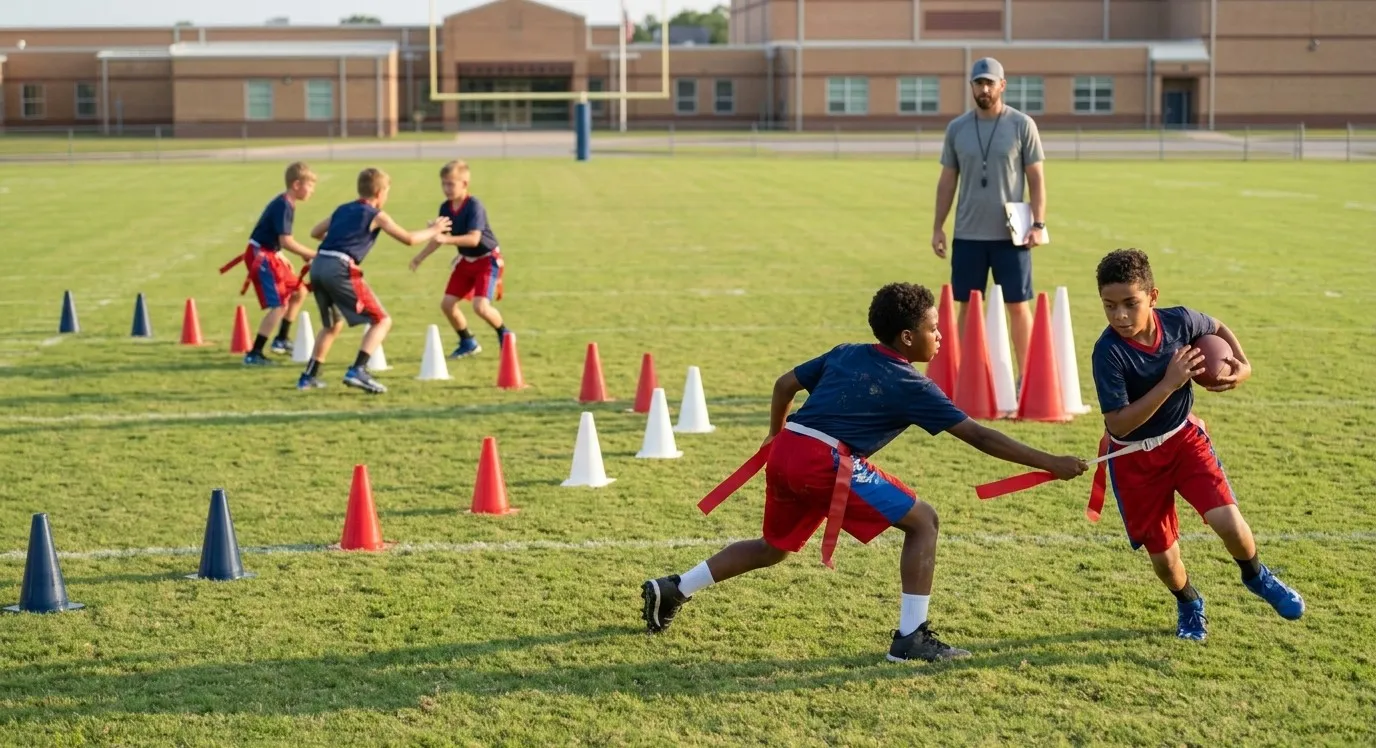
Flag football defense drills can be frustrating for coaches, parents, and beginner players when missed flags, poor pursuit angles, and blown coverage keep leading to big plays. Many young players work hard but struggle with footwork, reaction time, and defensive positioning. Over the years, I have noticed that these problems usually come from weak fundamentals, not lack of effort. Players often improve faster when coaches focus on simple drills and repeat them consistently instead of teaching complicated schemes too early.
In my experience studying youth football practice methods and beginner skill development, the biggest improvements come from mastering the basics. Players who learn proper flag pulling, communication, pursuit angles, and coverage skills become more confident and make better decisions during games. In this guide, you will learn 13 simple drills that coaches can use during practice and parents can use at home. If you are looking for more beginner training ideas, check out our flag football drills for kids guide. These beginner-friendly drills require little equipment and help young players improve coverage, reaction time, and defensive awareness while building a stronger defense.
Key Takeaways
- Good defense starts with footwork, communication, and proper flag-pulling technique.
- Players should learn pursuit angles instead of chasing the ball carrier.
- Man coverage and zone coverage both have advantages in different situations.
- Defensive backs need quick feet and strong coverage skills.
- Linebackers and pass rushers must react quickly and stay under control.
- Team defense improves when players communicate before and during the play.
- Simple drills repeated consistently often work better than advanced schemes for beginners.
- Short practice sessions can help players build confidence and make more plays.
Drill Summary Table
| Drill | Main Skill |
|---|---|
| Flag Pull Drill | Flag pulling |
| Mirror Drill | Footwork and lateral movement |
| Pursuit Angle Drill | Pursuit angles and containment |
| Zone Coverage Drill | Coverage and passing lane awareness |
| No Passing Zone Drill | Defensive awareness and closing speed |
| Pass Rush Drill | Quarterback pressure and acceleration |
| Team Pursuit Drill | Communication and team defense |
| Box Drill | Agility, backpedal, and hip turns |
| Tip Drill | Ball skills and interceptions |
| Receiver Coverage Drill | Man coverage and break on the ball |
| Shuffle and Break Drill | Reaction time and change of direction |
| Read-and-React Drill | Defensive awareness and defensive transition |
| Chase Drill | Closing speed and pass rush |
What Makes a Good Flag Football Defender?

Good defenders do more than run after the ball. They stay in position, react quickly, and work with their teammates. Learning these skills can help players make more stops and avoid giving up big plays.
Defensive Stance
Every play starts with a good stance. Strong footwork is also important for quick changes of direction. Coaches who want more movement exercises can explore our football footwork drills guide for cone drills, ladder drills, and balance training.
Footwork and Balance
Quick feet are important in flag football. Defenders need good footwork to stay with receivers and change direction. Players should avoid crossing their feet because it can slow them down. Small, quick steps help maintain balance and control.
Pursuit Angles
Running straight at the ball carrier does not always work. Defenders should take the proper pursuit angle to cut off space and prevent long gains. Good angles help players close the gap and pull the flag before the runner reaches the end zone.
Reaction Time
Defenders must react to the quarterback, receiver, and ball movement. Fast reactions help players break on the ball and stay in coverage. Reaction drills and read-and-react drills can improve this skill.
Communication
Good defense depends on teamwork. Players should talk before and during the play. Calling out receivers and warning teammates about motion can help the entire defense stay organized.
Flag-Pulling Technique
A defender should stay under control when approaching the ball carrier. Reaching too early often leads to missed flags. Instead, players should break down, stay balanced, and pull the flag with quick hands. Proper flag-pulling technique helps prevent extra yards.
Coverage Skills
Defenders need to understand both man coverage and zone coverage. They should keep their eyes on the play and avoid getting caught out of position. Good coverage skills make it harder for receivers to get open and create passing lanes for interceptions.
By building these fundamentals, players can improve their footwork, reaction time, closing speed, and overall defensive awareness. These skills make every flag football defense drill more effective.
Equipment Needed for Flag Football Defense Drills
Most youth coaches and parents already have these items. Many drills can be done in a backyard, park, or practice field. Usually flag football defense drills need only a few items.
- Cones
- Football
- Flag belts
- Markers
- Agility ladder (optional)
Equipment Checklist
| Equipment | Required |
|---|---|
| Football | Yes |
| Flag Belts | Yes |
| Cones | Yes |
| Markers | Optional |
| Agility Ladder | Optional |
These tools help players work on footwork, coverage, and reaction time.
Drill Difficulty Levels
| Skill Level | Recommended Drills |
|---|---|
| Beginner | Flag Pull Drill, Mirror Drill, Pursuit Angle Drill |
| Intermediate | Zone Coverage Drill, Receiver Coverage Drill, Box Drill |
| Advanced | Tip Drill, Pass Rush Drill, Team Pursuit Drill |
Best Flag Football Defense Drills
These flag football defense drills help players improve coverage, pursuit angles, reaction time, and flag-pulling skills. Most drills need only cones, a football, and a few players. Coaches can use them during practice to build strong defensive habits.
Flag Pull Drill
The flag pull drill teaches players how to approach the ball carrier and remove the flag under control. This drill is easy for parents and coaches to teach. It works well for beginners and young players who are learning proper defensive technique.
Purpose
Improve flag-pulling technique and body control.
Equipment Needed
- Cones
- Flag belts
Players Needed
Two or more players
Setup
Place two cones about five yards apart. One player acts as the ball carrier, and the other player starts on defense.
How to Run the Drill
The ball carrier runs forward at a moderate speed. The defender stays balanced and closes the gap. Instead of diving or reaching early, the defender breaks down and pulls the flag.
Coaching Tips
- Keep your eyes on the hips of the runner.
- Stay low and under control.
- Use quick hands when reaching for the flag.
Defenders should stay in a good breakdown position and use proper leverage to stop the ball carrier in open-field defense.
Common Mistakes
- Reaching too early
- Running too fast
- Looking at the flag instead of the ball carrier
Skills Developed
- Flag pulling
- Body control
- Balance
- Closing speed
- Open-field defense
Mirror Drill

The mirror drill helps defenders stay with receivers and improve lateral movement. The mirror drill is a great choice for home practice because it only needs two players and a small amount of space.
Purpose
Develop coverage skills and quick feet.
Equipment Needed
- Cones
Players Needed
Two players
Setup
Players face each other inside a small area marked by cones.
How to Run the Drill
One player moves side to side while the defender mirrors every movement. The defender should stay balanced and avoid crossing the feet. Players should keep their eyes up and maintain good eye discipline while changing direction.
Coaching Tips
- Take short steps.
- Stay low.
- Keep your head up.
Common Mistakes
- Crossing the feet
- Standing too upright
- Losing balance
Skills Developed
- Footwork
- Agility
- Reaction time
- Change of direction
- Lateral movement
Pursuit Angle Drill

This drill teaches defenders how to take the proper angle to the ball carrier.
Purpose
Improve pursuit angles and open-field defense.
Equipment Needed
- Cones
- Football
Players Needed
Three or more players
Setup
Place cones to create a running lane. One player carries the ball while another player starts from the side.
How to Run the Drill
The ball carrier runs down the lane. The defender takes an angle to cut off the runner and pull the flag before reaching the end zone. Defenders should maintain outside leverage and focus on containment instead of chasing directly behind the runner.
Coaching Tips
- Stay outside the runner.
- Avoid chasing from behind.
- Keep your feet moving.
Common Mistakes
- Taking a poor angle
- Overrunning the play
- Stopping the feet
Skills Developed
- Pursuit angles
- Open-field defense
- Speed
- Leverage
- Containment
- Defensive awareness
Zone Coverage Drill

This drill teaches players how to defend areas instead of following one receiver.
Purpose
Improve zone coverage and defensive awareness.
Equipment Needed
- Cones
- Football
Players Needed
Four or more players
Setup
Mark several zones with cones. Assign defenders to each area.
How to Run the Drill
The quarterback throws short passes while defenders stay in their zones and react to the ball. Players should communicate and break on the ball quickly. Defenders should read the quarterback, protect passing lanes, and react quickly when they break on the ball.
Coaching Tips
- Keep your eyes on the quarterback.
- Stay in your zone.
- Talk with teammates.
- Maintain eye discipline.
- Stay aware of nearby receivers.
Common Mistakes
- Chasing receivers everywhere
- Leaving assigned areas
- Poor communication
Skills Developed
- Zone coverage
- Communication
- Defensive awareness
- Break on the ball
- Passing lane awareness
No Passing Zone Drill
Purpose
Teach defenders to react quickly and protect short passing areas.
Equipment Needed
- Cones
- Football
Players Needed
Three or more players
Setup
Mark a short area near the goal line with cones.
How to Run the Drill
Receivers run short routes while defenders stay in position and react to the quarterback. Players should break on the ball and close passing lanes.
Coaching Tips
- Read the quarterback.
- Stay balanced.
- Communicate with teammates.
Common Mistakes
- Leaving coverage too early
- Watching only the quarterback
- Poor positioning
Skills Developed
- Defensive awareness
- Closing speed
- Zone coverage
- Break on the ball
Pass Rush Drill
The pass rush drill helps defenders pressure the quarterback without losing control.
Purpose
Develop pass-rushing skills and quick reactions.
Equipment Needed
- Cones
Players Needed
Two or more players
Setup
Place one cone as the starting point and another cone behind the quarterback.
How to Run the Drill
The rusher starts on the whistle and attacks under control. The goal is to reach the quarterback and pull the flag quickly. A strong first step and good acceleration help defenders pressure the quarterback without losing balance.
Coaching Tips
- Explode off the line.
- Stay balanced.
- Keep your eyes on the quarterback.
Common Mistakes
- Running too high
- Losing balance
- Taking a wide path
Skills Developed
- Pass rush
- Acceleration
- Closing speed
- Reaction time
- Acceleration
- Break on the ball
Team Pursuit Drill
Purpose
Teach defenders to rally to the football and work together. This short schedule works well for volunteer coaches who have limited practice time. Parents can also use individual drills at home to help players improve between practices.
Equipment Needed
- Cones
- Football
Players Needed
Four or more players
Setup
Players line up on defense while one player acts as the ball carrier.
How to Run the Drill
The ball carrier runs in different directions. Defenders take proper pursuit angles and work together to stop the play.
Coaching Tips
- Communicate before and during the play.
- Stay under control.
- Maintain outside leverage.
Common Mistakes
- Overrunning the play
- Poor pursuit angles
- Lack of communication
Skills Developed
- Team defense
- Communication
- Pursuit angles
- Open-field defense
Position-Specific Drill Guide
| Position | Best Drills |
|---|---|
| Defensive Back | Box Drill, Tip Drill, Receiver Coverage Drill |
| Linebacker | Shuffle and Break Drill, Read-and-React Drill, Pursuit Angle Drill |
| Pass Rusher | Pass Rush Drill, Chase Drill |
| All Defenders | Flag Pull Drill, Mirror Drill, Team Pursuit Drill |
Defensive Back Drills for Flag Football
Defensive backs need quick feet and fast reactions. They must stay with receivers, break on the ball, and make plays in open space. These drills help improve coverage skills, ball awareness, and change of direction.
Box Drill

The box drill helps defensive backs improve footwork and body control.
Purpose
Improve footwork, hip movement, and change of direction.
Equipment Needed
- Four cones
Players Needed
One player
Setup
Place four cones in a square about five yards apart.
How to Run the Drill
Start at one cone and move around the box using side shuffles, backpedals, and forward sprints. Stay low and keep your eyes up during the drill. Coaches looking for more movement patterns can explore our cone drills for football guide for additional cone setups and footwork exercises.
Coaching Tips
- Take short steps.
- Stay balanced.
- Keep your hips low.
- Move with control.
Common Mistakes
- Crossing the feet
- Standing too tall
- Losing balance around the cones
Skills Developed
- Footwork
- Agility
- Hip turns
- Change of direction
- Backpedal
- Hip turns
Tip Drill
The tip drill teaches players how to react to deflected passes and create interceptions.
Purpose
Improve ball tracking and reaction time.
Equipment Needed
- Football
Players Needed
Three or more players
Setup
Two players stand close together while another player lines up behind them.
How to Run the Drill
One player tosses the football. Another player tips the ball into the air. The defender tracks the ball and catches it before it hits the ground.
Coaching Tips
- Keep your eyes on the football.
- Use both hands.
- Stay ready for sudden changes.
Common Mistakes
- Looking away from the ball
- Waiting too long to react
- Using one hand
Skills Developed
- Ball awareness
- Interceptions
- Hand-eye coordination
- Reaction time
Receiver Coverage Drill
This drill teaches defenders how to stay with receivers and break on the football.
Purpose
Improve man coverage and defensive positioning.
Equipment Needed
- Cones
- Football
Players Needed
Three players
Setup
One player acts as the quarterback, one player runs routes, and one player plays defense.
How to Run the Drill
The receiver runs simple routes while the defensive back mirrors the movement. The quarterback throws the ball, and the defender tries to stay in position and make a play. Defenders should use proper backpedal technique and open their hips when following receivers down the field.
Coaching Tips
- Watch the receiver’s hips.
- Stay between the receiver and the goal line.
- Keep moving your feet.
Common Mistakes
- Looking at the quarterback too early
- Crossing the feet
- Giving too much space
Skills Developed
- Man coverage
- Footwork
- Closing speed
- Break on the ball
- Backpedal
- Hip turns
Read-and-React Drill
The read-and-react drill teaches defenders to recognize the play and respond quickly.
Purpose
Improve defensive awareness and reaction speed.
Equipment Needed
- Football
- Cones
Players Needed
Four or more players
Setup
Players line up in their positions while a coach stands in front with the football.
How to Run the Drill
The coach points or throws the ball in different directions. Defenders react, move to the football, and finish with a flag pull or interception attempt. Players who want more exercises for speed and quick reactions can explore our football agility drills guide.
Coaching Tips
- Stay focused before the snap.
- React quickly.
- Communicate with teammates.
Common Mistakes
- Slow reactions
- Poor positioning
- Watching only the quarterback
Skills Developed
- Defensive awareness
- Reaction time
- Communication
- Team defense
- Defensive transition
Linebacker and Pass Rush Drills
Linebackers and pass rushers must react quickly and attack under control. These drills help players improve pursuit angles, communication, and pressure on the quarterback.
Shuffle and Break Drill
Purpose
Improve lateral movement and reaction time.
Equipment Needed
- Cones
Players Needed
One or more players
Setup
Place two cones about five yards apart.
How to Run the Drill
Players shuffle sideways between the cones. On the coach’s signal, they plant their feet and sprint forward.
Coaching Tips
- Stay low.
- Keep your feet moving.
- Explode out of the break.
Common Mistakes
- Crossing the feet
- Standing too high
- Slow first step
Skills Developed
- Lateral movement
- Acceleration
- Body control
Read-and-React Drill
Purpose
Teach linebackers to react quickly.
Equipment Needed
- Football
- Cones
Players Needed
Three or more players
Setup
The coach stands with the football while defenders line up.
How to Run the Drill
The coach points or throws the ball. Players react and move toward the football.
Coaching Tips
- Keep your eyes up.
- React quickly.
- Communicate with teammates.
Skills Developed
- Defensive awareness
- Reaction time
- Pursuit
Chase Drill
Purpose
Improve pass-rushing skills and closing speed.
Equipment Needed
- Cones
Players Needed
Two players
Setup
One player acts as the quarterback and another player acts as the rusher.
How to Run the Drill
The defender attacks from the starting point and works to reach the quarterback before the play ends.
Coaching Tips
- Explode off the line.
- Take a direct path.
- Stay balanced.
Skills Developed
- Pass rush
- Acceleration
- Closing speed
Drill Difficulty Levels
Beginner Drills
- Flag Pull Drill
- Mirror Drill
- Pursuit Angle Drill
Intermediate Drills
- Zone Coverage Drill
- Receiver Coverage Drill
- Box Drill
Advanced Drills
- Tip Drill
- Pass Rush Drill
- Team Pursuit Drill
Man Coverage vs. Zone Coverage in Flag Football
Defenders should understand both man coverage and zone coverage. Each system has strengths and works best in different situations.
Man Coverage
In man coverage, each defender is responsible for one receiver. Players must stay with their assignment and avoid losing position.
Best for:
- Short-yardage situations
- One-on-one matchups
- Aggressive defenses
Zone Coverage
In zone coverage, defenders protect an area of the field instead of following one receiver. Zone coverage is often easier for beginner teams because it helps players stay in position and protect passing lanes.
Best for:
- Preventing deep passes
- Youth flag football teams
- Defenses that rely on communication
Both coverages can help stop big plays when players understand their responsibilities.
| Coverage Type | Best Used For | Main Advantage |
|---|---|---|
| Man Coverage | Short-yardage situations | Aggressive defense and pressure |
| Zone Coverage | Youth and beginner teams | Better communication and fewer blown assignments |
Common Defensive Mistakes and How to Fix Them
Even good players make mistakes. Avoiding these problems can help defenders make more plays.
Common Defensive Mistakes
| Mistake | Simple Fix |
|---|---|
| Watching the quarterback too early | Focus on the receiver first |
| Poor pursuit angles | Take proper leverage and containment |
| Crossing the feet | Use short shuffle steps |
| Reaching too early | Stay balanced and break down before pulling the flag |
| Poor communication | Talk before and during the play |
Watching the Quarterback Too Early
Many players stop watching the receiver. This creates separation.
Fix: Watch the receiver first and break on the football at the right time.
Poor Pursuit Angles

Running straight at the ball carrier often leads to missed flags.
Fix: Take an angle that cuts off the runner.
Bad angles often force defenders to recover late and reduce recovery speed near the sideline.
Crossing the Feet
Crossing the feet slows defenders and causes balance problems.
Fix: Use short shuffle steps and stay under control.
Reaching Too Early
Players often dive for flags before they are close enough.
Fix: Break down and pull the flag with quick hands.
Poor Communication
Silent defenses give up big plays.
Fix: Talk before and during every play.
15-Minute Flag Football Defense Practice Plan
Coaches who want a complete schedule can follow our 30 minute football practice plan for short sessions, use the first week football practice plan to organize early practices, or explore the youth football practice plan for season-long development.
Warm-Up (3 Minutes)
- High knees
- Side shuffles
- Backpedals
Coverage Drills (5 Minutes)
- Mirror Drill
- Receiver Coverage Drill
Flag-Pulling Drills (4 Minutes)
- Basic Flag Pull Drill
- Pursuit Angle Drill
Team Defense Drill (3 Minutes)
- Zone Coverage Drill
- Communication practice
This schedule helps players improve coverage, reaction time, and defensive awareness in a short practice.
Can You Practice Flag Football Defense With Only Two Players?
Yes. Many flag football defense drills work with only two players. If you have limited space, our backyard football practice drills guide includes more small-area exercises that players can do at home.
One-player drills:
- Box Drill
- Footwork drills
- Backpedal drills
Two-player drills:
- Flag Pull Drill
- Mirror Drill
- Receiver Coverage Drill
Team drills:
- Zone Coverage Drill
- Team Pursuit Drill
- Pass Rush Drill
Tips for Coaching Youth Flag Football Defense
Coaches should focus on fundamentals before advanced schemes.
Use Positive Feedback
Young players learn faster when coaches praise effort and improvement. Small corrections and encouragement can help players build confidence.
Keep Drills Simple
Young players learn better when drills are easy to understand.
Teach Flag Pulling Early
Good flag-pulling skills prevent extra yards.
Focus on Footwork
Quick feet help players stay in position.
Keep Players Active
Avoid long lines and long breaks. Players improve more when they get many repetitions. Before starting defensive drills, coaches should use proper warm-ups to prepare players for movement. Our football warmup drills before practice guide and injury prevention drills for beginners can help players stay ready and reduce the risk of injuries
Encourage Communication
Talking helps defenders stay organized.
Build Confidence
Praise effort and improvement during practice.
Frequently Asked Questions
What are the best flag football defense drills?
Some of the best flag football defense drills include the flag pull drill, mirror drill, pursuit angle drill, zone coverage drill, and pass rush drill.
How do you teach defense in flag football?
Start with basic skills such as footwork, flag pulling, pursuit angles, and communication. Then add coverage drills and team concepts.
What is the difference between man coverage and zone coverage?
Man coverage assigns each defender to one receiver. Zone coverage asks defenders to protect areas of the field.
How do players improve flag pulling?
Players can improve flag pulling by staying balanced, taking proper angles, and practicing under control.
How often should youth teams practice defense?
Most youth teams should spend part of every practice working on defensive fundamentals and coverage drills.
Conclusion
Strong defenses are built through repetition and good habits. In my experience, young players make the most progress when coaches keep practices simple and focus on fundamentals before advanced concepts. Skills like flag pulling, pursuit angles, footwork, and communication often have a bigger impact than complex defensive schemes. Small improvements made during practice can lead to fewer mistakes and more stops on game day.
These flag football defense drills give youth coaches, parents, and beginner players a simple way to improve coverage, man coverage, zone coverage, and pass-rushing skills. With regular practice and the right coaching approach, players can develop better defensive awareness, react faster, and play with more confidence. Building a strong defense takes time, but consistent practice and sound fundamentals can help young athletes become more reliable defenders.
