



Introduction
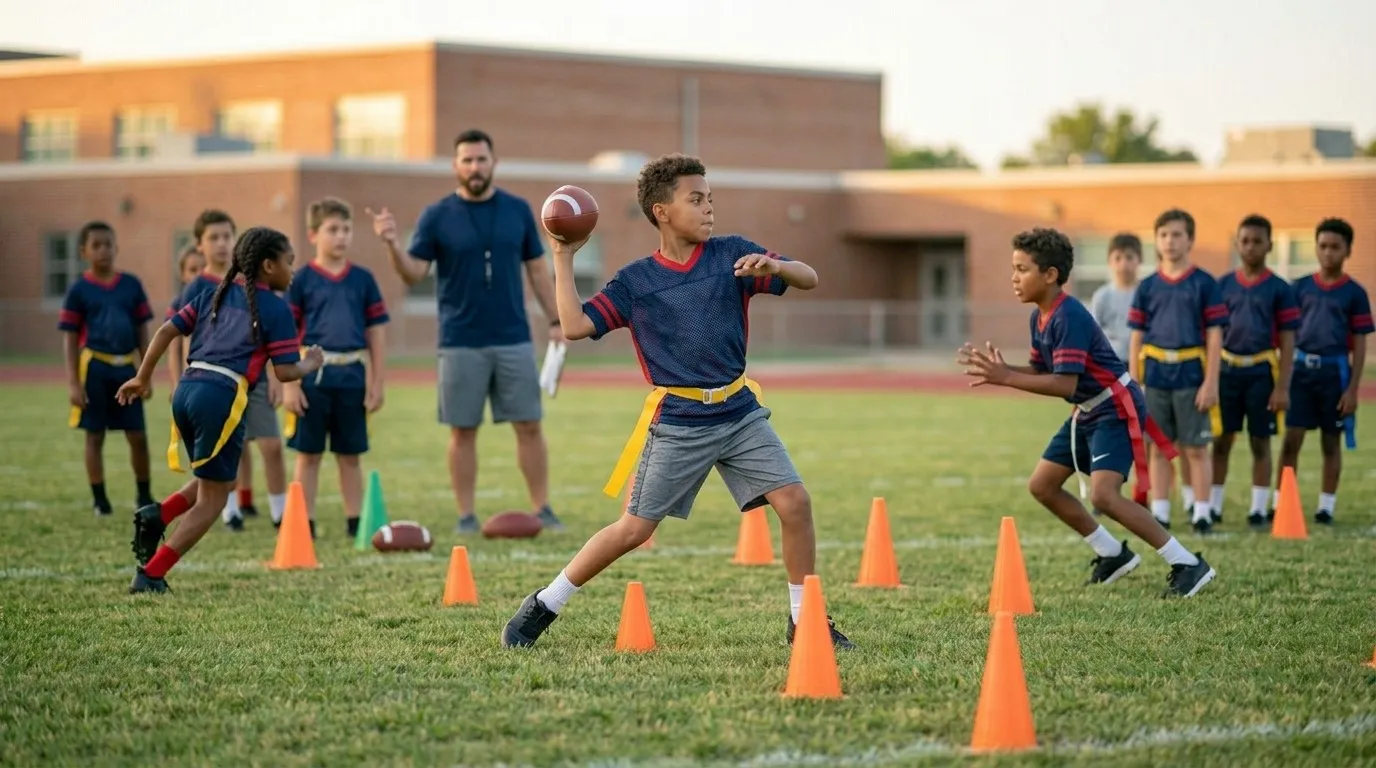
Flag football passing drills can help solve one of the most common problems young teams face: incomplete passes. Many beginner quarterbacks struggle with passing accuracy, while receivers often get open but never see the ball arrive on time. As a result, drives stall, players lose confidence, and simple offensive plays become difficult to execute.
As a youth football coach, I have seen this happen with many beginner players. Most of the time, the problem is not arm strength. Instead, it comes down to footwork, ball placement, route timing, and throwing mechanics. Once players start practicing the right drills, their completion percentage and confidence usually improve quickly. In this guide, you will learn flag football passing drills that help quarterbacks throw more accurately, improve receiver timing, and build a more effective passing game.
What Are Flag Football Passing Drills?
Flag football passing drills are practice exercises that help quarterbacks and receivers improve passing accuracy, route timing, ball placement, and communication. These drills teach players how to complete short passes, intermediate routes, and deep passes more effectively during games.
A good passing drill also improves throwing mechanics, footwork, field vision, and decision-making. Players who are still learning the basics can also benefit from football fundamental drills, which help build throwing, catching, footwork, and overall football skills.
Equipment Needed for Flag Football Passing Drills
Most passing drills require only a few pieces of equipment.
Basic equipment includes:
- Flag football
- Cones
- Flag belts
- Field markers
- Training targets
- Stopwatch
- Practice jerseys
Coaches can also use buckets, hoops, or target nets to improve passing accuracy and ball placement.
Simple equipment is often enough to create effective passing drills for youth players and beginners.
Best Flag Football Passing Drills by Age Group
Players develop skills at different speeds. Choosing age-appropriate drills can make practice more effective.
Ages 6–8
Young players should focus on basic throwing and catching skills.
Recommended drills:
- Partner Passing Drill
- Circle Passing Drill
- Target Cone Passing Drill
Ages 9–12
Players can begin learning route timing and ball placement.
Recommended drills:
- Moving Target Drill
- Lead Receiver Drill
- Route Timing Drill
Ages 13–16
Older players can handle more advanced decision-making drills.
Recommended drills:
- Read and Throw Drill
- Route Combination Drill
- Small-Sided Passing Game
Coaches should adjust drill difficulty based on player experience rather than age alone.
Flag Football Passing Routes Every Beginner Should Learn
Learning routes helps quarterbacks and receivers work together during offensive plays. These basic routes are commonly used in youth flag football.
Slant Route
The receiver runs forward and then cuts diagonally across the field.
This route works well for quick passes and helps create separation from defenders.
Out Route
The receiver runs straight before making a sharp cut toward the sideline.
Quarterbacks must throw with good timing and accuracy to complete this pass.
Curl Route
The receiver runs forward and then turns back toward the quarterback.
This route gives quarterbacks a reliable short-pass option.
Go Route
The receiver sprints straight down the field.
This route is often used for deep passes and big-play opportunities.
Quarterbacks should focus on throwing a spiral throw and leading the receiver into open space.
Drag Route
The receiver runs across the field at a shallow depth.
Drag routes are useful against defensive coverage and help create easy completions.
Why Routes Matter in Passing Drills
Passing drills become more effective when receivers run actual routes.
Route practice helps improve:
- Route timing
- Read progression
- Ball placement
- Passing lanes
- Completion percentage
- Receiver confidence
As quarterbacks learn the route tree, they become more comfortable making quick decisions during games.
Coach Tip
Young quarterbacks should focus on accuracy before distance.
Many beginners try to throw deep passes before they master short throws. However, strong throwing mechanics, proper footwork, and consistent ball placement usually produce better results than throwing with maximum force.
A quarterback who completes short and intermediate passes consistently is often more effective than a player who only attempts deep throws.
Why Passing Drills Matter in Flag Football

Passing is one of the most important skills in flag football. While speed and agility are valuable, teams often rely on accurate passing to move the ball and create scoring opportunities.
Regular passing drills help players build strong fundamentals. They also help quarterbacks and receivers work together more effectively.
Improve Passing Accuracy
Accuracy is the foundation of every successful passing game. A quarterback must place the ball where the receiver can catch it safely.
Passing drills help players:
- Hit moving targets more consistently
- Improve ball placement
- Reduce missed throws
- Complete more passes during games
As accuracy improves, quarterbacks become more confident and make better decisions under pressure.
Develop Quarterback Confidence
Many beginner quarterbacks hesitate before throwing the ball. This often leads to late passes or missed opportunities.
Consistent practice helps quarterbacks:
- Read the field faster
- Trust their throwing motion
- Make quicker decisions
- Stay calm during game situations
Confidence grows when players see successful results during practice.
Build Better Receiver Timing
Quarterbacks and receivers must work together. Even an accurate throw can fail if the receiver is not in the correct position.
Passing drills help improve:
- Route timing
- Receiver spacing
- Ball tracking
- Communication between players
When timing improves, offensive plays become more effective.
Prepare for Game Situations
Game situations often happen quickly. Defenders move, receivers change direction, and quarterbacks must react fast.
Passing drills help players practice:
- Throwing on the move
- Leading receivers
- Making quick reads
- Passing under pressure
As a result, players feel more prepared when real game situations occur.
Key Passing Fundamentals Before Starting Drills
Before players begin advanced flag football passing drills, they should learn the basic fundamentals. Strong mechanics improve accuracy and reduce bad habits.
Proper Football Grip
A good grip helps quarterbacks control the football.
To hold the football correctly:
- Place your fingers across the laces.
- Keep a comfortable grip.
- Avoid squeezing the ball too tightly.
- Keep your wrist relaxed.
A proper grip helps create a clean spiral and improves ball control.
Throwing Stance and Balance
Balance is important for accurate passing.
When preparing to throw:
- Keep your feet shoulder-width apart.
- Bend your knees slightly.
- Stay balanced throughout the throw.
- Keep your eyes on the target.
Good balance helps quarterbacks generate power without losing accuracy.
Release Point and Follow Through
The release point affects where the football travels.
Players should:
- Bring the football near the ear.
- Release the ball smoothly.
- Point the throwing hand toward the target.
- Finish the motion with a full follow-through.
A consistent release improves throwing accuracy and ball placement.
Leading the Receiver
Quarterbacks should throw the ball to where the receiver is going, not where the receiver is standing.
This technique is called leading the receiver.
Leading the receiver helps:
- Maintain speed after the catch
- Create separation from defenders
- Improve pass completion rates
It is one of the most valuable skills in flag football.
Basic Quarterback Footwork
Footwork plays a major role in passing success.
Quarterbacks should practice:
- Quick setup steps
- Balanced movement
- Stepping toward the target
- Staying under control
Good footwork improves both accuracy and timing.
Better footwork often leads to more accurate throws and improved balance, which is why many coaches include football footwork drills in their practice routines.
Beginner Flag Football Passing Drills
These beginner-friendly drills help players develop passing accuracy, throwing mechanics, and receiver coordination. Coaches can use them during individual practice sessions or team workouts.
Partner Passing Drill

The partner passing drill is one of the easiest ways to improve throwing accuracy.
Setup
- Two players
- One football
- Open practice area
How to Perform
- Stand 5 to 10 yards apart.
- Throw the football back and forth.
- Focus on proper grip and throwing mechanics.
- Complete 10 to 15 accurate passes.
- Increase the distance gradually.
Coaching Tips
- Focus on accuracy before distance.
- Maintain proper throwing form.
- Watch the target before every throw.
Target Cone Passing Drill

This drill helps quarterbacks improve ball placement and accuracy.
Setup
- 3 to 5 cones
- One football
- Open field space
How to Perform
- Place cones at different distances.
- Stand behind a throwing line.
- Aim passes toward each cone.
- Rotate through all targets.
- Track successful throws.
Coaching Tips
- Start with short throws.
- Increase distance as accuracy improves.
- Focus on consistent release points.
Stationary Accuracy Drill
This drill teaches quarterbacks to hit a fixed target.
Setup
- One receiver or target object
- One football
How to Perform
- Position the target 10 yards away.
- Throw multiple passes to the same target.
- Focus on ball placement.
- Repeat from different angles.
Coaching Tips
- Throw with controlled power.
- Keep your feet balanced.
- Follow through after each pass.
Bucket Passing Drill
The bucket passing drill improves touch and accuracy.
Setup
- Bucket or large container
- One football
- Open practice area
How to Perform
- Place the bucket several yards away.
- Attempt to throw the football into the bucket.
- Complete multiple rounds.
- Increase distance over time.
Coaching Tips
- Focus on soft, controlled throws.
- Practice different throwing distances.
- Aim for consistency rather than power.
Quick Catch and Throw Drill
This drill improves reaction time and passing rhythm.
Setup
- Two players
- One football
How to Perform
- Stand 5 to 7 yards apart.
- Catch the football.
- Quickly return the pass.
- Continue without long pauses.
- Maintain proper technique throughout the drill.
Coaching Tips
- Keep eyes on the target.
- React quickly after catching the ball.
- Maintain good footwork during each throw.
Youth Flag Football Passing Drills
Youth players learn best through simple and active drills. These passing drills help young athletes improve throwing accuracy, receiver timing, and teamwork while keeping practice fun.
Coaches and parents looking for more beginner-friendly activities can also use flag football drills for kids to build fundamental skills and keep practices enjoyable.
Four Corner Passing Drill
The four corner passing drill improves accuracy, communication, and quick decision-making.
Setup
- Four players
- One football
- Four cones placed in a square
How to Perform
- Place one player at each cone.
- Start with one football.
- Pass the ball clockwise around the square.
- After several rounds, reverse the direction.
- Increase speed as players improve.
Coaching Tips
- Encourage accurate throws.
- Call out the receiver’s name before passing.
- Keep feet moving after each throw.
Circle Passing Drill
This drill helps players react quickly and stay focused.
Setup
- Five or more players
- One football
How to Perform
- Players form a circle.
- One player starts with the football.
- The quarterback passes to different receivers around the circle.
- Receivers return the ball immediately.
- Continue for several rounds.
Coaching Tips
- Change passing targets often.
- Encourage quick reactions.
- Focus on clean catches and accurate throws.
Relay Passing Drill
The relay passing drill adds movement and competition.
Setup
- Two teams
- One football per team
- Cones for distance markers
How to Perform
- Divide players into teams.
- The first player throws to the next teammate.
- Continue passing until the ball reaches the final player.
- The first team to finish wins.
- Repeat multiple rounds.
Coaching Tips
- Reward accuracy over speed.
- Keep players spread out.
- Use different passing distances.
Moving Target Drill
Game situations rarely involve stationary receivers. This drill teaches quarterbacks to hit moving targets.
Setup
- One quarterback
- One receiver
- One football
How to Perform
- The receiver jogs across the field.
- The quarterback throws ahead of the receiver.
- The receiver catches the pass while moving.
- Repeat from different directions.
Coaching Tips
- Focus on leading the receiver.
- Start at a slow pace.
- Increase speed as timing improves.
Quarterback Passing Drills
Quarterbacks need more than arm strength. They must develop accuracy, footwork, timing, and decision-making skills. These quarterback passing drills help build those abilities.
Passing Tree Drill
The passing tree drill teaches quarterbacks to throw to multiple route types.
Setup
- Quarterback
- One or more receivers
- Cones for route markers
How to Perform
- Assign a route to the receiver.
- The receiver runs the route.
- The quarterback delivers the pass on time.
- Rotate through several routes.
- Repeat until timing improves.
Coaching Tips
- Focus on route timing.
- Throw before the receiver turns.
- Practice both short and deep routes.
Rollout Passing Drill
This drill helps quarterbacks throw accurately while moving.
Setup
- Quarterback
- Receiver
- Cones
How to Perform
- The quarterback starts behind a cone.
- Move left or right after the snap.
- Set feet quickly.
- Throw to the receiver.
- Alternate both directions.
Coaching Tips
- Keep eyes downfield.
- Stay balanced while moving.
- Avoid throwing off the back foot.
Sprint and Throw Drill
This drill develops mobility and passing accuracy.
Setup
- Quarterback
- Receiver
- Several cones
How to Perform
- Sprint around a cone.
- Stop under control.
- Deliver an accurate pass.
- Repeat from different angles.
Coaching Tips
- Control body movement before throwing.
- Keep shoulders square to the target.
- Focus on accuracy first.
Read and Throw Drill

Quarterbacks must learn how to make quick decisions.
Setup
- Quarterback
- Two receivers
- Coach or defender
How to Perform
- Two receivers run separate routes.
- The coach signals which receiver is open.
- The quarterback identifies the target.
- Deliver the pass immediately.
- Repeat several times.
Coaching Tips
- Make quick decisions.
- Keep eyes up.
- React without hesitation.
Receiver and Passing Timing Drills
Great passing requires teamwork between the quarterback and receiver. These drills improve route running, timing, and ball placement.
Lead Receiver Drill
This drill teaches quarterbacks how to throw the ball ahead of a moving receiver.
Setup
- Quarterback
- Receiver
- Football
How to Perform
- The receiver runs across the field.
- The quarterback throws into open space.
- The receiver catches the ball while running.
- Repeat from different directions.
Coaching Tips
- Focus on ball placement.
- Allow the receiver to stay in stride.
- Practice different route angles.
Route Timing Drill
Timing is one of the most important parts of a successful passing game.
Setup
- Quarterback
- Receiver
- Route markers
How to Perform
- The receiver runs a designated route.
- The quarterback counts the route timing.
- Deliver the pass at the correct moment.
- Repeat until both players develop rhythm.
Coaching Tips
- Use consistent route speed.
- Release the football on time.
- Repeat frequently.
Slant Route Passing Drill
The slant route is one of the most common flag football routes.
Setup
- Quarterback
- Receiver
- Cones
How to Perform
- The receiver runs three to five steps forward.
- Cut diagonally across the field.
- The quarterback throws before the break.
- Catch the pass in stride.
Coaching Tips
- Focus on quick releases.
- Maintain sharp route cuts.
- Lead the receiver across the field.
Crossing Route Drill
Crossing routes help create separation from defenders.
Setup
- Quarterback
- Receiver
- Cones
How to Perform
- The receiver runs across the middle of the field.
- The quarterback tracks the route.
- Deliver the football in front of the receiver.
- Repeat from both sides.
Coaching Tips
- Keep throws accurate.
- Focus on receiver movement.
- Practice different crossing angles.
Team Flag Football Passing Drills
Team passing drills help players apply their skills in game-like situations. These drills improve communication, timing, route execution, and overall offensive performance.
Route Combination Drill

This drill teaches quarterbacks and receivers how to work together during multi-route plays.
Setup
- One quarterback
- Two or more receivers
- Cones for route markers
How to Perform
- Assign different routes to each receiver.
- Start the play on the coach’s signal.
- Receivers run their routes at full speed.
- The quarterback reads the routes and chooses a target.
- Repeat using different route combinations.
Coaching Tips
- Focus on timing between routes.
- Encourage quick decision-making.
- Use common routes such as slants, outs, and crossing routes.
Small-Sided Passing Game
This drill creates realistic game situations.
Setup
- Two small teams
- Marked practice area
- One football
How to Perform
- Create a small playing field.
- Run short offensive plays.
- Allow quarterbacks to make quick passing decisions.
- Rotate players frequently.
- Keep rounds short and active.
Coaching Tips
- Encourage teamwork.
- Focus on passing accuracy.
- Keep players moving between reps.
Pressure Passing Drill
Quarterbacks often face pressure during games. This drill helps them stay calm and make accurate throws.
Setup
- Quarterback
- Receiver
- Coach or defender
How to Perform
- The receiver runs a route.
- A coach or defender creates light pressure.
- The quarterback quickly finds the target.
- Deliver an accurate pass.
- Repeat with different routes.
Coaching Tips
- Keep eyes downfield.
- Stay balanced under pressure.
- Focus on quick releases.
Common Passing Mistakes and How to Fix Them
Many beginner players make the same passing mistakes. Identifying these issues early can improve performance faster.
| Mistake | Why It Happens | Quick Fix |
|---|---|---|
| Throwing off the back foot | Poor balance | Step toward the target before throwing |
| Overthrowing receivers | Too much force | Focus on ball placement instead of power |
| Late passes | Slow decision-making | Practice timing drills regularly |
| Poor spiral throws | Incorrect grip | Place fingers correctly on the laces |
| Inaccurate passes | Weak footwork | Improve balance and throwing mechanics |
| Missing moving receivers | Poor anticipation | Learn to lead the receiver |
15-Minute Flag Football Passing Practice Plan
This quick practice plan works well for beginners, youth teams, and individual training sessions.
Warm-Up (3 Minutes)
Perform light throwing and catching exercises.
Focus on:
- Proper grip
- Throwing motion
- Basic footwork
Accuracy Drills (5 Minutes)
Use:
- Partner Passing Drill
- Target Cone Passing Drill
- Bucket Passing Drill
Goal: Improve passing accuracy and ball placement.
Timing Drills (4 Minutes)
Use:
- Lead Receiver Drill
- Route Timing Drill
Goal: Improve quarterback and receiver coordination.
Competitive Passing Game (3 Minutes)
Finish practice with:
- Circle Passing Drill
- Small-Sided Passing Game
Goal: Apply skills in a fun and active environment.
Coaches who want more structured sessions can also use beginner-friendly football practice plans to organize drills and build consistent routines throughout the season.
5-Minute Backyard Passing Routine
Parents often want a simple way to help their child practice at home. This quick routine requires very little equipment.
Minute 1–2: Partner Passing
Focus on grip, throwing mechanics, and accuracy.
Minute 3: Target Passing
Use a cone, bucket, or marker as a target.
Minute 4: Lead Receiver Drill
Have the receiver jog slowly while the quarterback practices leading the throw.
Minute 5: Quick Catch and Throw
Finish with fast repetitions to improve reaction time and confidence.
Even a few minutes of practice can help young players improve consistency.
Coaching Tips for Better Passing Performance
Players improve faster when coaches focus on fundamentals and consistency.
Keep Drills Competitive and Fun
- Accuracy contests
- Team passing relays
- Target competitions
Parents and young players with limited space can also use backyard football practice drills to continue practicing passing, footwork, and catching skills at home.
How to Measure Progress in Flag Football Passing Drills
Practicing drills is important. However, tracking progress helps players improve faster. Coaches and players should measure results regularly to identify strengths and areas that need more work.
Best Flag Football Passing Drills by Goal
Different drills develop different skills. Coaches, parents, and players can choose drills based on their biggest area of improvement.
| Goal | Recommended Drill |
|---|---|
| Improve Passing Accuracy | Target Cone Passing Drill |
| Improve Ball Placement | Accuracy Challenge Drill |
| Improve Route Timing | Route Timing Drill |
| Improve Receiver Coordination | Lead Receiver Drill |
| Improve Decision-Making | Read and Throw Drill |
| Improve Team Communication | Four Corner Passing Drill |
| Improve Game Performance | Small-Sided Passing Game |
| Improve Throwing Mechanics | Partner Passing Drill |
Choosing the right drill helps players improve faster and makes practice sessions more productive.
Track Completion Percentage
Completion percentage measures how many passes reach the target successfully.
For example:
- 20 pass attempts
- 15 completed passes
Completion Percentage = 75%
As passing accuracy improves, the completion percentage should increase.
Monitor Ball Placement
A completed pass is good. However, accurate ball placement is even better.
Ask these questions:
- Did the receiver catch the ball comfortably?
- Was the pass thrown into open space?
- Did the receiver stay in stride after the catch?
Strong ball placement often leads to more successful offensive plays.
Evaluate Route Timing
Quarterbacks and receivers must stay in sync.
Watch for:
- Early throws
- Late throws
- Missed route breaks
- Poor receiver positioning
Good route timing allows the quarterback to release the football before the receiver becomes fully open.
Measure Decision-Making Speed
Quarterbacks should learn to identify passing lanes quickly.
During practice, pay attention to:
- Time needed to find an open receiver
- Ability to move through a read progression
- Reaction to changing situations
Faster decisions often lead to better passing results.
Beginner Passing Drill Progression Plan

Many new players try advanced drills too early. A step-by-step progression helps build skills in the correct order.
Week 1: Build Throwing Fundamentals
Focus on:
- Proper grip
- Throwing mechanics
- Footwork
- Follow-through
Recommended Drills:
- Partner Passing Drill
- Stationary Accuracy Drill
Week 2: Improve Accuracy and Ball Placement
Focus on:
- Hitting targets consistently
- Controlling throw power
- Improving ball placement
Recommended Drills:
- Target Cone Passing Drill
- Accuracy Challenge Drill
Week 3: Develop Receiver Timing
Focus on:
- Route timing
- Leading the receiver
- Catch-and-throw rhythm
Recommended Drills:
- Lead Receiver Drill
- Route Timing Drill
- Moving Target Drill
Week 4: Practice Game Situations
Focus on:
- Passing lanes
- Field vision
- Quick decision-making
Recommended Drills:
- Read and Throw Drill
- Route Combination Drill
- Small-Sided Passing Game
Following a weekly progression helps players build skills gradually. Players who want to develop other areas of their game can also explore football drills for beginners to practice catching, footwork, route running, and position-specific skills.
Best Flag Football Passing Drills by Goal
Different drills improve different skills. Coaches, parents, and players can choose drills based on their biggest area of improvement.
| Goal | Recommended Drill |
|---|---|
| Improve Passing Accuracy | Target Cone Passing Drill |
| Improve Ball Placement | Accuracy Challenge Drill |
| Improve Route Timing | Route Timing Drill |
| Improve Receiver Coordination | Lead Receiver Drill |
| Improve Decision-Making | Read and Throw Drill |
| Improve Team Communication | Four Corner Passing Drill |
| Improve Game Performance | Small-Sided Passing Game |
Choosing the right drill helps players improve faster and makes practice sessions more productive.
Coach’s Passing Drill Checklist
Before ending practice, review these fundamentals:
Proper football grip
Balanced footwork
Eyes on the target
Good ball placement
Lead the receiver
Complete follow-through
Communicate with receivers
Practice at game speed
This simple checklist helps players build strong habits during every practice session.
Frequently Asked Questions
What are the best flag football passing drills for beginners?
The best beginner drills include the Partner Passing Drill, Target Cone Passing Drill, Stationary Accuracy Drill, and Quick Catch and Throw Drill. These drills teach proper mechanics and improve accuracy.
How can quarterbacks improve passing accuracy?
Quarterbacks can improve accuracy by practicing proper grip, footwork, release points, and target-focused drills. Consistent repetition is important.
How often should players practice passing drills?
Most players benefit from practicing passing drills two to four times per week. Regular practice helps develop muscle memory and confidence.
What is the most effective passing drill for youth flag football?
The Moving Target Drill is highly effective because it teaches quarterbacks to lead receivers while improving timing and ball placement.
Do passing drills help receivers as well as quarterbacks?
Yes. Passing drills improve receiver timing, route running, catching skills, and communication with the quarterback.
Conclusion
The best flag football passing drills focus on more than just throwing the football. They help players improve footwork, throwing mechanics, field vision, route timing, and communication with receivers. When these skills improve together, quarterbacks can make better decisions and complete more passes during games.
From my coaching experience, the players who improve the fastest are usually the ones who master the basics and practice consistently. Strong passing skills are built through repetition, proper technique, and game-like training. Start with the beginner drills, follow the progression plan, and focus on steady improvement. Over time, players can develop better accuracy, higher completion percentages, and greater confidence on the field.
