



Introduction
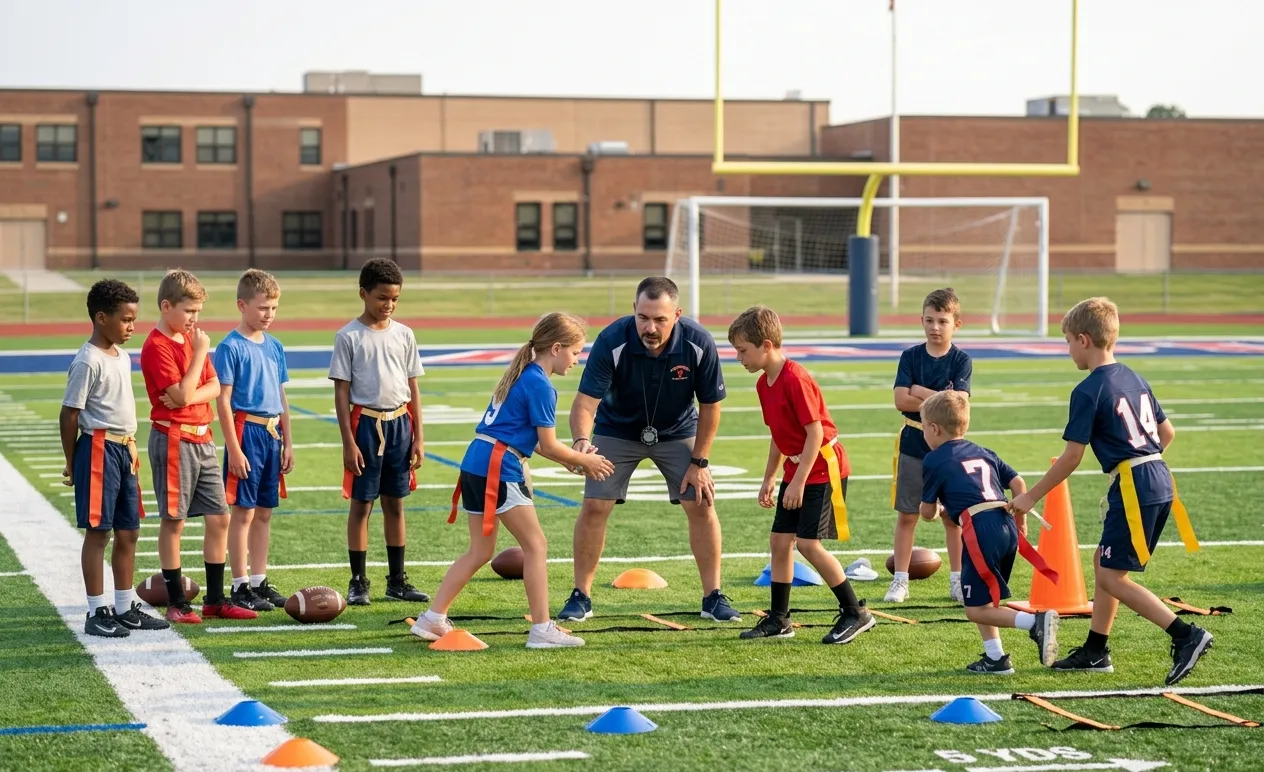
Flag football drills for kids help young players develop football fundamentals while keeping practices fun and engaging. However, many coaches and parents face common challenges during practice. Kids can lose focus, get bored while waiting in long lines, or struggle with drills that are too advanced for their age and skill level. Choosing the right activities can make a big difference in how quickly players learn and how much they enjoy the game. Coaches looking for a complete season structure can also follow a youth football practice plan.
After working with beginner youth players, one thing becomes clear: children learn best when drills are simple, active, and age-appropriate. Activities that focus on passing, catching, flag pulling, agility, and teamwork often produce the best results because they keep players involved and build confidence. In this guide, you will find effective flag football drills, fun practice games, and coaching tips that can help young athletes improve their skills in a safe non-contact environment.
What Are the Best Flag Football Drills for Kids?
The best flag football drills for kids include Red Light Green Light, Partner Passing, Toss and Catch, Flag Pull Relay Race, Cone Weave Drill, and Sharks and Minnows. These drills help improve passing, catching, agility, flag pulling, teamwork, and overall football fundamentals while keeping practice fun and engaging.
Best Warm-Up Flag Football Drills for Kids

A good warm-up helps kids prepare for practice. It increases movement, improves coordination, and gets players focused before more challenging drills begin. Football Warm-up drills before practice should be simple, active, and fun. This helps young athletes stay engaged while reducing the risk of injury.
Red Light Green Light
Red Light Green Light is one of the easiest flag football drills for kids. Players line up on one side of the field while a coach stands several yards away.
When the coach calls “green light,” players run forward. When the coach calls “red light,” they must stop immediately. Players who keep moving after the stop command return to the starting line or take a few steps back.
Players Needed: 4+
Skills developed:
- Reaction time
- Body control
- Balance
- Acceleration
- Listening skills
This drill works especially well for players between ages 5 and 8.
Follow the Coach
In this drill, players spread out with enough space between each other. The coach leads different movements while players copy every action.
The coach can include:
- High knees
- Side shuffles
- Backpedaling
- Quick sprints
- Jumping movements
Changing directions often keeps players alert and improves athletic movement skills.
Players Needed: 3+
Skills developed:
- Coordination
- Agility
- Footwork
- Body awareness
- Movement patterns
This drill is useful for players of all ages and skill levels.
Dynamic Movement Warm-Up
A dynamic warm-up prepares muscles and joints for football activities. Unlike static stretching, players stay in motion throughout the exercise.
A simple dynamic warm-up may include:
- Jogging for 30 seconds
- High knees for 20 yards
- Butt kicks for 20 yards
- Side shuffles for 20 yards
- Short acceleration runs
The entire routine takes only a few minutes. However, it helps players move better during passing, catching, and flag pulling drills later in practice.
Skills developed:
- Mobility
- Speed preparation
- Athletic movement
- Coordination
- Injury prevention
Quick Warm-Up Tips for Coaches
- Keep warm-ups under 10 minutes.
- Use simple instructions.
- Avoid long waiting lines.
- Keep every player moving.
- Add fun competition whenever possible.
Young players learn best when they stay active. Therefore, a fast-paced warm-up often leads to a more productive flag football practice.
Best Flag Pulling Drills for Kids
Flag pulling is one of the most important skills in flag football. A player may have great speed and strong passing skills, but the defense still needs to stop the ball carrier. Good flag pulling drills teach young players how to react quickly, stay under control, and take the correct angle to the ball.
The drills below help improve defensive skills while keeping practice fun and active.
Partner Flag Pull Drill

This is one of the easiest flag football drills for kids to learn.
Players work in pairs. One player wears a flag belt while the other starts a few yards away. The ball carrier jogs forward while the defender moves in and pulls a flag.
After each repetition, players switch roles.
Players Needed: 2
Skills developed:
- Flag pulling
- Body control
- Defensive reaction
- Confidence
Flag Pull Relay Race
Divide players into two or more teams. Each team forms a line behind a starting cone.
The first player runs to a teammate wearing a flag belt, pulls a flag, and returns to tag the next player. The relay continues until every player completes the challenge.
Adding a race element keeps kids engaged throughout the drill.
Players Needed: 4+
Skills developed:
- Speed
- Flag pulling
- Teamwork
- Competitive effort
Angle Pursuit Drill
Set up two cones to create a running lane. The ball carrier starts near one cone and runs toward the opposite side of the field.
The defender starts a few yards away and must take the proper pursuit angle to reach the ball carrier and pull a flag.
Young players often chase directly behind the runner. This drill teaches a smarter path.
Players Needed: 2
Skills developed:
- Pursuit angle
- Defensive footwork
- Open-field defense
- Field awareness
One-on-One Flag Pull Challenge
Create a small playing area with cones.
One player starts with the football while another player lines up as the defender. The offensive player tries to run past the defender. The defender attempts to pull a flag before the runner reaches the end zone.
Keep each rep short and fast.
Players Needed: 2
Skills developed:
- Defensive reaction
- Agility
- Change of direction
- Ball carrier tracking
Mirror and Pull Drill
Players work in pairs. One player acts as the leader while the defender mirrors every movement.
The offensive player moves left, right, forward, or backward for a few seconds. After the coach’s signal, the defender attacks and pulls a flag.
This drill improves balance and quick reactions.
Players Needed: 2
Skills developed:
- Lateral movement
- Balance
- Reaction time
- Defensive positioning
Flag Box Drill
Create a square using four cones.
The ball carrier stays inside the box and tries to avoid defenders. Defenders must stay under control while working to pull a flag.
Because space is limited, players learn to break down and move their feet instead of diving.
Players Needed: 3-6
Skills developed:
- Quick feet
- Defensive control
- Agility
- Open-field defense
Coaching Tips for Flag Pulling Drills
- Teach players to keep their eyes on the hips of the ball carrier.
- Encourage short, quick steps when closing space.
- Focus on control instead of diving.
- Allow plenty of repetitions.
- Praise good effort even when a flag is missed.
Strong flag pulling skills help young players become better defenders. As players improve their reactions, pursuit angles, and defensive footwork, they become more effective during game situations.
Best Passing Drills for Kids
Passing is one of the most exciting parts of flag football. Young players enjoy throwing the ball and making successful completions. However, good passing takes practice. Quarterbacks must learn proper throwing mechanics, while receivers need to understand timing and communication.
These passing drills help kids improve accuracy, confidence, and football fundamentals.
Partner Passing Drill
The Partner Passing Drill is a great starting point for beginners.
Players work in pairs and stand about 5 to 10 yards apart. They throw the football back and forth while focusing on proper technique.
Coaches should remind players to step toward the target and follow through after every throw.
As players improve, increase the distance between partners.
Players Needed: 2
Skills developed:
- Passing accuracy
- Throwing mechanics
- Hand-eye coordination
- Ball control
Target Passing Challenge
Place cones, buckets, or other targets at different distances.
Players attempt to throw the football through or near the targets. Each successful throw earns points.
This drill adds a fun challenge while helping players focus on ball placement.
Players Needed: 1+
Skills developed:
- Accuracy
- Ball placement
- Concentration
- Throwing consistency
Moving Target Passing Drill
A receiver slowly jogs across the field while the quarterback throws the football to the moving target.
Start with short routes before increasing speed and distance.
This drill helps players prepare for real game situations.
Players Needed: 2
Skills developed:
- Timing
- Passing game fundamentals
- Throwing accuracy
- Receiver communication
Quarterback Accuracy Challenge
Set up several cones at different distances.
Players throw the football toward each target and try to hit the correct area. Coaches can award points for accurate throws.
This activity keeps practice competitive and encourages players to improve their passing technique. Players who want to develop stronger throwing mechanics and accuracy can also practice quarterback drills for beginners.
Players Needed: 1+
Skills developed:
- Quarterback development
- Accuracy
- Focus
- Confidence
Pass and Move Drill
Players form small groups.
After making a pass, the quarterback immediately runs to a new position before receiving another football.
This drill combines movement with passing and keeps every player active.
Players Needed: 3+
Skills developed:
- Athletic movement
- Communication
- Throwing under pressure
- Field awareness
Route and Throw Drill
Receivers run simple routes such as:
- Slants
- Outs
- Quick hooks
- Short crossing routes
The quarterback delivers the football at the correct time.
This drill introduces route running while improving passing skills.
Players Needed: 2+
Skills developed:
- Route timing
- Passing accuracy
- Receiver development
- Offensive football skills
Three-Pass Challenge
Divide players into small teams.
The goal is to complete three consecutive passes without dropping the football. If a pass is missed, the team starts again.
Kids enjoy the challenge because it creates friendly competition.
Players Needed: 4+
Skills developed:
- Teamwork
- Communication
- Catch-and-throw skills
- Consistency
Coaching Tips for Passing Drills
- Use age-appropriate footballs.
- Focus on technique before distance.
- Encourage players to keep their eyes on the target.
- Keep lines short to maximize repetitions.
- Celebrate improvement, not just perfect throws.
Strong passing skills help young players become more confident during games. When quarterbacks improve their throwing mechanics and receivers learn proper timing, the entire offense becomes more effective.
Best Catching Drills for Kids

Great catches can turn a simple play into a big gain. That is why catching skills are an important part of every youth flag football practice. Young players need to learn how to track the football, position their hands correctly, and catch with confidence.
The following drills help kids improve receiving skills while keeping practice fun and active. Coaches can also add football catching drills to further develop reaction time and ball control.
Toss and Catch Drill
This is one of the simplest flag football drills for kids.
Players work in pairs and stand a few yards apart. One player tosses the football while the other focuses on making a clean catch.
Start with short throws and gradually increase the distance.
Coaches should encourage players to watch the football all the way into their hands.
Players Needed: 2
Skills developed:
- Catching technique
- Hand-eye coordination
- Focus
- Ball tracking
Soft Hands Drill
Players form a line while a coach stands several yards away.
The coach throws easy passes to each player. Instead of grabbing the football with stiff arms, players should relax their hands and absorb the ball.
This helps young receivers make cleaner catches.
Players Needed: 2+
Skills developed:
- Soft hands
- Catch control
- Receiving confidence
- Hand positioning
Over-the-Shoulder Catch Drill
Players jog downfield while looking over one shoulder.
The coach throws the football slightly ahead of the receiver. The player tracks the ball and makes the catch without slowing down.
Begin with short distances before increasing difficulty.
Players Needed: 2
Skills developed:
- Ball tracking
- Receiver development
- Concentration
- Game-like catching skills
Reaction Catch Drill
Players face away from the coach.
When the coach gives a signal, the player turns around quickly and locates the football in the air.
The goal is to react fast and make a clean catch.
This drill is both fun and challenging for young athletes.
Players Needed: 2
Skills developed:
- Reaction time
- Focus
- Hand-eye coordination
- Catching under pressure
Tennis Ball Catch Drill
Instead of a football, use a tennis ball.
The smaller target forces players to focus closely and react quickly. Once players become comfortable, switch back to a football.
Many coaches use this drill to improve hand speed and concentration.
Players Needed: 2
Skills developed:
- Quick reactions
- Hand speed
- Coordination
- Focus
High Ball Catch Drill
The coach throws high passes above the player’s head.
Receivers must jump, extend their arms, and secure the football at its highest point.
This drill teaches players to attack the football instead of waiting for it to come down.
Players Needed: 2
Skills developed:
- Timing
- Confidence
- Ball tracking
- Catch radius
Catch and Turn Drill
A receiver catches a short pass and immediately turns upfield.
Players should secure the football first and then accelerate into open space.
This drill introduces game situations while reinforcing proper catching habits. Learning proper ball security helps reduce turnovers and improves possession during game situations.
Players Needed: 2
Skills developed:
- Pass reception
- Ball security
- Acceleration
- Field awareness
Coaching Tips for Catching Drills
- Teach players to keep their eyes on the football.
- Encourage catching with the hands instead of trapping the ball against the body.
- Start with easy throws before increasing difficulty.
- Give players plenty of repetitions.
- Build confidence through positive reinforcement.
Strong receiving skills help young players become more reliable teammates. As children improve their catching technique, ball tracking, and concentration, they will make more plays during games and gain confidence on the field.
Best Agility and Footwork Drills for Kids

Agility and footwork are important in flag football. Players need to change direction quickly, avoid defenders, and react to game situations. These drills help young athletes improve speed, balance, and body control.
Cone Weave Drill
Set up several cones in a straight line. Players weave through the cones while staying under control.
Encourage quick feet and sharp direction changes.
Players Needed: 1+
Skills developed:
- Agility
- Footwork
- Body control
- Change of direction
Ladder Footwork Drill
Place an agility ladder on the ground. Players move through each square using different foot patterns.
Start with simple movements before introducing more advanced patterns.
Players Needed: 1+
Skills developed:
- Quick feet
- Coordination
- Balance
- Athletic movement
Shuttle Run Challenge
Place two cones about 5 to 10 yards apart.
Players sprint to one cone, touch the ground, and sprint back. Repeat several times.
Players Needed: 1+
Skills developed:
- Acceleration
- Speed
- Conditioning
- Direction changes
Side Shuffle Race
Players move sideways between two cones without crossing their feet.
This drill teaches proper lateral movement used in both offense and defense.
Players Needed: 2+
Skills developed:
- Lateral movement
- Balance
- Defensive footwork
- Coordination
Reaction Sprint Drill
Players start in an athletic stance. When the coach points in a direction, they sprint toward the indicated cone.
Changing the signal keeps players alert and focused.
Players Needed: 1+
Skills developed:
- Reaction time
- Speed
- Athletic awareness
- Acceleration
Figure Eight Cone Drill
Arrange two cones several yards apart. Players run in a figure-eight pattern around both cones.
This drill challenges balance and body control while changing direction.
Players Needed: 1+
Skills developed:
- Agility
- Footwork
- Balance
- Coordination
Coaching Tips for Agility Drills
- Focus on proper movement before speed.
- Keep players moving.
- Encourage good effort.
- Use short work periods with quick breaks.
- Make drills competitive when possible.
Improved agility and footwork help players perform better in every area of flag football. These skills support passing, receiving, flag pulling, and route running.
Fun Flag Football Games for Kids
Kids learn best when they enjoy practice. Fun games keep players engaged while helping them build important football skills.
Flag Tag
One player starts as the chaser while everyone else tries to avoid having their flag pulled.
Once a player’s flag is pulled, they become the next chaser.
Players Needed: 5+
Skills developed:
- Agility
- Flag pulling
- Reaction time
- Speed
Sharks and Minnows
Players line up on one side of the field while a few defenders stand in the middle.
The goal is to cross the field without losing a flag.
Players Needed: 6+
Skills developed:
- Open-field running
- Evasion skills
- Decision-making
- Agility
Capture the Flag Football Edition
Divide players into two teams.
Each team protects its flag while trying to capture the opponent’s flag.
Players Needed: 8+
Skills developed:
- Teamwork
- Communication
- Strategy
- Athletic movement
Relay Race Challenge
Teams compete in football-themed relay races that include sprinting, catching, and flag pulling stations.
Players Needed: 4+
Skills developed:
- Teamwork
- Speed
- Coordination
- Competition
End Zone Challenge
Players attempt to reach the end zone while defenders try to pull their flags.
This game creates excitement while reinforcing game situations.
Players Needed: 4+
Skills developed:
- Ball carrying
- Defensive reaction
- Field awareness
- Confidence
Football Obstacle Course
Set up cones, ladders, and football stations.
Players complete the course while carrying a football.
Players Needed: 1+
Skills developed:
- Agility
- Coordination
- Ball control
- Athletic development
Fun games help maintain player engagement and create positive practice experiences for young athletes.
Flag Football Drills by Age Group

Choosing age-appropriate drills helps players learn faster and enjoy practice more.
Ages 5–7
Young players benefit from simple activities with plenty of movement.
Recommended drills:
- Red Light Green Light
- Follow the Coach
- Flag Tag
- Toss and Catch
- Cone Chase Drill
Focus on:
- Coordination
- Basic movement skills
- Confidence
- Fun participation
For players under age 8, focus on movement, catching, and flag pulling before introducing advanced route-running concepts. Building strong fundamentals early often leads to better long-term development.
Ages 8–10
Players in this group can handle more structured drills and simple competition.
Recommended drills:
- Partner Passing
- Flag Pull Relay Race
- Cone Weave Drill
- Reaction Catch Drill
- Sharks and Minnows
Focus on:
- Football fundamentals
- Teamwork
- Skill development
- Game awareness
Ages 11–12
Older players are ready for more advanced concepts and game situations.
Recommended drills:
- Route and Throw Drill
- Quarterback Accuracy Challenge
- One-on-One Flag Pull Challenge
- Reaction Sprint Drill
- Small-Sided Scrimmages
Focus on:
- Route running
- Football IQ
- Decision-making
- Position-specific skills
| Age Group | Main Focus | Recommended Practice Length |
|---|---|---|
| 5–7 | Movement, catching, flag pulling, fun games | 30–45 minutes |
| 8–10 | Passing, teamwork, agility, football fundamentals | 45–60 minutes |
| 11–12 | Route running, game situations, football IQ | 60–75 minutes |
Common Skills Kids Develop Through Flag Football Drills
Flag football drills do more than teach football fundamentals. They also help young athletes build skills that support success in many sports and daily activities.
Hand-Eye Coordination
Passing and catching drills improve hand-eye coordination by teaching players to track and control the football.
Agility and Footwork
Cone drills, ladder drills, and reaction exercises help players move efficiently and change direction with confidence.
Teamwork and Communication
Many flag football games require players to work together, communicate clearly, and support teammates.
Football IQ
As players learn route running, positioning, and defensive responsibilities, they begin to develop better football awareness and decision-making skills.
Confidence
Mastering new skills and seeing improvement over time can help young athletes feel more confident on and off the field.
Best Flag Football Drills for Kids at a Glance
| Drill | Skill Developed | Age Group |
|---|---|---|
| Red Light Green Light | Reaction Time | 5–7 |
| Toss and Catch | Catching Skills | 5–10 |
| Partner Passing | Passing Accuracy | 8–12 |
| Flag Pull Relay Race | Defensive Skills | 8–12 |
| Cone Weave Drill | Footwork | 8–12 |
| Reaction Catch Drill | Concentration | 8–12 |
| Route and Throw Drill | Game Skills | 11–12 |
| Sharks and Minnows | Agility | 5–12 |
Best Flag Football Drills by Skill
| Skill | Recommended Drill |
|---|---|
| Passing Accuracy | Partner Passing Drill |
| Catching Skills | Reaction Catch Drill |
| Flag Pulling | Flag Pull Relay Race |
| Agility | Cone Weave Drill |
| Footwork | Ladder Footwork Drill |
| Speed | Shuttle Run Challenge |
| Teamwork | Capture the Flag Football Edition |
| Football Awareness | Route and Throw Drill |
This table can help coaches quickly choose drills based on the specific skill they want to improve during practice.
How Many Kids Are Needed for Each Drill
| Drill | Players Needed |
|---|---|
| Partner Passing | 2 |
| Toss and Catch | 2 |
| Flag Pull Relay Race | 4+ |
| Sharks and Minnows | 6+ |
| Capture the Flag Football Edition | 8+ |
| Cone Weave Drill | 1+ |
| Ladder Footwork Drill | 1+ |
| End Zone Challenge | 4+ |
This table helps parents, youth coaches, and volunteer coaches choose drills based on the size of their group.
Sample 30-Minute Flag Football Practice Plan for Kids

A simple practice plan keeps players active and organized.
| Time | Activity |
|---|---|
| 5 Minutes | Dynamic Warm-Up |
| 5 Minutes | Flag Pull Relay Race |
| 5 Minutes | Partner Passing Drill |
| 5 Minutes | Reaction Catch Drill |
| 5 Minutes | Cone Weave Drill |
| 5 Minutes | End Zone Challenge |
This schedule keeps waiting time low and allows players to practice multiple skills during one session.
Young players do not need complicated drills to improve. In most youth flag football practices, consistent repetitions, simple instructions, and positive feedback are often more effective than advanced schemes or playbooks.
Common Coaching Mistakes to Avoid
Long Waiting Lines
Players lose focus when they spend too much time standing around.
Instead, create smaller groups and multiple stations.
Using Drills That Are Too Difficult
Young athletes learn best through simple progressions.
Start with basic drills before moving to advanced activities.
Talking More Than Practicing
Short explanations work better than long speeches.
Allow players to learn through repetition.
Focusing Only on Winning
Youth sports should focus on development first.
Praise effort, improvement, and teamwork.
Ignoring Skill Progression
Players need age-appropriate drills that match their current abilities.
Build skills step by step.
Safety Tips for Youth Flag Football
Safety should always be part of every practice.
Encourage Proper Hydration
Provide regular water breaks, especially during warm weather.
Use Age-Appropriate Equipment
Make sure players use properly fitted flag belts and youth footballs.
Maintain a Safe Playing Area
Check the field for holes, rocks, or other hazards before practice begins.
Start Every Practice With a Warm-Up
A proper warm-up helps prepare muscles and reduces the risk of injury.
Supervise All Activities
Coaches should watch drills closely and correct unsafe behavior when needed.
Equipment Needed for Flag Football Drills
You do not need expensive equipment to run effective practices.
Basic items include:
- Youth footballs
- Flag belts
- Training cones
- Agility ladder
- Field markers
- Pinnies
- Whistle
- Water bottles
With a few simple tools, coaches can create fun and productive training sessions.
- Choose drills based on the age and skill level of your players.
- Keep practices active to reduce waiting time and improve engagement.
- Focus on passing, catching, flag pulling, agility, and teamwork.
- Use fun games to help kids learn while staying motivated.
- Short, organized practices often produce better results than long sessions.
- Prioritize player development, confidence, and enjoyment over winning.
Conclusion
The best flag football drills for kids are usually the ones that keep players active, engaged, and excited to learn. While every team is different, young athletes often improve faster when practices focus on simple skill development, consistent repetition, and positive coaching. Drills that teach passing, catching, flag pulling, agility, and teamwork can help build a strong foundation for long-term success.
From a youth coaching perspective, the goal is not simply to win games. It is to help players develop confidence, learn football fundamentals, and enjoy being part of a team. By using age-appropriate drills, creating a fun practice environment, and encouraging steady improvement, coaches and parents can help young players continue growing both on and off the field.
Frequently Asked Questions
What are the best flag football drills for kids?
Some of the best flag football drills for kids include Red Light Green Light, Partner Passing, Flag Pull Relay Race, Cone Weave Drill, and Reaction Catch Drill. These activities develop football skills while keeping players engaged.
How long should a flag football practice be for kids?
Most youth flag football practices last between 30 and 60 minutes. Younger players often perform best with shorter sessions.
What age can children start flag football?
Many leagues welcome children as young as 5 years old. Simple drills and fun games work best for beginners.
Which drills improve flag pulling skills?
Partner Flag Pull Drill, Angle Pursuit Drill, Mirror and Pull Drill, and Flag Pull Relay Race are effective choices.
How often should kids practice flag football?
Two to three practices per week are usually enough for skill development while keeping the sport enjoyable.
