



Quick Takeaway
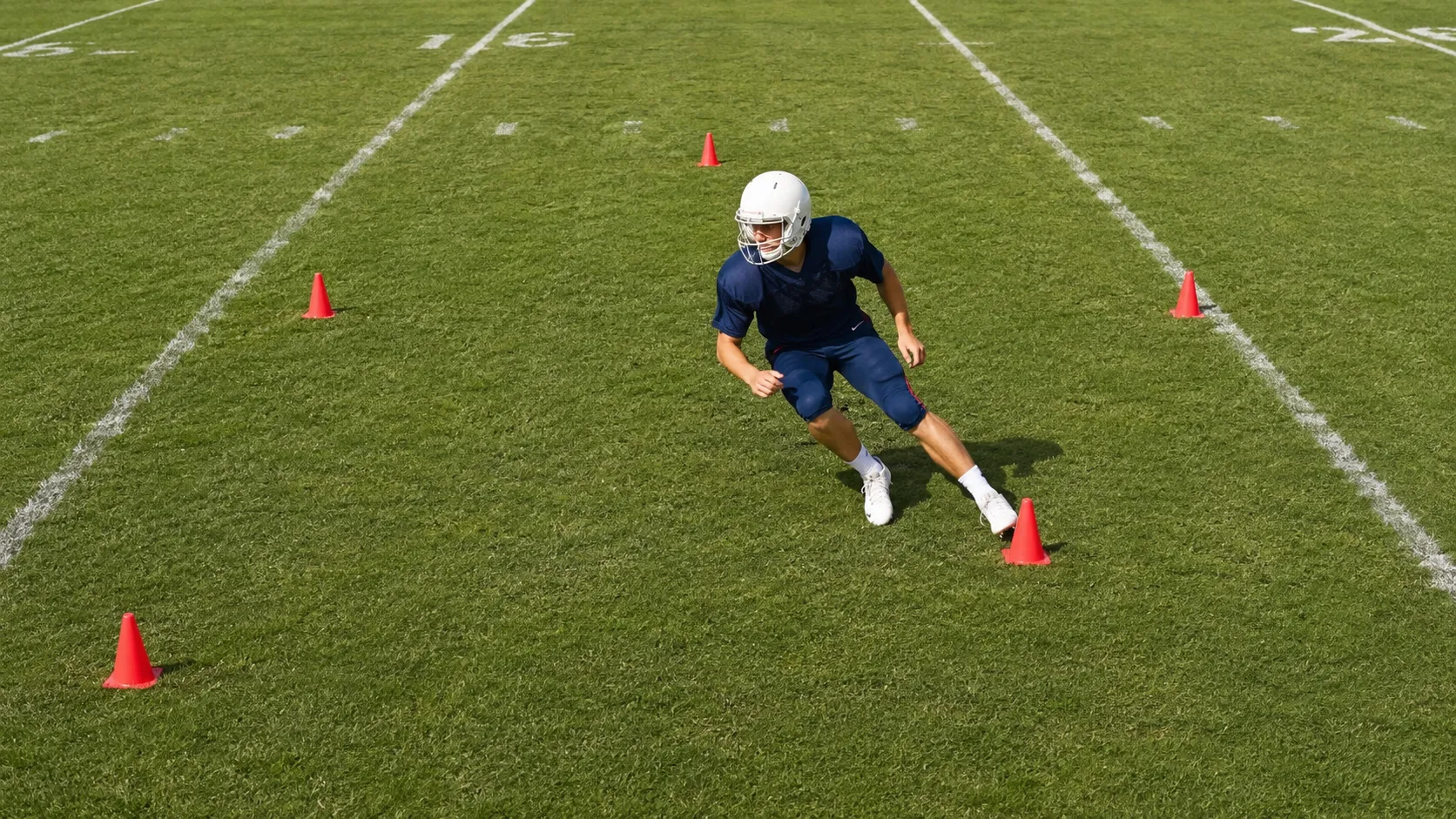
The Star Drill uses five cones in a star-shaped pattern. The player accelerates between cones, controls the approach, plants, changes direction, and speeds up again. Beginners should learn the route at a controlled pace before trying faster reps. Run the drill from both sides to practice changing direction each way.
What Is the Star Drill?
The Star Drill is a multidirectional football drill performed with cones. In the five-cone version, the cones mark the outer points of a star. The player follows a set route that creates several direction changes during one rep.
The name Star Drill can also refer to other layouts. Some versions use a center cone with players moving out and back. This guide covers the five-cone football version, where the player runs through the outer points of the star.
Because the route is known before the player starts, the standard version is mainly a planned change-of-direction drill. A coach can later add an unknown signal or cone call to make a variation more reactive.
Benefits of the Star Drill for Football
The Star Drill combines several movement skills in one continuous pattern. Players who want broader training can also use football agility drills that include different movement and reaction patterns.
- Repeated planned direction changes: The star-shaped route makes players cut several times during one rep. Because the route is known before the player starts, the standard Star Drill mainly trains planned change of direction. For more focused work on planting, cutting, and redirecting movement, see these change of direction drills for football.
- Speed control before several cuts: Players must control their approach before planting and moving toward the next cone. The NSCA explains that during deceleration, athletes use braking to slow down before moving into another action, such as a cut.
- Re-acceleration through different angles: After each plant and direction change, the player pushes into a new direction and builds speed toward the next cone. This sequence repeats as the player moves through the star.
- Balance through a crossing star route: The crossing pattern sends the player through several angles in one rep. Staying balanced helps the player control each plant, cut, and exit without making wide turns.
Equipment and Setup
Equipment You Need
The basic Star Drill needs very little equipment:
- 5 cones
- A flat, open training area
- Football field markings if available
- A stopwatch if you want to record completion time
No football is required for the basic movement version.
How to Set Up the Star Drill
Place five cones at the five outer points of a star. The football version described by Football Drills Book uses a star about 10 yards high.

Use the bottom-left cone as the starting point.
The route is:
Bottom left → Top → Bottom right → Far left → Far right → Finish across the starting side
Make sure the player knows the full route before increasing speed. Beginners can walk through the pattern once or twice first.
Coach’s Tip: A numbered diagram is useful for this drill. Mark each cone in running order so a new player can understand the route before the first rep.
How to Perform the Star Drill
- Start at the bottom-left cone. Use a balanced athletic stance with the knees slightly bent and eyes forward.
- Accelerate toward the top cone. Build speed while staying under control.
- Control your approach. As you get close to the cone, prepare for the direction change instead of running past it. Players who struggle to slow down before a cut can first practice basic football deceleration drills.
- Plant and change direction. Stay balanced through the plant and turn toward the bottom-right cone.
- Re-accelerate after the cut. Push into the new direction and use quick first steps to regain speed. This approach follows the same basic COD sequence used in NSCA coaching: control the approach, make the cut, and accelerate into the new direction.

- Continue through the star. Move from the bottom-right cone to the far-left cone, then toward the far-right cone.
- Finish across the starting side. Complete the full star pattern without skipping a cone.
- Repeat from the opposite side. After learning the pattern, start from the bottom-right side and reverse the route.
Running the pattern in both directions gives the player practice with cuts to each side.
Coaching Tips for Better Direction Changes
Good technique matters more than rushing through the cones.
- Keep your eyes up instead of staring at your feet.
- Stay balanced as you approach each cone.
- Control your final steps before a sharp cut.
- Keep the hips in a comfortable athletic position.
- Plant close enough to the cone to avoid a wide turn.
- Push away from the plant and move into the new direction.
- Use quick steps when leaving the cut.
- Keep the arms active during acceleration.
- Practice the star in both directions.
Players who still struggle with basic step control can build that foundation with simpler football footwork drills before increasing Star Drill speed.
Do not chase a faster time if the player starts missing cones or losing control.
Common Star Drill Mistakes and Fixes
| Mistake | Simple Fix |
|---|---|
| Running too wide around a cone | Stay closer to the cone and control the approach |
| Entering the cut too fast | Reduce speed slightly before the plant |
| Staying too upright | Use a balanced athletic position during the cut |
| Taking uncontrolled steps | Shorten the approach steps as needed |
| Losing balance at the plant | Slow the drill down and clean up the movement |
| Slow exit after the cut | Push into the new direction and use quick first steps |
| Forgetting the route | Walk through the pattern before faster reps |
| Always starting on one side | Reverse the starting side regularly |
Recommended Reps and Rest
Beginners do not need a large number of Star Drill reps. The goal is to keep each repetition controlled and clean. These are practical starting ranges for beginners, not fixed rules.
| Goal | Reps |
|---|---|
| Learning | 2–3 |
| Technique | 3–4 |
| Faster COD | 3–5 |
Research on multidirectional training supports using recovery between high-intensity repetitions when the goal is to preserve movement quality. However, there is no single Star Drill rep and rest formula that is best for every football player.
Stop or add more recovery if technique starts to break down.
Beginner Star Drill Progression
New players should build speed in stages.
1: Walk the route
Learn where every cone is located.
2: Jog the pattern
Follow the correct path without worrying about speed.

3: Use controlled cuts
Practice approaching, planting, and leaving each cone with balance.
4: Add more speed
Increase the pace while keeping the turns controlled.
5: Run faster reps
Use higher effort once the player can complete the pattern without losing control.
Moving through these stages helps beginners learn the drill before making speed the main goal.
Star Drill Variations
Star Drill Variations
Reverse Star Drill
Opposite side se start karke route reverse direction mein complete karein. Isse player dono turning directions practice karta hai.
Short Star Drill
Cones ko closer set karein. Beginners pehle smaller pattern mein route aur controlled cuts learn kar sakte hain.
Mixed-Movement Star Drill
Selected sections mein sprint ke saath lateral shuffle ya backpedal use karein. Is variation ko simple rakhein taake movement sequence clear rahe.
Reactive Star Drill
Have the coach call a cone number, direction, or give a visual signal so the player does not know the next movement in advance. This adds a decision-making element to the standard Star Drill, which follows a planned route.
A 2026 study of U16 soccer players compared predetermined multidirectional drills, including a Star Drill, with similar training performed in response to visual cues. The reactive group showed greater improvements in the study’s reactive-agility tests.
Star Drill vs Other Football Cone Drills
Different cone drills place more focus on different movement patterns.
| Drill | Main Focus |
|---|---|
| Star Drill | Repeated multidirectional changes |
| 5-10-5 Shuttle Drill | Lateral change of direction and re-acceleration |
| T Drill | Forward, lateral, and backward movement |
| L Drill | Curved movement and direction changes |
| Figure 8 Drill | Controlled rounded turns around two cones |
The Star Drill is useful when you want several planned direction changes in one continuous route. Other drills may be better when the training goal is a specific movement pattern.
Who Should Use the Star Drill?
The Star Drill is most useful as a general movement drill for players who need repeated changes of direction. Defensive backs, linebackers, running backs, and special teams players may find the pattern useful, but the drill does not copy a specific game action.
For beginners, focus on learning the pattern and moving with control before using faster reps.
When to Add the Star Drill to Practice
Use the Star Drill after a suitable warm-up when players are ready for faster movement.
If the goal is change-of-direction technique or speed, place it before players become heavily tired. This makes it easier to focus on clean footwork, controlled plants, and strong re-acceleration.
The drill can also fit into a football agility or cone-drill session.
Continue Training
Build your footwork, agility, and change-of-direction skills with these related football drills.
Football Agility Drills
Practice beginner-friendly drills for better footwork, body control, and direction changes.
View Drills →Football Footwork Drills
Build quicker feet, better balance, and more controlled movement with simple drills.
View Drills →L Drill (3 Cone Drill)
Practice tight turns, curved movement, footwork, and short-area direction changes.
Learn the Drill →Speed & Agility Drills
Combine simple speed and agility work to improve controlled football movement.
Start Training →Frequently Asked Questions
How many cones do you need for the Star Drill?
The football Star Drill in this guide uses five cones. Place them at the five outer points of a star. The player then follows a planned route between the cones and makes several direction changes during one rep.
How far apart should Star Drill cones be?
A common five-cone football version uses a star-shaped setup about 10 yards high. Coaches can reduce the spacing for beginners who are still learning the route. Keep enough space for players to approach, plant, and change direction under control.
Is the Star Drill an agility drill?
The standard Star Drill is more accurately described as a planned change-of-direction drill because the player knows the route before starting. A reactive variation can add a coach call or visual cue, which requires the player to make a decision before changing direction.
Is the Star Drill good for beginners?
Yes, but beginners should learn the route before adding speed. Start by walking or jogging through the star pattern. Then add controlled cuts and faster reps as the player becomes more comfortable with the route and direction changes.
Conclusion
The Star Drill gives football players a simple way to practice repeated changes of direction in several angles. Five cones create the route, while each turn requires the player to control speed, plant, redirect, and accelerate again.
Start slowly, learn the pattern, and keep each cut under control. Once the movement looks clean, increase the pace and practice the drill in both directions.
References
- Doua N, Marzouki H, Selmi O, et al. (2026). Comparative effects of reactive and planned agility training on physical performance, internal load and enjoyment in youth soccer players. Scientific Reports, 16, 11302.
- Nature / Scientific Reports National Strength and Conditioning Association. Acceleration and Deceleration Mechanics.
- NSCA source National Strength and Conditioning Association. Run and Cut
