



Quick Takeaways
- The W Drill trains backpedaling, planting, change of direction, and the forward break.
- It is mainly used by defensive backs, including cornerbacks and safeties.
- Players practice quick feet, balance, body control, and defensive footwork.
- Beginners should learn the W-shaped movement pattern at a controlled pace first.
- Add more speed only when the player can complete each transition with clean footwork.
What Is the W Drill in Football?
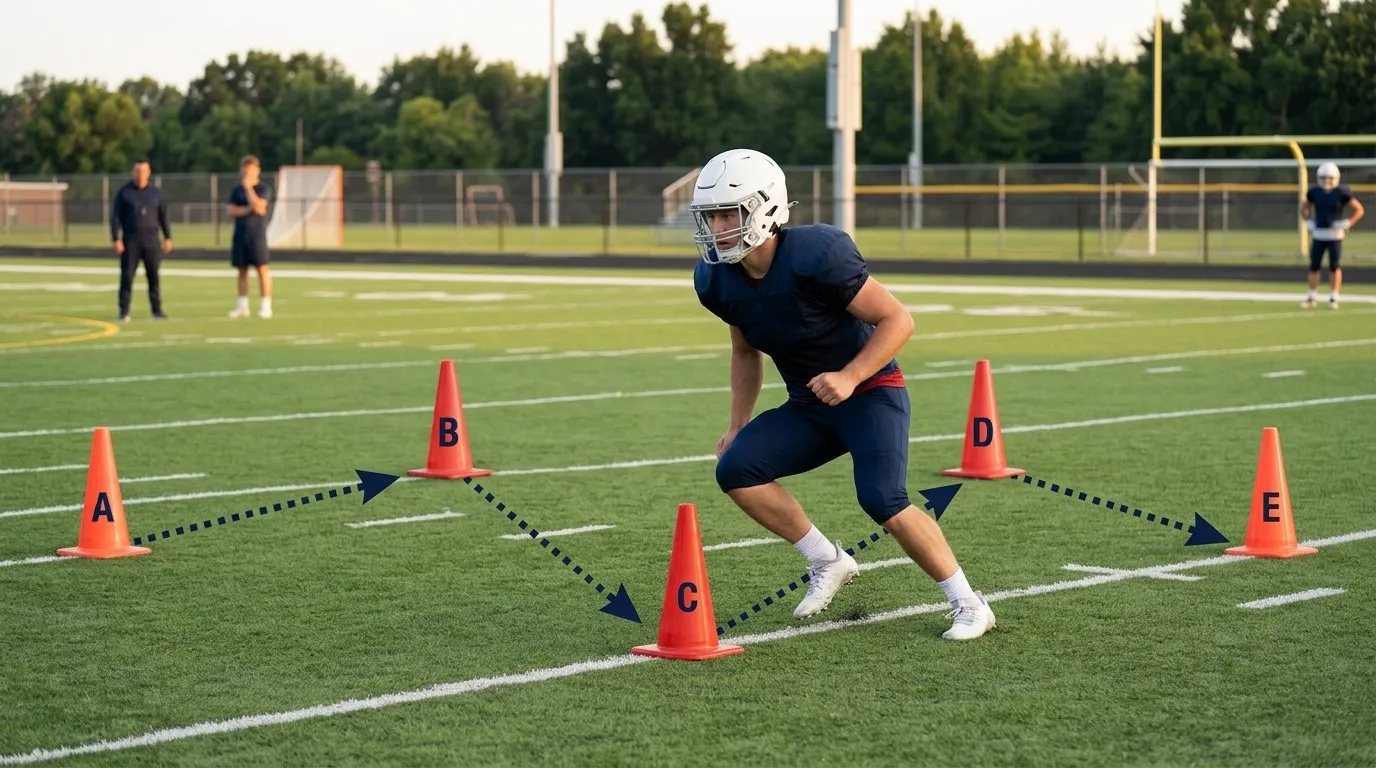
The W Drill is a cone drill that uses repeated backward and forward movements to create a W-shaped path. A player backpedals toward a cone, controls the approach, plants, and then drives forward at an angle.
Defensive backs, including cornerbacks and safeties, use the drill to practice moving from a backpedal in coverage into a forward break. NFL Play Football also includes the W Drill in its defensive football training resources.
The goal is not to move through the cones as fast as possible. Players should stay balanced, use clean footwork, and control each change of direction.
What Skills Does the W Drill Train?
The W Drill combines several movement skills in one simple pattern.
- Backpedal control: The player learns to move backward while keeping the body balanced.
- Defensive footwork: The drill uses movement patterns common for defensive backs.
- Deceleration: The player must control backward momentum before planting.
- Change of direction: Each plant changes the path from backward to forward movement.
- Players who need more practice with planting, cutting, and controlling directional changes can also use these change of direction drills.
- Re-acceleration: After the plant, the player must drive forward again.
- Balance and body control: Good posture helps the player stay stable through each transition.
- Quick feet: Controlled steps make it easier to plant and break without extra foot movement. For more ways to develop controlled steps, balance, and quick feet, see our football footwork drills guide.
These skills also explain why the W Drill should be treated as a technique drill rather than simple conditioning.
Benefits of the W Drill for Football
- Improves defensive footwork: Helps players control their feet during backward and forward movement.
- Builds backpedal control: Teaches defensive backs to stay balanced while moving backward.
- Trains change of direction: Players practice planting and moving quickly into a new direction.
- Improves body control: Repeated transitions help players stay balanced during each break.
- Develops quicker transitions: Trains the move from a backpedal into a forward break.
- Works both directions: Players can practice planting and breaking to the left and right.
- Adds football-specific movement: The pattern matches movements cornerbacks and safeties often use in coverage.
The W Drill can also be used alongside other football agility drills to develop a wider range of movement patterns.
Equipment Needed for the W Drill
You only need a few items:
- 5 or 6 training cones
- A flat football field or safe training area
- About 5 yards of spacing between cones as a starting point
- A football for an optional ball-finish variation
Players should have enough room to backpedal, plant, and drive forward without running into another athlete.
How to Set Up the W Drill
Place the cones so the player’s route forms a W pattern. If you want to practice other movement patterns with the same equipment, explore these cone drills for football.

For a simple beginner setup, use five cones. Space the cones about 5 yards apart and alternate them forward and backward to create the W shape.
Cone layouts can vary by version. NFL Flag Football, for example, shows a longer W Drill using seven or more cones spaced about 5 yards apart.
The player begins at the first cone in a defensive stance. The remaining cones show where each backpedal and forward break will finish.
Do a slow walk-through before the first full rep. This helps the player learn the route without looking down at every cone.
Why W Drill Setups Can Look Different
There is no single W Drill layout used by every coach. Some versions use five cones, while others use six or more. Cone angles can also change based on the space available and the skill being coached.
The key pattern stays similar: backpedal, control the plant, change direction, and drive forward.
For beginners, keep the setup simple and give the player enough space to control each transition.
How to Perform the W Drill Step by Step
- Start in a defensive stance. Keep the knees slightly bent, hips controlled, chest up, and eyes forward.
- Backpedal toward the first change point. Use controlled steps instead of reaching backward with long strides.
- Control your approach to the cone. Do not wait until the last moment to control your backward momentum.
- Plant and change direction. Keep your body balanced as you move from the backpedal into the forward break.
- Drive forward toward the next cone. Use the arms and legs together to move out of the break.
- Transition back into the backpedal. Stay under control as the next part of the W begins.
- Repeat the pattern. Continue the backpedal, plant, and forward-break sequence through the remaining cones.
- Finish through the final cone. Do not slow down before reaching the end of the drill.
Run reps from both starting directions when possible. This gives players practice planting and breaking on both sides.
See the three key movements used in the W Drill: backpedal, controlled plant, and forward break.
W Drill Coaching Tips
Focus on movement quality before speed.
Stay low and balanced. A slight bend at the knees and hips can help the player control the backpedal and plant.
Keep the eyes forward. Beginners may need to look at the cones during the first walk-through. Once they know the pattern, encourage them to keep their eyes up.

Use controlled backpedal steps. Long reaching steps can make the next plant harder to control.
Do not rush the plant. The player must control backward movement before driving in the new direction. This braking phase is an important part of clean direction changes. Players who struggle to slow down before the plant can first practice basic deceleration drills.
Use the arms during the forward break. Good arm action should work with the legs as the player moves forward.
Train both directions. Alternate the starting side so the athlete does not practice only one plant or break.
A good rep should look controlled in the backpedal, clean at the plant, and quick out of the forward break.
Common W Drill Mistakes and How to Fix Them
| Common mistake | Why it causes a problem | Simple fix |
|---|---|---|
| Standing too upright | Makes the backpedal and plant harder to control | Bend the knees and stay in an athletic position |
| Taking long backpedal steps | Can reduce balance before the plant | Use shorter, controlled steps |
| Rounding the cone | Removes the clear change of direction | Control the approach, plant, then break |
| Losing balance at the plant | Makes the forward transition slower and less controlled | Reduce speed and clean up the plant first |
| Looking down throughout the drill | Limits visual awareness | Learn the pattern slowly, then keep the eyes forward |
| Taking extra steps after planting | Delays the forward break | Practice a cleaner plant-to-drive transition |

If technique starts to break down, reduce the speed. A slower clean rep is more useful for a beginner than a fast rep with poor footwork.
W Drill Progressions and Variations
Start with the basic version. Then make the drill harder only when the player can stay balanced through the full pattern.
Beginner W Drill: Walk through the pattern first. Then perform it at a controlled speed. Focus on the backpedal, plant, and forward break.
Reactive W Drill: Instead of relying only on the cone pattern, have a coach give a visual or verbal signal for the break. This adds a reaction element.
Ball-Finish W Drill: After the final break, the coach throws a football. The defensive back must find the ball and complete the catch. This adds ball awareness to the footwork pattern.
A Colts defensive-back W-Drill uses a similar progression: the coach signals the changes during the backpedal, and the defensive back finishes by locating and catching a thrown football.
These progressions move the drill from a planned movement toward a more football-specific response.
Who Is the W Drill Best For?
The W Drill is mainly useful for defensive backs, especially cornerbacks and safeties.
These players often need to backpedal in coverage and then break forward as the play changes. This Drill gives them a controlled setting to practice that transition.
Other defensive players may use parts of the pattern when it fits their training goal. However, the drill should remain focused on movement quality rather than being used as a general conditioning drill for every position.
When to Use the W Drill in Football Practice
Use the drill after players have completed a proper warm-up. It can fit well during a defensive-back individual period or a short footwork and change-of-direction block.
For beginners, start with a small number of controlled reps. Allow enough rest for the player to repeat the drill with good technique. The goal is clean movement, not fatigue.
A simple progression is to practice the basics of the drill first. Once the player’s footwork becomes consistent, increase the speed or add a coach signal or football finish.
Safety Tip:
Use a flat, dry surface with enough space between players. Stop the rep if a player cannot control the plant or change of direction safely.
Continue Learning
Build better footwork, agility, and change of direction with these related football drills.
5-10-5 Shuttle Drill
Practice quick plants, short acceleration, and fast change-of-direction movements.
View Drill Guide →T Drill
Train forward, lateral, and backward movement while improving footwork and body control.
View Drill Guide →L Drill (3 Cone Drill)
Practice tight turns, balance, foot placement, and change of direction around three cones.
View Drill Guide →W Drill FAQs
1. How many cones do you need for the W Drill?
A basic W Drill can use five cones. Some versions use six or more cones to add extra backpedal-to-forward transitions.
2. How far apart should W Drill cones be?
About 5 yards is a useful starting point. Coaches can reduce or increase the spacing based on age, skill level, and the movement being trained.
3. Is the W Drill good for defensive backs?
Yes. The W Drill is especially useful for cornerbacks and safeties because it practices backpedaling, planting, and breaking forward.
4. Can beginners do the W Drill?
Yes. Beginners should learn the cone pattern at a controlled speed first. Increase speed after they can plant and change direction without losing balance.
5. Should you do the W Drill at full speed?
Not at first. Beginners should focus on clean footwork and body control. Once the movement is consistent, they can gradually perform faster reps.
References
- NFL Play Football. Video Gallery: Defense – W Drill. Features the W Drill as a defensive football training drill and demonstrates defensive-back movement and footwork. NFL Play Football – W Drill
- National Strength and Conditioning Association (NSCA). Personal Training Quarterly, Issue 1.2: W-Drill, p. 31. Covers the five-cone W setup and the backpedal, deceleration, and forward acceleration sequence.
NSCA W-Drill, Page 31 - Indianapolis Colts. The Last Line of Defense. Covers a defensive-back W Drill using coach signals, backpedaling, forward breaks, opposite-direction reps, and a football catch at the finish.
Indianapolis Colts W-Drill
