



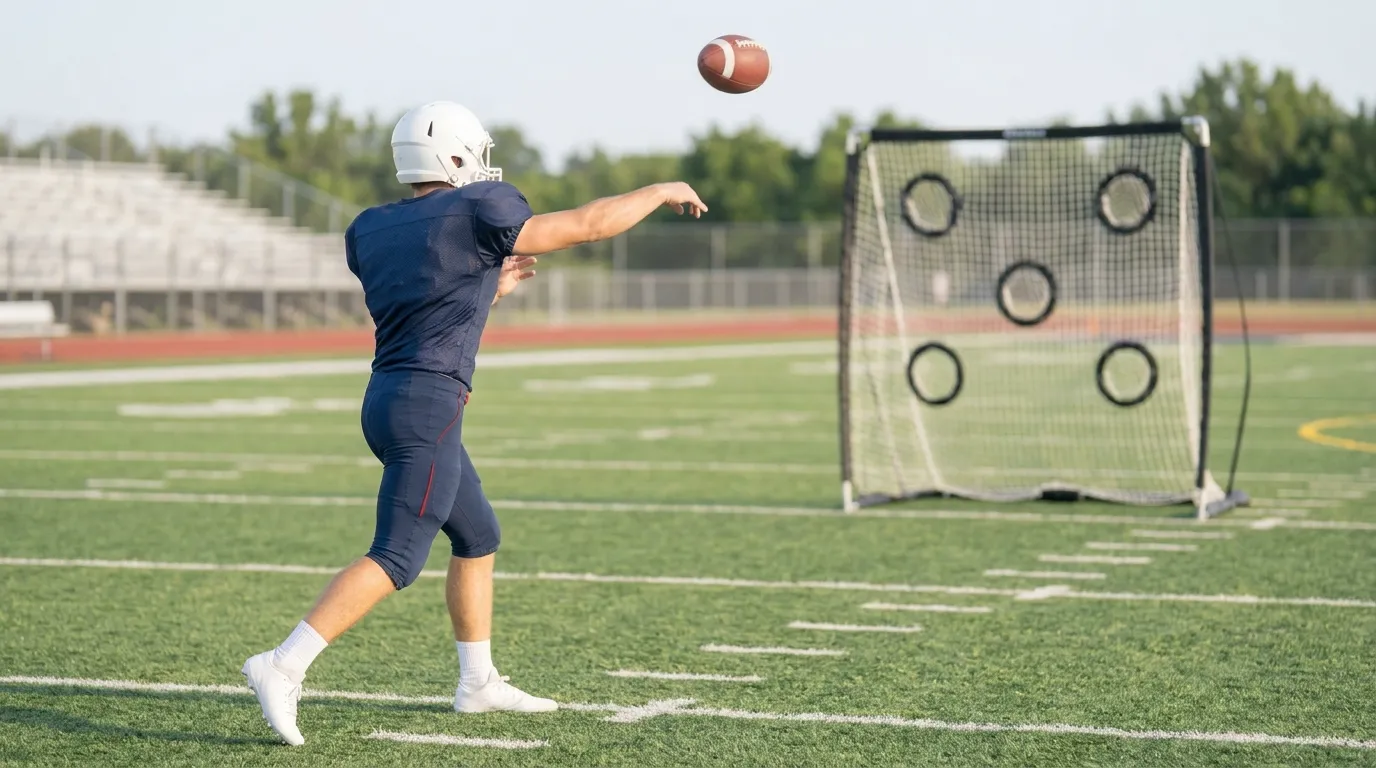
Quarterback passing accuracy drills help players improve ball placement, throwing mechanics, and control. These exercises teach beginner quarterbacks how to throw more accurate passes through better footwork, balance, and timing.
Accurate passing is not just about throwing the football hard. It requires a consistent release, proper body alignment, and practice. This guide covers nine quarterback accuracy drills, common mistakes, ways to measure progress, and a simple practice plan for beginners.
Quick Answer: The best quarterback passing accuracy drills for beginners are Stationary Target Passing, Punch Step Accuracy, and Three-Target Passing. Start with short throws and large targets. Once your technique becomes consistent, add distance, dropbacks, and moving receivers.
What Makes a Quarterback Throw Accurate?
Accurate passes depend on five basic skills:
- Football grip: Hold the ball mainly with your fingers. Keep your grip firm but relaxed.
- Throwing stance: Keep your feet about shoulder-width apart and your knees slightly bent.
- Footwork and weight transfer: Step toward the target while rotating your hips and shoulders naturally.
- Release and follow-through: Use a smooth throwing motion and let your arm finish naturally across your body.
- Timing and ball placement: Aim for a spot where the receiver can catch the ball without making a difficult adjustment.
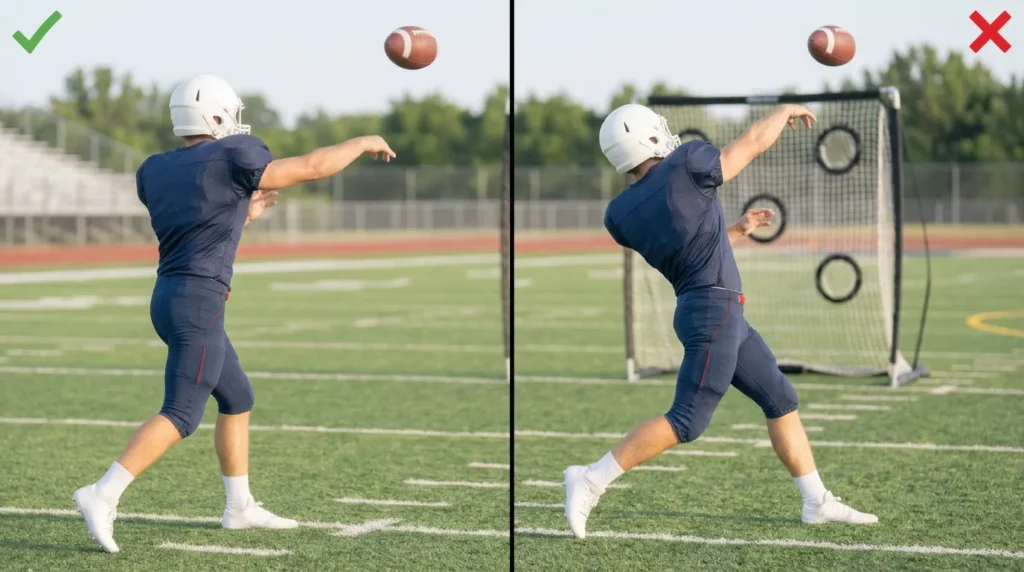
Accurate passing depends on how these skills work together. According to USA Football’s guide to passing mechanics, proper foot placement, weight transfer, and throwing timing help quarterbacks deliver more consistent passes.
Beginners who want to build their overall quarterback skills can start with our quarterback drills for beginners, which cover throwing, footwork, and basic QB movements.
Equipment and Setup for QB Accuracy Drills
You only need a few basic items:
- Football: Choose the correct size for the player’s age.
- Cones: Mark throwing spots and movement paths.
- Target: Use a passing net, marked target, or receiver.
- Practice area: Choose a safe, open field with enough throwing space.
- Partner: Optional for most drills, but needed for moving-receiver practice.
Beginners can start about 5 yards from a large target. Adjust the distance based on throwing ability.
Warm up with easy throws before harder drills. Stop if shoulder or elbow pain develops.
Which Quarterback Accuracy Drill Should You Practice?
Choose a drill based on the passing problem you want to improve.
| Passing problem | Recommended drill |
|---|---|
| Missing stationary targets | Stationary Target Passing |
| Poor foot alignment | Punch Step Accuracy |
| Difficulty controlling soft throws | Bucket Target Passing |
| Accuracy drops with distance | Distance Ladder Passing |
| Trouble changing targets | Three-Target Accuracy |
| Inaccurate passes after a dropback | Three-Step Drop Accuracy |
| Passes behind moving receivers | Moving Receiver Lead Pass |
| Poor accuracy after rolling out | Rollout and Reset Passing |
| Losing balance in the pocket | Pocket Movement Target Drill |
New to quarterback training? Start with Stationary Target Passing, Punch Step Accuracy, and Three-Target Passing. These drills build the basic skills needed for more difficult throws.
9 Best Quarterback Passing Accuracy Drills
These drills progress from stationary target practice to passing after movement.
For each drill, focus on controlled throws rather than speed. The suggested repetitions are beginner examples. Adjust them based on age, experience, and throwing workload.
1. Stationary Target Passing Drill
Purpose: Improve basic passing accuracy and consistent ball placement.
Setup: Place a large target net or marked target about 5 yards away. Mark the quarterback’s starting position.
How to Perform:
- Stand with your feet about shoulder-width apart.
- Hold the football near your throwing shoulder.
- Focus on the center of the target.
- Step toward the target and rotate your hips naturally.
- Release the ball smoothly and follow through.
- Reset your stance before repeating.
Beginner Reps: 2 sets of 5 throws.
Success Check: Count how many of your 10 throws hit the marked target zone.
Coaching Tip: Keep the target distance and starting position the same when tracking progress.
Common Mistake: Throwing harder after missing.
Fix: Use comfortable throwing effort and focus on a balanced finish.
2. Punch Step Accuracy Drill
Purpose: Improve foot alignment, weight transfer, and throwing control.
The punch step is also featured in USA Football’s quarterback accuracy drills. The exercise uses a short front-foot step to help quarterbacks coordinate footwork with the throwing motion.
Setup: Place a target 5–7 yards away. Begin in a balanced quarterback stance.
How to Perform:
- Hold the football near your throwing shoulder.
- Take a short, controlled step toward the target with your front foot.
- Transfer your weight forward while rotating your hips.
- Release the ball with a smooth throwing motion.
- Finish balanced and reset for the next throw.
Beginner Reps: 2 sets of 5 throws.
Success Check: Count throws that hit the target while you maintain a balanced finish.
Coaching Tip: Your front step should support the throw without pulling your body off balance.
Common Mistake: Taking an overly long step.
Fix: Shorten the stride until you can throw without leaning forward.
3. Bucket Target Passing Drill
Purpose: Improve touch and ball placement on short throws.
Setup: Place a large, stable bucket or marked target about 5 yards away. Beginners can use a passing net with a wide target opening.
How to Perform:
- Stand in a comfortable throwing stance.
- Focus on the target opening.
- Make a controlled throw toward the target area.
- Reset your feet after each attempt.
- Count successful throws.
Beginner Reps: 10 throws.
Success Check: Record how many throws reach the marked target area.
Coaching Tip: Begin with a large target. Reduce its size only when the player can throw with comfortable mechanics.
Common Mistake: Using an exaggerated throwing arc to land the ball in a small bucket.
Fix: Use a larger target or passing net that allows a natural throwing motion.
4. Distance Ladder Passing Drill
Purpose: Maintain passing accuracy as throwing distance increases.
Setup: Mark distances of 5, 10, and 15 yards from the same target. Adjust these distances to match the player’s ability.
How to Perform:
- Begin at the closest marker.
- Make five controlled throws.
- Record your successful target hits.
- Move to the next marker.
- Repeat the test at each comfortable distance.
Beginner Reps: 5 throws per distance.
Success Check: Compare your target-hit percentage at each distance.
Coaching Tip: Keep the target size the same so the results are easier to compare.
Common Mistake: Leaning backward or forcing longer throws.
Fix: Return to a shorter distance and rebuild a smooth throwing motion.
5. Three-Target Accuracy Drill
Purpose: Improve target changes, body alignment, and passing control.
Setup: Place three targets at similar distances: left, center, and right.
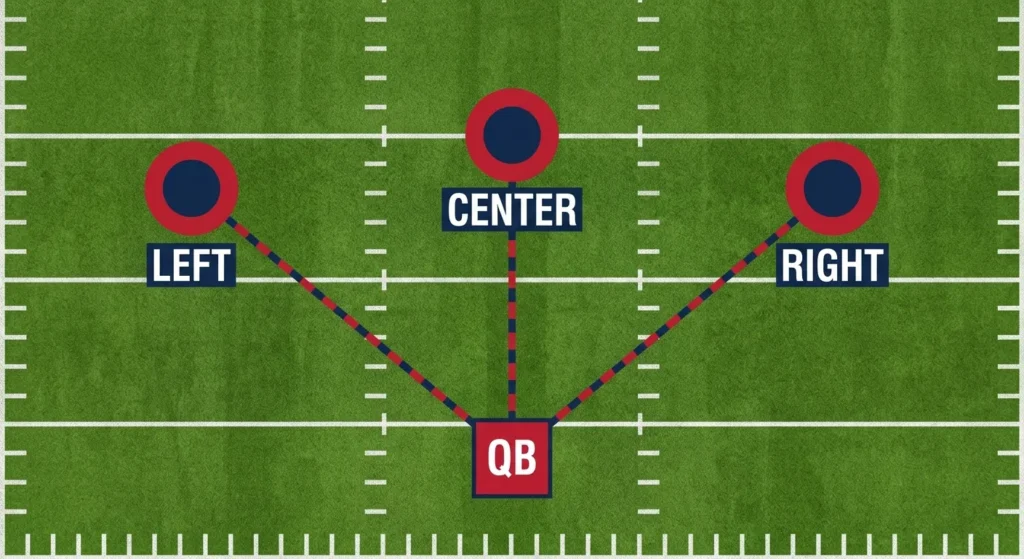
How to Perform:
- Begin at the marked throwing position.
- Choose one target.
- Turn and align your feet and body toward it.
- Make a controlled throw.
- Reset before choosing another target.
- Repeat until you have practiced all three targets.
Beginner Reps: 2 rounds of 6 throws.
Success Check: Track successful throws to each target separately.
Coaching Tip: Start with a planned order. Later, have a coach call out the target before each throw.
Common Mistake: Throwing across the body without adjusting foot position.
Fix: Reset your feet toward the selected target before releasing the ball.
6. Three-Step Drop Accuracy Drill
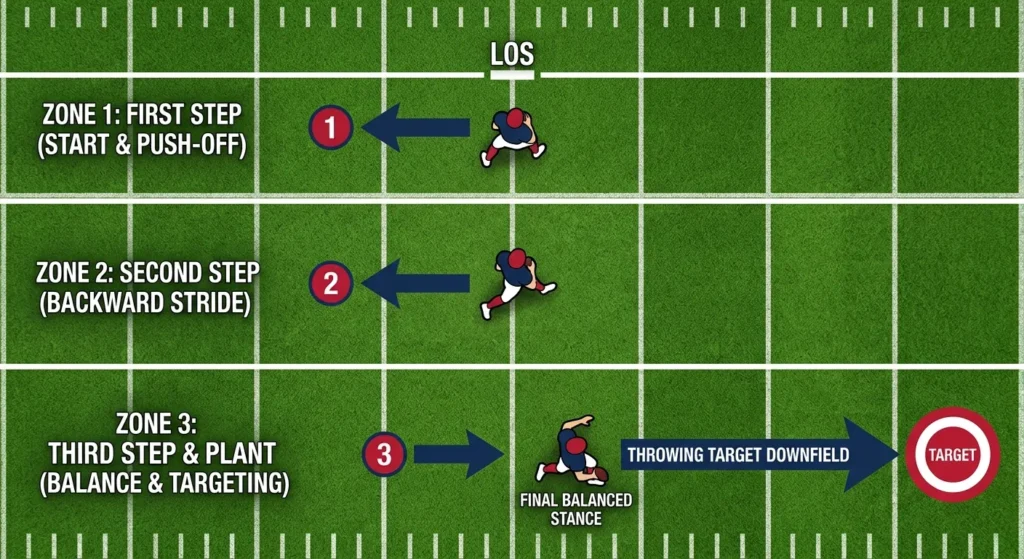
Purpose: Improve passing accuracy after a quarterback dropback.
NFL FLAG’s quarterback drill guide also includes three-step drop and rollout exercises. These drills help players practice footwork, body alignment, and passing after movement.
Setup: Place a target about 7–10 yards downfield. Leave enough space behind the quarterback.
How to Perform:
- Begin in a quarterback-ready stance.
- Simulate receiving the snap.
- Take a controlled three-step drop.
- Finish with a balanced throwing base.
- Step toward the target and throw.
- Reset before the next repetition.
Beginner Reps: 2 sets of 5 throws.
Success Check: Count accurate throws completed after a balanced dropback.
Coaching Tip: Practice the correct dropback pattern for your throwing hand. Right-handed and left-handed quarterbacks use mirrored footwork.
To improve balance and movement before throwing, practice these football footwork drills alongside your quarterback dropbacks.
Common Mistake: Rushing the throw before the feet are set.
Fix: Add a short pause after the dropback. Reduce the pause as balance improves.
7. Moving Receiver Lead Pass Drill
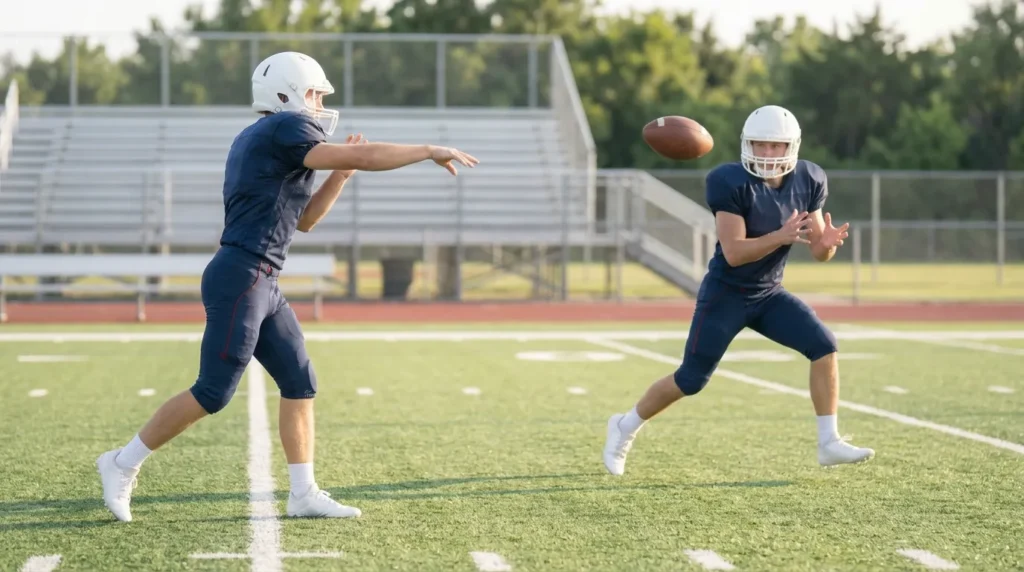
Purpose: Improve receiver timing and catchable ball placement.
Setup: Use one quarterback and one receiver. Mark a short crossing route with cones.
How to Perform:
- Have the receiver run the planned route at a controlled speed.
- Watch the receiver’s movement.
- Choose a catchable spot ahead of the receiver.
- Release the ball so it reaches the receiver’s running path.
- Repeat and adjust the timing when needed.
Beginner Reps: 2 sets of 5 throws.
Success Check: Count passes the receiver can catch without stopping or making a difficult adjustment.
Coaching Tip: Begin with a slow route before increasing receiver speed.
Common Mistake: Throwing directly at the receiver’s current position.
Fix: Aim ahead along the running path. Adjust the lead based on the receiver’s speed and distance.
For more practice with moving receivers and route timing, try these flag football passing drills, including lead passes and crossing routes.
8. Rollout and Reset Passing Drill
Purpose: Improve accuracy after moving outside the pocket.
Setup: Place a target 7–10 yards downfield. Use a cone to mark a short rollout path.
How to Perform:
- Start in a quarterback-ready stance.
- Simulate the snap and roll toward the cone.
- Slow down near the throwing spot.
- Reset your feet toward the target.
- Make a controlled throw.
- Repeat on both sides.
Beginner Reps: 4–5 throws per side.
Success Check: Compare accurate throws after rolling right and left.
Coaching Tip: Practice the movement without throwing until you can reset your feet smoothly.
Common Mistake: Throwing while leaning away from the target.
Fix: Slow down and establish a balanced throwing position before releasing the ball.
9. Pocket Movement Target Drill
Purpose: Improve passing accuracy after short movements inside the pocket.
Setup: Use four cones to mark a small pocket. Place a target downfield.
How to Perform:
- Start in the center of the pocket.
- Hold the football securely near your throwing position.
- Take short steps forward, backward, or sideways.
- Follow the movement direction given by your coach.
- Reset your feet and focus on the target.
- Make a controlled throw.
Beginner Reps: 2 sets of 5 throws.
Success Check: Count accurate throws made after a controlled pocket reset.
Coaching Tip: Use small, quick steps while keeping your eyes downfield.
Common Mistake: Taking large steps and losing balance.
Fix: Reduce the movement distance and focus on a stable throwing base.
How to Measure Quarterback Passing Accuracy
Measuring accuracy helps you track progress and identify areas that need work.
What Counts as an Accurate Pass?
For stationary target drills, count a successful throw when the ball reaches the marked target zone.
For moving-receiver drills, an accurate pass should reach a catchable location along the receiver’s route. The receiver should not need to stop suddenly or make an extreme adjustment.
A target hit and a completed pass are different measurements. Track them separately.
Passing Accuracy Formula
Accuracy (%) = (Successful Target Hits ÷ Total Throws) × 100
For example, 7 successful hits from 10 throws equals 70% target accuracy.
Sample Accuracy Scorecard
| Distance | Target hits | Attempts | Accuracy |
|---|---|---|---|
| 5 yards | 9 | 10 | 90% |
| 10 yards | 7 | 10 | 70% |
| 15 yards | 5 | 10 | 50% |
These are sample results, not required performance standards.
For fair comparisons, use the same target size, distance, and number of throws during each test. Record results over several sessions instead of judging progress from one practice.
Common Quarterback Passing Mistakes and How to Fix Them
Inaccurate throws can have several causes. Look for repeated patterns before changing your technique.
| Passing problem | What to check | Practice correction |
|---|---|---|
| Throws too high | Release timing and body balance | Make five short target throws with a balanced finish. |
| Throws too low | Release point and follow-through | Practice smooth throws at a comfortable distance. |
| Throws left or right | Foot alignment and body rotation | Use the Punch Step Drill and check your front-foot direction. |
| Passes behind receivers | Throw timing and ball placement | Slow the receiver’s route and practice leading the target. |
| Accuracy drops after movement | Foot reset and throwing balance | Pause after movement before throwing, then shorten the pause. |
| Longer throws lose accuracy | Throwing effort and mechanics | Return to a shorter distance and rebuild control. |
These are possible causes, not fixed diagnoses. A coach should watch the full throwing motion before recommending a correction.
Coach’s Tip: Work on one problem at a time. This makes it easier to see which adjustment improves accuracy.
Quarterback Accuracy Drills at Home
You can practice quarterback accuracy without a receiver or full football field.
Try these three options:
- Target Net Passing: Throw toward a marked target net from a comfortable distance. Count successful hits.
- Three-Zone Target Practice: Mark left, center, and right zones on a safe target. Change your aim between throws.
- Footwork Without Throwing: Practice controlled steps, dropbacks, and throwing-position resets without releasing the football.
These are home-friendly versions of the main drills, so you do not need a separate full workout for each one.
Players who want more solo training ideas can explore these backyard football practice drills for target throwing, footwork, and small-space practice.
Safety Reminder: Choose an open area with a clear throwing direction. Never throw toward windows, roads, people, or fragile objects.
Beginner Quarterback Accuracy Progression
Build passing accuracy in stages:
- Stationary accuracy: Hit a large target from a short distance.
- Footwork accuracy: Add a controlled step or dropback.
- Multiple targets: Practice changing target locations.
- Moving receivers: Add timing and lead passes.
- Pocket movement: Reset your feet after short movements before throwing.
Move to the next stage when your footwork, release, and ball placement remain consistent.
If accuracy drops sharply or your technique becomes rushed, return to an easier version.
15-Minute Quarterback Passing Accuracy Practice Plan
Use this short routine to practice the main beginner skills.
| Activity | Time | Focus |
|---|---|---|
| Easy warm-up throws | 3 minutes | Smooth mechanics |
| Stationary Target Passing | 4 minutes | Basic accuracy |
| Punch Step Accuracy | 3 minutes | Foot alignment |
| Three-Target Passing | 3 minutes | Target changes |
| Accuracy check and notes | 2 minutes | Track progress |
| Total | 15 minutes |
Coaches planning a complete team session can use this football practice plan with drills to combine quarterback training with other position drills and team activities.
Keep the throwing volume comfortable for your age and ability. Take breaks when needed, and stop if pain or unusual fatigue develops.
Continue Learning
Build on your passing accuracy with these beginner-friendly football drills and practice guides.
Quarterback Drills for Beginners
Build your throwing, footwork, and basic quarterback skills with simple step-by-step drills.
Explore QB Drills →Football Footwork Drills
Improve balance, quick steps, and body control before making a pass.
Practice Footwork →Flag Football Passing Drills
Practice passing timing, moving targets, and accurate throws to receivers.
Improve Passing →Football Practice Plan With Drills
Organize your training with structured practice sessions for beginner players.
Plan Your Practice →Frequently Asked Questions
What are the best drills to improve quarterback accuracy?
Stationary Target Passing, Punch Step Accuracy, and Three-Target Passing are useful starting drills. They build ball placement, footwork, and consistent throwing mechanics. Add moving-receiver and dropback drills as control improves.
How can I improve my quarterback accuracy at home?
Use a target net or marked target in a safe open area. Practice short, controlled throws and record your target hits. You can also practice footwork without throwing when space is limited.
Does footwork affect quarterback passing accuracy?
Yes. Good footwork helps quarterbacks maintain balance and align their bodies for accurate throws. Poor foot placement can make the release less consistent.
Why does my football pass go too high or too low?
High or low passes may result from release timing, body alignment, or poor balance. Check for repeated patterns and practice short target throws. A coach can help identify the cause.
How often should youth quarterbacks practice passing accuracy?
Practice frequency depends on age, experience, and overall throwing workload. Short, controlled sessions can help, but players also need recovery. Stop throwing if shoulder or elbow pain develops.
Final Coaching Tips
Improving quarterback passing accuracy starts with repeatable mechanics and controlled practice. Focus on short target throws, balanced footwork, and catchable ball placement before adding harder drills. Track your results, correct one mistake at a time, and increase difficulty as your accuracy improves.
References
1. USA Football. Build Passing Mechanics From the Ground Up.
https://blogs.usafootball.com/blog/1118/build-passing-mechanics-from-the-ground-up
2. USA Football. 4 Drills to Help QBs Sharpen Accuracy.
https://blogs.usafootball.com/blog/1430/4-drills-to-help-qbs-sharpen-accuracy
3. NFL FLAG. Quarterback Drills.
https://nflflag.com/coaches/default/football-drills/quarterback-drills
