



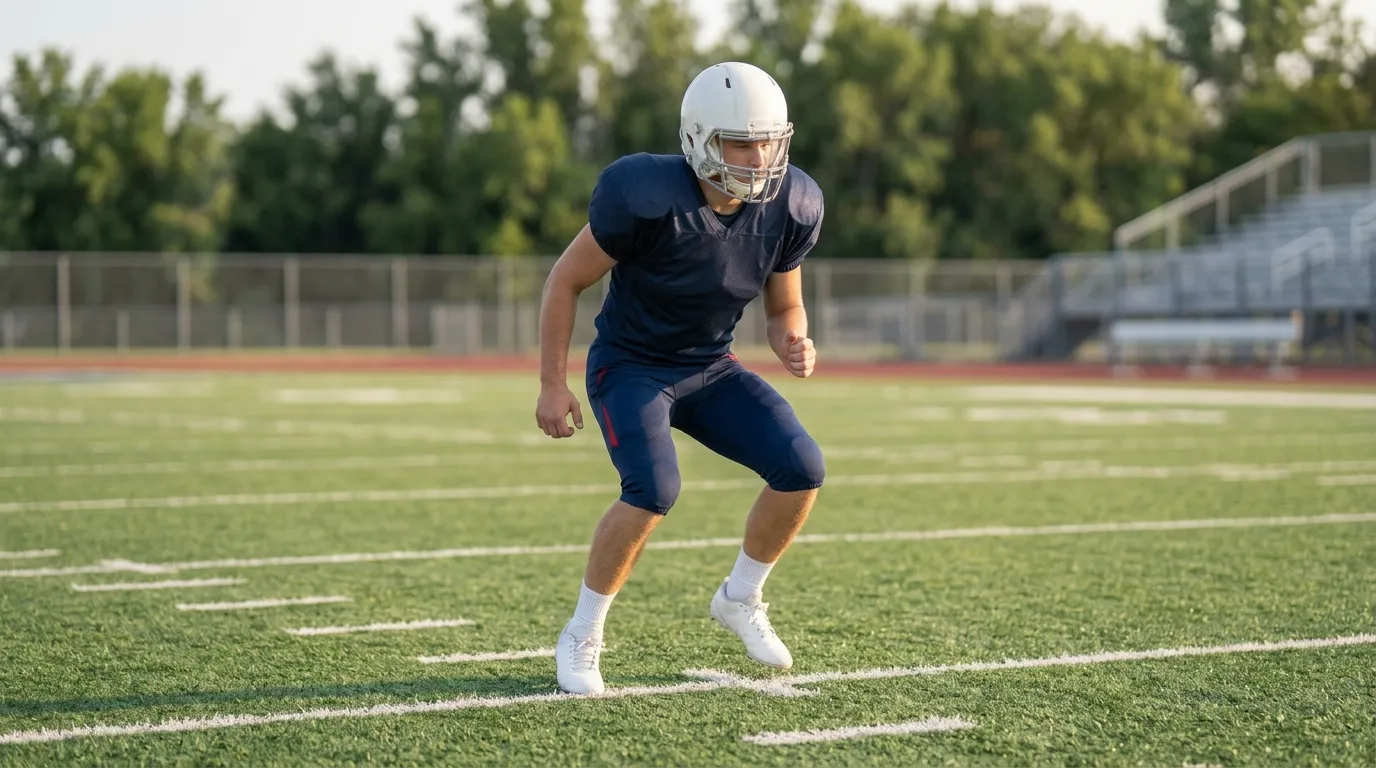
The Quick Feet Drill is a simple football footwork exercise that teaches players to take short, fast steps while staying balanced. It is also called the Fast Feet Drill or Foot Fire Drill.
You do not need a ladder, cones, or special equipment. Beginners can practice it on a flat surface in just a few minutes.
This guide explains how to perform the Quick Feet Drill, use proper technique, avoid common mistakes, and add simple progressions to football practice.
What Is the Quick Feet Drill?
The Quick Feet Drill is a stationary footwork exercise where players rapidly alternate their feet while keeping their knees slightly bent.
Unlike sprinting, the goal is not to cover distance. Instead, players focus on quick ground contacts, steady rhythm, and body control.
The drill is often used during football warm-ups and footwork sessions. It gives beginners a simple way to practice moving their feet without losing their athletic stance.
The basic movement is similar to running in place, but the knees stay low and the steps remain short.
How to Set Up the Quick Feet Drill
You only need a small, clear training area.
- Surface: Choose flat, dry grass, turf, or another non-slip surface.
- Equipment: None required. A stopwatch is optional.
- Space: Leave enough room to move safely without hitting another player.
- Footwear: Wear athletic shoes or football cleats suited to the surface.
- Starting stance: Stand with your feet about shoulder-width apart and knees slightly bent.

Keep your chest up, shoulders relaxed, and eyes forward. Let your hips move back slightly into a balanced athletic position. Quick Feet is also a useful option for players training at home. For more simple exercises, explore these football drills without equipment.
Coach Tip: Practice a few slow steps before starting the timed drill. This helps beginners find a steady rhythm.
How to Perform the Quick Feet Drill Step by Step
Follow these six steps to perform the Quick Feet Drill with proper form.
- Start in an athletic stance. Stand with your feet about shoulder-width apart. Bend your knees slightly and keep your weight balanced.
- Lean forward slightly. Keep your back in a natural position, chest up, and head steady. Avoid bending too far at the waist.
- Lift one foot a small distance. Raise your right foot just an inch or two off the ground. Keep your knee lift low and avoid bouncing upward.
- Alternate your feet quickly. As your right foot returns, lift your left foot. Continue switching with short, light steps.
- Move your arms naturally. Bend your elbows and let your arms move in rhythm with your legs. Keep your shoulders relaxed.
- Maintain control until the set ends. Continue for the planned time without traveling forward or losing balance.

Aim to land with your feet close to underneath your hips. Use light contacts around the balls of your feet without forcing your heels to stay off the ground.
Start slowly. Increase your stepping speed only when you can keep your posture and foot placement steady.
Coach Tip: Think “short, light, and controlled.” Fast steps are useful only when you can maintain good technique.
Recommended Sets, Duration, and Rest for Beginners
Beginners should start with short intervals instead of trying to move at maximum speed for a long time.
| Training level | Work duration | Sets | Rest between sets |
|---|---|---|---|
| New beginner | 8–10 seconds | 2–3 | 30–45 seconds |
| Comfortable beginner | 10–15 seconds | 3 | 30–45 seconds |
| Reaction progression | 5–10 seconds plus a signal | 3–4 | 45–60 seconds |
These shorter intervals are suggested starting points for beginners. The NFL’s Machine Guns exercise uses 15–20-second sets, but new players can begin with less time while learning proper form. Increase the duration only when you can maintain short, controlled steps.
Rest long enough to repeat the drill with good form. If your steps become heavy or your balance changes, slow down or end the set.
For a simple warm-up, complete two controlled sets after light jogging and dynamic movements.
Benefits of the Quick Feet Drill for Football
The Quick Feet Drill can be a useful part of beginner football training because it lets players practice several basic movement skills.
- Foot coordination: Practice alternating your feet in a controlled pattern.
- Movement rhythm: Learn to maintain short, steady steps without rushing.
- Balance and body control: Practice keeping your body stable while your feet move.
- Athletic stance: Get comfortable moving with slightly bent knees and relaxed shoulders.
- Warm-up preparation: Short Quick Feet sets can fit into a dynamic warm-up before football footwork, reaction, or sprint practice.
For more ways to practice balance, coordination, and controlled steps, explore these football footwork drills. They include different movement patterns that can support beginner football practice.
The calves, ankles, thighs, and hip muscles all help support the movement. Your core also helps keep your upper body steady.
For football players, this exercise works best as one part of a wider training routine. It should not replace sprinting, strength work, or drills that require actual changes in direction.
Wide receivers (WRs), running backs (RBs), and defensive backs (DBs) can use Quick Feet as a short warm-up exercise. They can then move into position-specific drills that involve acceleration, stopping, or reacting to an opponent. Quick Feet alone does not teach these game movements.
Common Quick Feet Drill Mistakes and How to Fix Them

Small technique errors can make the movement harder to control. Watch for these common mistakes.
| Common mistake | How to fix it |
|---|---|
| Lifting the knees too high | Keep your steps low and short instead of turning the drill into high knees. |
| Landing heavily | Reduce your speed and practice lighter foot contacts. |
| Standing with locked knees | Maintain a small knee bend and relaxed athletic stance. |
| Looking down constantly | Keep your head up and look mostly forward. |
| Taking steps too far ahead | Place your feet close to underneath your hips. |
| Moving too fast and losing balance | Slow down until your foot rhythm becomes steady again. |
Coach Tip: Watch the player’s upper body as well as their feet. Excessive bouncing, stiff shoulders, or poor balance often show that the player is moving faster than they can control.
Beginner Quick Feet Drill Progressions
Once you can perform the basic movement with good form, try these three stages. Each stage adds a small challenge without changing the main exercise.
Stage 1: Basic Stationary Quick Feet
Start in an athletic stance and perform short, fast alternating steps in place.
- Complete 2–3 sets of 8–10 seconds.
- Keep your steps low and light.
- Focus on rhythm, posture, and balance.
Move to the next stage when you can finish each set without heavy steps or excessive bouncing.
Stage 2: Quick Feet With a Coach’s Signal
This variation adds a simple reaction task.
- Begin performing stationary quick feet.
- Keep your eyes forward while listening for a signal.
- When the coach whistles or calls “stop,” freeze in a balanced athletic stance.
- Reset and repeat.
This helps players practice responding to an outside cue while controlling their body position.
A partner can give the signal if no coach is available.
Stage 3: Quick Feet Into a Short Sprint
This stage connects stationary footwork with forward movement.
- Mark a finish point 3–5 yards ahead.
- Perform quick feet for about 5 seconds.
- On the coach’s signal, push off and accelerate toward the finish.
- Slow down safely after crossing the finish point.
- Walk back and rest before repeating.
The National Strength and Conditioning Association (NSCA) explains how coaches can add sound or visual signals to movement drills. These cues give players a chance to practice reacting while maintaining body control.
Start with three controlled repetitions.
Focus on making a strong first push rather than taking many tiny steps after the signal.
This variation can fit into a beginner football practice before more demanding acceleration drills for football. These drills focus on the first steps and forward acceleration.
Does the Quick Feet Drill Improve Football Speed?
The Quick Feet Drill helps players practice moving their feet quickly, but fast feet do not automatically mean faster sprinting or better agility.
Sprint speed depends on how effectively a player applies force to the ground, coordinates their running movement, and accelerates forward. Strength coach Michael Boyle also explains that moving the feet quickly does not automatically improve sprint speed or agility. He highlights lower-body strength, force production, and single-leg control as important parts of athletic movement.
The NSCA’s guide to acceleration and deceleration mechanics explains that effective acceleration requires coordinated movement of the ankles, knees, and hips to apply force against the ground.
Likewise, football agility involves more than quick steps. Players must slow down, control their bodies, recognize a signal or opponent’s movement, and change direction.
The Quick Feet Drill can support a training session by practicing foot rhythm and controlled movement. However, players also need:
- Lower-body strength and single-leg control.
- Proper sprint mechanics and acceleration practice.
- Deceleration and change-of-direction training.
- Reaction drills that involve decisions and movement.
For beginners, the best approach is to use Quick Feet as a short supporting exercise rather than the main method for improving football speed.
Quick Feet Drill vs High Knees
Quick Feet and High Knees may look similar, but they use different movement patterns.
| Feature | Quick Feet Drill | High Knees |
|---|---|---|
| Knee lift | Low | Higher, often toward hip height |
| Step pattern | Short, fast alternating steps | Repeated knee drives |
| Main focus | Foot rhythm and controlled steps | Knee drive and running coordination |
| Body position | Balanced athletic stance | Tall running posture |
| Movement | Usually stationary | Stationary or moving forward |
| Common use | Football footwork warm-up | Dynamic running warm-up |
Use Quick Feet when the goal is to practice short foot contacts and steady rhythm.
Use High Knees when the goal is to practice repeated knee drive and coordinated arm movement.
Both exercises can fit into a beginner warm-up, but they should not replace full-speed running practice. For a different footwork challenge, try the Icky Shuffle Drill. Unlike stationary Quick Feet, it uses a ladder pattern with steps moving inside and outside the squares.
Continue Learning
Ready to build on your quick-feet practice? Try these beginner-friendly football drills to develop footwork, coordination, and movement control.
Football Footwork Drills
Practice simple movement patterns that challenge balance, coordination, and foot control.
Explore Drills →Icky Shuffle Drill
Learn an agility ladder pattern with controlled steps inside and outside the squares.
Learn the Steps →Dot Drill
Practice quick, controlled foot movements using five marked spots on the ground.
Try the Drill →Quick Feet Drill FAQs
How long should beginners do the Quick Feet Drill?
Beginners can start with 8–10 seconds per set and complete two or three sets. Rest for about 30–45 seconds between sets. Increase the duration gradually while maintaining good form.
Can you do the Quick Feet Drill without a ladder?
Yes. The basic Quick Feet Drill requires no ladder or cones. You can perform short, alternating steps in place on a flat, non-slip surface.
Is the Quick Feet Drill good for youth football players?
Yes, it can be a simple footwork exercise for youth players who can follow instructions and maintain good balance. Keep the sets short, use a safe surface, and focus on control rather than maximum speed.
How often should you practice the Quick Feet Drill?
Beginners can include a few short sets in two or three football practice warm-ups each week. Adjust the amount based on age, training experience, and the rest of the session.
What muscles does the Quick Feet Drill use?
The drill uses the calf muscles, quadriceps, hip flexors, and other lower-body muscles to lift, move, and support the feet. Core muscles help maintain balance and posture.
Final Thoughts
The Quick Feet Drill is an easy, no-equipment exercise for practicing short, fast foot movements. Beginners can use it to work on rhythm, coordination, and body control during football warm-ups.
Start with controlled stationary steps. Once your technique becomes steady, add a coach’s signal or a short sprint.
For better overall football movement, combine quick-feet practice with strength training, sprint mechanics, and change-of-direction drills.
References
- Boyle, M. (2010). The Truth About “Quick Feet” and Agility Ladder Drills. Eric Cressey.
- Darius, D. Three Exercises to Develop Quick Feet. National Football League (NFL).
- National Strength and Conditioning Association (NSCA). (2019). Change of Direction Speed Drill Adaptation. Kinetic Select. Excerpt from Developing Agility and Quickness, Second Edition.
- National Strength and Conditioning Association (NSCA). (2020). Acceleration and Deceleration Mechanics. Kinetic Select. Excerpt from Developing Agility and Quickness, Second Edition.
