



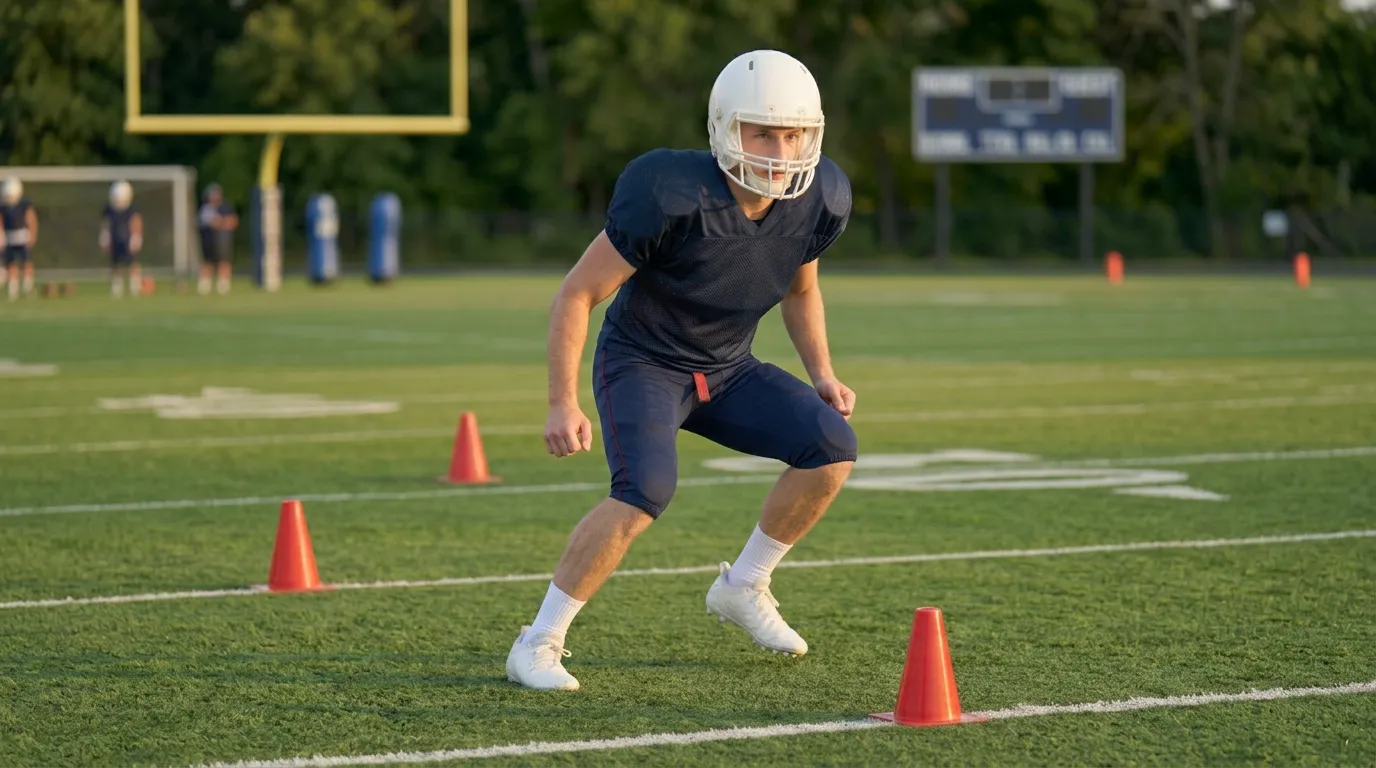
The Backpedal Drill teaches football players how to move backward with balance and control. It is a basic footwork drill for defensive backs, especially cornerbacks and safeties.
Players learn to keep their hips low, use short steps, and stay ready to react. For beginners, the goal is not to move backward as fast as possible. Good technique comes first.
Quick Takeaway
The Backpedal Drill helps defensive backs improve backward movement, footwork, balance, and body control. Start in a low defensive back stance and push backward with short, controlled steps. Keep your eyes up and your feet close to the ground. Beginners should learn the movement at a controlled pace before adding more speed.
What Is the Backpedal Drill?
The Backpedal Drill is a football footwork exercise that teaches a player to move backward while staying in an athletic position. It is commonly used by defensive backs during practice.
A defensive back may need to move backward while keeping a receiver and the play in front. The player must also stay ready to stop, plant, or react.
The drill focuses on the basic movement before harder skills are added. This makes it useful for players who are still learning proper defensive back footwork.
Players can build on this movement with other defensive back drills that train coverage footwork, reaction, and position-specific skills
Benefits of the Backpedal Drill
The Backpedal Drill can help players build several basic skills:
- Better footwork: Players learn controlled backward steps.
- Balance: A good stance helps the player stay under control.
- Body control: The drill teaches players to keep their hips and upper body in a stable position.
- Coverage movement: Defensive backs practice moving backward while keeping their eyes forward.
- Reaction position: Good backpedal technique leaves the player in a better position to stop or change direction.
- Movement confidence: Beginners can learn the skill at a slower pace before increasing speed.
Backpedaling is only one part of defensive movement. Players can also use football footwork drills to work on other basic movement patterns.
Equipment and Setup
The Backpedal Drill needs very little equipment.
Equipment
You need:
- 2 cones
- A football field or flat practice area
- About 5 to 10 yards of open space
A coach or partner can also give a start or stop signal, but this is optional.
Setup
Place one cone at the starting point. Put the second cone about 5 to 10 yards behind it.
Stand at the first cone in a defensive back stance. Face forward, away from the direction you will travel.
Beginners can start with a shorter distance. The goal is to keep good form from the first step to the last.
How to Perform the Backpedal Drill
Follow these steps:
- Start in a balanced stance. Keep your feet slightly staggered and about shoulder-width apart.
- Bend your knees and hips. Stay low without sitting too far back.
- Keep your head and eyes up. Look forward instead of down at your feet.
- Push backward. Use the front foot to begin the movement.
- Take short, controlled steps. Avoid reaching far backward with each step.
- Keep your feet close to the turf. Do not lift the feet higher than needed.
- Move your arms naturally. Use a normal running-style arm action.
- Backpedal to the second cone. Finish under control instead of falling or leaning backward.
Glazier Clinics also teaches defensive backs to push off the front foot, keep the chest over the feet, keep the feet close to the ground, and use active arm movement during the backpedal.
Walk back to the start and reset before the next repetition.
Proper Backpedal Technique
Correct technique matters more than speed, especially for beginners.

Keep Your Hips Low
Bend at the hips and knees while keeping a stable athletic position. Avoid standing taller as you move.
This becomes even more important when speed increases. A player who rises too high may have a harder time stopping or reacting to a receiver’s movement.
Keep Your Weight Controlled
Keep your weight over the front or middle part of your feet instead of sitting back on your heels.
Your chest should stay controlled over your base. Do not lean your entire upper body backward just because you are moving backward.
Use Short Steps
Long backward strides can make it harder to stay balanced.
Use quick, controlled steps and keep your feet close to the playing surface. The movement should look smooth rather than like a backward sprint.
Glazier Clinics recommends keeping the backpedal under control with short strides instead of turning it into a full backward sprint.
Keep Your Eyes Up
Defensive backs need to see what is happening in front of them.
Keep your head in a natural position and your eyes forward. Avoid watching your feet while you move.
Use Natural Arm Action
Move your arms as you would during normal running. Keep them relaxed and controlled.
Do not let your arms swing across your body or become stiff.
Coach’s Tip: Start slower than you think you need to. Watch the player’s hips and feet. Increase the pace only when the same body position can be held through the full rep.
Common Backpedal Mistakes and How to Fix Them
Small technique problems can make the Backpedal Drill harder to control.
| Mistake | What Happens | Simple Fix |
|---|---|---|
| Standing too tall | The player may be slower to react | Bend the knees and keep the hips lower |
| Leaning backward | Balance becomes harder to control | Keep the chest controlled over the feet |
| Taking long steps | The feet spend more time away from the turf | Use shorter backward steps |
| Lifting the feet too high | Extra movement can slow the footwork | Keep the feet close to the ground |
| Looking down | The player loses sight of the action ahead | Keep the head and eyes up |
| Hips rising with speed | Changing direction becomes harder | Reduce speed and hold the same body position |
| Going too fast too soon | Technique starts to break down | Learn at a controlled pace first |
| Stiff arm action | Movement becomes less natural | Relax the arms and pump them normally |

If technique starts to fall apart, shorten the distance or reduce the speed.
Backpedal Drill Progression for Beginners

| Level | Progression | How to Perform | Main Focus |
|---|---|---|---|
| 1 | Short Controlled Backpedal | Backpedal about 5 yards at an easy pace. | Low hips, short steps, and balance |
| 2 | Increase the Distance | Extend the backpedal toward 10 yards while keeping the same form. | Maintain technique over a longer distance |
| 3 | Add Speed | Gradually increase your pace without standing taller or taking long steps. | Keep body position as speed increases |
| 4 | Backpedal and Stop | Backpedal until a coach gives a stop signal, then finish under control. | Balance and controlled stopping |
| 5 | Backpedal and Break | Backpedal, make a controlled plant, and begin a forward or angled break. | Transition from backward to forward movement |
Do not rush through the stages. If your hips rise, steps become too long, or balance starts to drop, return to a slower pace.
Once the basic movement is consistent, the W Drill can help you practice the backpedal, plant, and forward break in a more structured pattern.
Players who need more work on planting and moving into a new direction can practice change of direction drills separately.
Backpedal Drill Variations
Once the basic version feels comfortable, a few simple variations can make the drill harder.
Short-Distance Backpedal
Use a 3 to 5-yard distance and keep the pace controlled.
This version is useful for beginners who are learning the movement.
Throttle Backpedal
A coach uses a visual signal to tell the player when to backpedal slower or faster.
The player tries to change speed without standing taller or losing balance. This variation teaches speed control while keeping the same defensive stance.
Backpedal and Break
Backpedal for a short distance, plant under control, and break in the direction given by the coach.
Keep this variation simple. Players should first be able to perform the basic Backpedal Drill with good form.
How to Know If Your Backpedal Is Correct
You do not need a stopwatch to check every rep.
Ask these questions:
- Do my hips stay low?
- Are my knees bent?
- Are my head and eyes up?
- Are my steps short and controlled?
- Do my feet stay close to the turf?
- Is my upper body balanced?
- Are my arms moving naturally?
- Can I stop without losing balance?
- Does my technique stay similar when I increase the speed?
If several answers are no, slow the drill down and correct the movement before adding more speed.
Who Should Use the Backpedal Drill?
The Backpedal Drill is most useful for defensive backs, including cornerbacks and safeties.
It is also useful for youth and beginner players who are learning basic defensive movement. Coaches can use a short version during individual position work before moving into more advanced coverage drills.
The drill does not teach complete pass coverage by itself. Instead, it builds one of the movement skills a defensive back can use while maintaining position in front of a receiver. USA Football explains that defensive backs can use the pedal to maintain cushion against a receiver before moving into a faster pedal or turn as that space closes. For broader training that includes reaction, balance, and multi-direction movement, players can also use football agility drills
Continue Training
Once your backpedal feels controlled, use these drills to build the next movement skills.
W Drill
Practice the backpedal, controlled plant, and forward break.
Learn the W Drill →Football Footwork Drills
Build better balance, foot control, and basic football movement.
Explore Footwork Drills →Change of Direction Drills
Learn how to slow down, plant, and move in a new direction.
Practice Direction Changes →Football Agility Drills
Improve quick movement, body control, and reaction on the field.
View Agility Drills →Frequently Asked Questions
1. How far should you backpedal in the Backpedal Drill?
Beginners can start with about 5 yards. Once they can keep good technique and balance, they can progress toward 10 yards. Longer distances are less important than keeping the hips low, steps controlled, and feet close to the ground.
2. How fast should beginners perform the Backpedal Drill?
Beginners should start at a controlled pace. Increase speed only when the player can keep low hips, short steps, good balance, and proper body position throughout the drill.
3. How many reps of the Backpedal Drill should you do?
Start with a few short, quality reps and allow enough recovery to keep the movement clean. The exact number can depend on the player’s age and training level. Stop or reduce the pace when technique begins to break down.
4. Why do defensive backs practice backpedaling?
Defensive backs use the backpedal to move backward while keeping the receiver and play in front of them. Good backpedal technique also helps the defender stay ready to stop, plant, turn, or react during coverage.
5. What is the correct technique for backpedaling in football?
Keep the knees bent, hips low, eyes up, and weight controlled over the front or middle of the feet. Use short backward steps, keep the feet close to the turf, and move the arms naturally. Avoid leaning backward or taking long strides.
References
- References
- Glazier Football. Defensive Back Backpedal Football Drill. Glazier Clinics, August 3, 2021. Covers defensive back stance, front-foot push, 10-yard backpedal, chest position, foot movement, and arm action.
- Glazier Football. Top Defensive Back Drills for Practice. Glazier Clinics, August 1, 2022. Covers defensive back stance, low pad level, short strides, controlled backpedaling, cushion progression, and change-of-direction work.
- Kuchar, Mike. Reading the Wide Receiver’s Hips to Teach Man Coverage. USA Football, April 14, 2016. Covers alignment, leverage, cushion, control pedal, speed pedal, man turn, and defensive back footwork progressions.
