



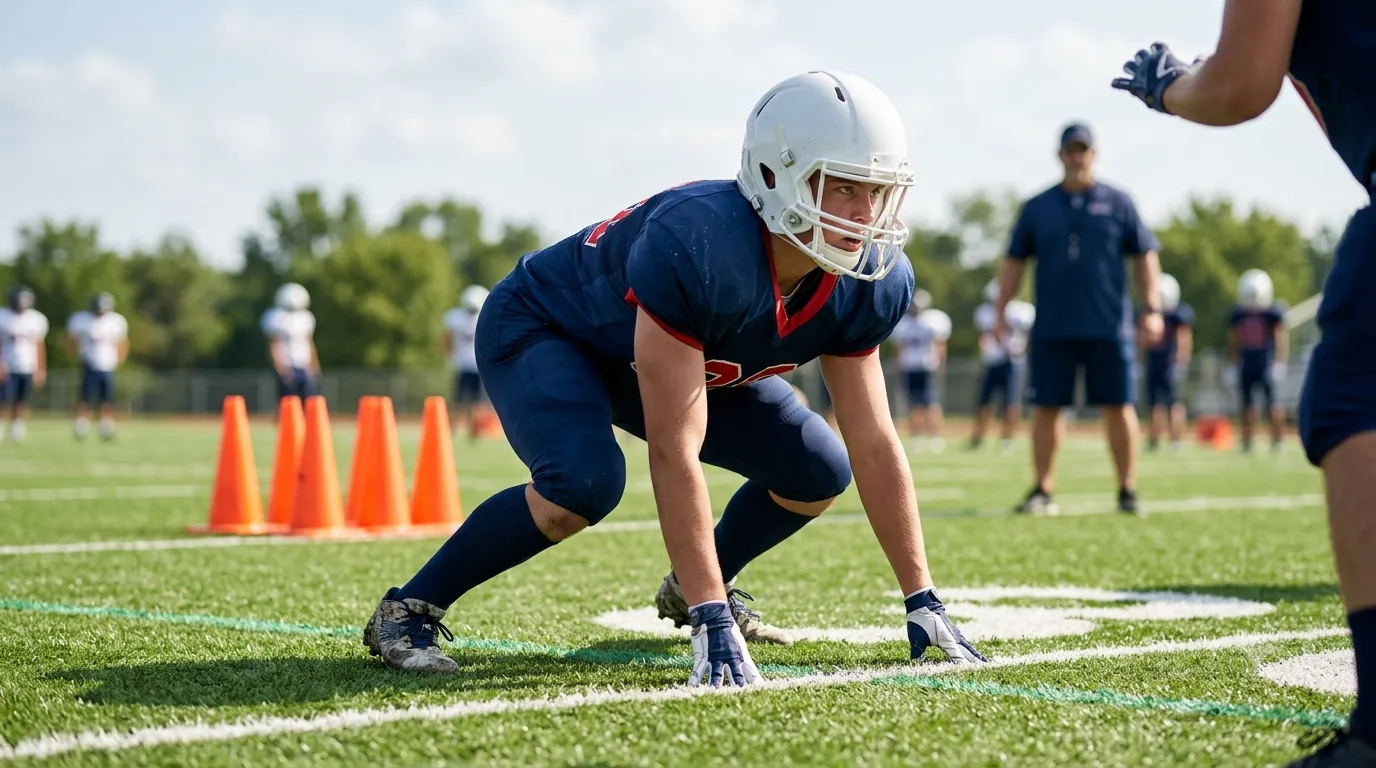
Linebacker drills are football practice drills that help players improve tackling, footwork, reaction speed, pursuit angles, and play reading. Some of the best linebacker drills include the Read and React Drill, Shuffle and Fill Drill, Pursuit Drill, Mirror Drill, Angle Tackling Drill, and Cone Drill. Practising these drills regularly helps linebackers move faster, stay in position, and make more plays on defense.
Introduction
Playing linebacker takes more than strength. You need quick feet, fast reactions, and good tackling skills. You also need to read the play and move to the right spot before the ball carrier gets there.
The best way to build these skills is by practising linebacker drills. The right drills improve footwork, reaction time, tackling, pursuit angles, and football awareness. They also help you play with more confidence on game day. Before learning position-specific drills, build a strong base with our Football Drills for Beginners guide.
I have coached many beginners who wanted to play linebacker but did not know where to start. Most of them tried to move too fast before learning the basics. Once they focused on good technique and practised the right drills, they became more confident and made better tackles. Good linebackers do more than make tackles. They read the play, react quickly, and move to the football under control. USA Football’s Player Development Model encourages coaches to teach these fundamental skills through structured, age-appropriate practice before introducing more advanced techniques.
In this guide, I’ll show you the best linebacker drills, how to do each one, common mistakes to avoid, and simple coaching tips to help you improve faster.
Key Takeaways
- Linebacker drills build footwork, tackling, reaction speed, and football IQ.
- Learn good technique before trying to move at full speed.
- Keep your eyes up and read the play before attacking.
- Stay low and balanced during every drill.
- Train two or three times each week to improve steadily.
- Youth players should start with non-contact drills before live tackling.
- Regular practice builds confidence and helps you play faster on game day.
Coach’s Tip
One mistake I see often is linebackers rushing forward too early. Stay patient, read your keys first, then attack the play. Good decisions usually lead to better tackles.
What Are Linebacker Drills?

Linebacker drills are football exercises that teach players how to move, react, and tackle. They help linebackers read the play, stay in position, and stop the ball carrier. You can learn more defensive skills in our Defensive Football Drills for Beginners: Simple Drills to Improve Defense guide
A good linebacker needs more than strong tackles. They also need quick feet, good balance, fast reactions, and smart decision-making. That is why coaches use different drills to build each skill step by step.
Most linebacker drills focus on improving:
- Footwork
- Reaction speed
- Pursuit angles
- Tackling technique
- Block shedding
- Balance
- Play reading
- Football awareness
Many of these skills also improve with football agility drills, football footwork drills, and cone drills for football. These drills build a strong base before you move on to more advanced linebacker training.
Why They Matter
Linebackers are involved in almost every defensive play. They must stop the run, cover short passes, chase the ball carrier, and sometimes rush the quarterback. That means they must react quickly and make good decisions every time the ball is snapped.
Regular linebacker drills help you:
- React faster after the snap.
- Take better angles to the ball.
- Improve footwork and balance.
- Make stronger and safer tackles.
- Stay in the right position.
- Build confidence before games.
From my coaching experience, many beginners hesitate because they are unsure where to go. The more they practise these drills, the faster they learn to trust what they see and react with confidence.
Good technique also helps keep players safer. Staying balanced and using proper tackling form lowers the chance of poor tackles and unnecessary contact.
Skills Every Linebacker Needs
Great linebackers do more than make tackles. They read the play, move quickly, and stay under control. These are the most important skills every linebacker should build.
Read the Play
A linebacker must read the offense before attacking. Watching the right keys helps you react faster and make better decisions.
Quick Footwork
Fast feet help you shuffle, change direction, and stay balanced. Good footwork also keeps you ready to react at any time.
Pursuit Angles
A pursuit angle is the path you take to reach the ball carrier. Taking the right angle helps you make the tackle instead of chasing from behind.
Tackling Technique
Good tackling starts with the right body position. Keep your head up, stay low, and drive through the tackle instead of reaching with your arms.
Reaction Speed
Football plays happen fast. Quick reactions help you get to the ball before the offense gains extra yards.
Side-to-Side Movement
Linebackers move side to side on many plays. Good lateral movement helps you stay in your gap and change direction without losing balance.
Communication
Linebackers often lead the defense. They call out plays, help teammates get lined up, and keep everyone working together.
Football Awareness
Great linebackers always know what is happening on the field. They watch the ball, read the offense, and stay ready for the next move.
Did You Know?
The fastest player is not always the best linebacker. Players who read the play quickly and take good pursuit angles often reach the ball carrier first.
Who Should Use Linebacker Drills?
Linebacker drills are useful for players of different ages and skill levels. The table below shows who benefits the most and why.
| Player | Why They Should Use Linebacker Drills |
|---|---|
| Beginner Players | Learn proper footwork, tackling, pursuit angles, and defensive positioning. |
| Youth Linebackers | Build safe football habits and improve reaction speed before playing at full speed. |
| Middle Linebackers (Mike) | Improve play recognition, communication, and stopping inside runs. |
| Weakside Linebackers (Will) | Develop speed, pursuit angles, and open-field tackling. |
| Strongside Linebackers (Sam) | Improve block shedding, edge defense, and tackling against larger players. |
| Coaches | Add structured linebacker drills to practice plans and develop defensive fundamentals. |
If you are new to football, start with simple footwork and reaction drills. As your confidence grows, you can add tackling drills, block shedding drills, and game-like situations.
Read and React Drill

Why It Matters
The Read and React Drill teaches linebackers to read the offense and make quick decisions after the snap. USA Football’s Football Development Model teaches football skills through progressive learning, helping players build strong fundamentals before advancing to more complex techniques. Instead of guessing, players learn to watch their keys, react quickly, and move to the football under control. This drill builds reaction speed, football IQ, and confidence on the field.
Setup
Place three cones about 5 yards apart in a straight line. The linebacker starts at the middle cone while a coach or teammate stands several yards in front to give movement signals.
Steps
- Start in a low linebacker stance with your eyes on the coach.
- Wait for the movement signal.
- React immediately and shuffle or sprint in the correct direction.
- Stay balanced as you move.
- Finish each rep at full speed, then return to the starting position.
Coach’s Tip
Read the play before you move. A correct first step is more important than reacting as fast as possible.
Common Mistake: Guessing the direction before the signal instead of reacting to what you see.
Best For
Mike, Will, and Sam linebackers of all skill levels.
2. Shuffle and Fill Drill

The Shuffle and Fill Drill teaches linebackers how to move side to side while staying balanced. It also helps players fill the correct running lane when the ball carrier commits to a gap. This drill improves footwork, body control, and pursuit without taking players out of position.
Many new linebackers run forward too early and leave their gap open. This drill teaches patience and proper movement before attacking the ball.
Setup
Place two cones about 5 yards apart. The linebacker starts between them in a ready stance. The coach stands several yards in front and gives the signal to attack.
How to Perform It
- Start in a low linebacker stance.
- Shuffle side to side between the cones without crossing your feet.
- Stay square to the coach throughout the movement.
- When the coach gives the signal, plant your outside foot.
- Sprint forward and fill the running lane.
- Finish under control and reset for the next rep.
Coach’s Tip
Do not rush forward too soon. Good linebackers stay patient, shuffle with control, and attack only after they read the play.
Common Mistake: Running forward too early and leaving your assigned gap open.
Best For
Mike, Will, and Sam linebackers. This drill is especially useful for youth players learning gap responsibility and side-to-side movement.
3. Pursuit Angle Drill

The Pursuit Angle Drill teaches linebackers how to take the best path to the ball carrier. Instead of running straight at the runner, players learn to close space, stay under control, and make a better tackle. Good pursuit angles help prevent missed tackles and stop runners from gaining extra yards.
I always remind young linebackers that being fast is not enough. Taking the right angle often gets you to the ball quicker than simply running as fast as you can.
Setup
Place two cones for the linebacker’s starting position and two or more cones to create the running path for the ball carrier. The ball carrier starts several yards away and runs toward the sideline or another marked area.
How to Perform It
- Start in a balanced linebacker stance.
- Watch the ball carrier as the play begins.
- Sprint using the best angle instead of chasing directly behind the runner.
- Keep your shoulders square and stay under control.
- Meet the runner in front of the target point.
- Finish with proper tackling position or tag off during non-contact practice.
Coach’s Tip
A good linebacker meets the runner where they are going, not where they are now. Taking the right angle often makes the tackle easier.
Common Mistake: Chasing directly behind the ball carrier instead of taking the shortest path to the tackle.
Best For
Mike, Will, and Sam linebackers. This drill is especially useful for improving run defense and open-field tackling.
4. Mirror Drill
The Mirror Drill helps linebackers improve reaction speed, lateral movement, and body control. One player leads while the other copies every movement without crossing their feet. This teaches linebackers to stay balanced, react quickly, and keep good defensive position.
The Mirror Drill is useful for covering running backs, tight ends, and mobile quarterbacks. It also helps linebackers stay patient instead of guessing where the offensive player will move next.
Setup
Mark a small practice area with cones if needed. One player becomes the leader, and the linebacker stands a few yards away in a low football stance, facing the leader.
How to Perform It
- Start in a balanced linebacker stance.
- Keep your eyes on the leader’s hips.
- Follow every movement by shuffling side to side.
- Avoid crossing your feet.
- Stay low and keep your shoulders square.
- Continue for 10 to 20 seconds before switching roles.
Coach’s Tip
Many beginners watch the player’s head, which can lead to false reactions. Focus on the hips because they usually show the true direction of movement.
Common Mistake: Crossing your feet while shuffling, which slows your reaction and makes it easier to lose balance.
Best For
Mike, Will, and Sam linebackers. It is also helpful for improving man coverage and overall defensive footwork.
Want to learn this drill in more detail? Read our complete 1-on-1 Mirror Drill guide for advanced coaching tips, variations, and step-by-step instructions.
5. Angle Tackling Drill
The Angle Tackling Drill teaches linebackers how to make safe and effective tackles when the ball carrier is running across the field. Instead of chasing from behind, players learn to take the right angle, stay balanced, and stop the runner with good tackling technique.
This drill is important because most tackles during a game happen from an angle, not head-on. Learning the correct approach helps linebackers make more tackles while staying in control.
Setup
Place two cones for the linebacker and two cones for the ball carrier. The players should start about 5 to 7 yards apart so the linebacker must close the distance before making the tackle.
How to Perform It
- Start in a low linebacker stance.
- The ball carrier runs toward the sideline or a marked cone.
- Sprint using the correct pursuit angle.
- Break down with short, quick steps as you get closer.
- Keep your head up and your shoulders square.
- Finish with proper tackling form or tag off during non-contact practice.
Coach’s Tip
Speed helps, but control wins more tackles. If you arrive too fast without breaking down, the runner can easily make you miss.
Common Mistakes
- Running too fast into the tackle.
- Looking down before contact.
- Diving at the runner’s legs.
Want to improve your tackling technique even more? Read our complete Tackling Drills for Beginners (Step-by-Step Guide for Youth Football) guide.
Best For
Mike, Will, and Sam linebackers. This drill is useful for both youth and high school players learning proper tackling technique.
6. Cone Drill
The Cone Drill helps linebackers improve footwork, balance, and change of direction. It teaches players how to stay low, move quickly, and change direction without losing speed or control. These skills help linebackers react faster when chasing the ball or covering a receiver.
Cone drills are simple to set up and can be added to almost any football practice. They are also a great way to build movement skills before adding live contact.
Setup
Place the cones in a straight line, square, zigzag, or “L” shape, depending on the movement you want to practise. Leave about 3 to 5 yards between each cone.
How to Perform It
- Start in a balanced linebacker stance.
- Sprint to the first cone.
- Shuffle, backpedal, or change direction as you reach each cone.
- Stay low and keep your feet moving.
- Finish the drill at full speed.
- Repeat using different cone patterns.
Coach’s Tip
Do not worry about finishing first. Focus on clean footwork and smooth direction changes. Speed will improve as your technique gets better.
Common Mistake: Looking down at the cones instead of keeping your eyes up, which slows your reactions and affects your balance.
Best For
Mike, Will, and Sam linebackers. Cone drills are excellent for beginners because they build the footwork needed for almost every defensive play.
Want to improve your movement even more? Check out our complete Cone Drills for Football guide to learn different cone patterns, coaching tips, and advanced variations.
7. Block Shedding Drill

The Block Shedding Drill teaches linebackers how to get past blockers and reach the ball carrier. During a game, offensive linemen, fullbacks, or tight ends will try to block you. This drill helps you stay in control, use your hands correctly, and break free without losing your balance.
A linebacker who cannot get off blocks will struggle to make tackles. Learning proper block shedding helps you stay in the play and stop the runner sooner.
Setup
The linebacker starts in a ready stance about 2 to 3 yards from a coach or teammate holding a blocking shield. Place a cone a few yards behind the blocker to represent the ball carrier.
How to Perform It
- Start in a low linebacker stance.
- Move toward the blocker with short, quick steps.
- Strike the blocking shield with your hands while keeping your head up.
- Extend your arms to create space.
- Use a quick shed move to get around the blocker.
- Sprint to the cone and finish under control.
Coach’s Tip
Many young linebackers try to run around every blocker. In real games, that gives the runner more space. Learn to defeat the block first, then attack the football.
Common Mistakes
- Stopping your feet after contact.
- Letting the blocker get into your chest.
- Standing too tall.
Best For
Mike, Will, and Sam linebackers. This drill is especially important for inside linebackers who face blockers on running plays.
8. Backpedal to Break Drill
The Backpedal to Break Drill teaches linebackers how to move backward, read the play, and drive forward quickly. It helps players cover short passes, react to the quarterback, and change direction without losing balance.
This drill is useful because linebackers often backpedal before moving forward to make a tackle or defend a pass. Practising this movement makes transitions quicker and smoother.
Setup
Place one starting cone and another cone about 5 yards behind it. Add two cones about 5 yards to the left and right of the back cone. The coach stands in front to give the direction signal.
How to Perform It
- Start in a balanced linebacker stance.
- Backpedal to the rear cone while keeping your eyes on the coach.
- When the coach gives a signal, plant your outside foot.
- Break forward or diagonally to the correct cone.
- Sprint with good body control.
- Finish the rep at full speed and return to the starting position.
Coach’s Tip
Do not lean too far backward while backpedaling. Stay balanced so you can break forward quickly when the play changes.
Common Mistakes
- Crossing your feet while backpedaling.
- Standing up too high.
- Looking at the ground.
- Taking slow steps after planting.
- Losing balance when changing direction.
Best For
Mike, Will, and Sam linebackers. This drill is especially helpful for improving pass coverage, reaction speed, and change of direction.
9. Open Field Tackling Drill
The Open Field Tackling Drill teaches linebackers how to make safe and controlled tackles when there is plenty of open space. In these situations, the ball carrier has more room to change direction, so linebackers must stay balanced, take the right angle, and finish the tackle with good technique.
This drill helps players improve tackling, body control, and confidence in one-on-one situations. It is especially useful for stopping running backs and mobile quarterbacks.
Setup
Mark a small tackling area with four cones. The linebacker and ball carrier start about 7 to 10 yards apart, facing each other. During youth or non-contact practice, replace live tackles with a tag or wrap-and-hold technique.
How to Perform It
- Start in a balanced linebacker stance.
- The ball carrier runs toward the open area.
- Take the correct pursuit angle to close the gap.
- Slow your feet as you get closer.
- Keep your head up and your eyes on the runner’s hips.
- Finish with proper tackling form or a controlled tag during non-contact practice.
Coach’s Tip
Many missed tackles happen because defenders try to make a big hit. Focus on good technique and wrapping up the runner first.
Common Mistakes
- Diving at the ball carrier.
- Taking a poor pursuit angle.
- Looking down before contact.
- Stopping your feet too early.
- Reaching with your arms instead of moving your body.
Best For
Mike, Will, and Sam linebackers. This drill is valuable for improving one-on-one tackling in open space.
10. Ball Reaction Drill
The Ball Reaction Drill helps linebackers react quickly when the football changes direction. Instead of guessing where the play is going, players learn to watch the ball, respond fast, and move under control. This drill improves reaction speed, football awareness, and play recognition.
I like using this drill near the end of practice because it brings together many of the skills players have already worked on, including footwork, balance, and quick decision-making.
Setup
The linebacker starts in a ready stance facing the coach. The coach holds the football and stands about 5 to 7 yards away. Cones can be placed in different directions to create movement targets.
How to Perform It
- Start in a low linebacker stance.
- Keep your eyes on the football.
- The coach points, tosses, or moves the ball in different directions.
- React immediately and sprint to the correct spot.
- Stay balanced while changing direction.
- Return to the starting position and repeat with different signals.
Coach’s Tip
Quick reactions come from good habits, not guessing. Stay focused on the football and trust what you see.
Common Mistakes
- Moving before the signal.
- Looking away from the football.
- Taking slow first steps.
Best For
Mike, Will, and Sam linebackers. This drill helps players improve reaction speed, football awareness, and overall defensive performance.
Keep Building Your Skills
These 10 linebacker drills work best when you practise them regularly. As your footwork, tackling, and reaction speed improve, you can add more advanced defensive drills to prepare for real game situations.
Position-Specific Tips

Each linebacker position has a different role. While all linebackers need good tackling, quick reactions, and strong footwork, the skills they use most depend on where they line up.
Mike Linebacker (Middle Linebacker)
The Mike linebacker plays in the middle of the defense. This player directs the defense, stops inside runs, and helps teammates get into the right position before the snap.
Best drills:
- Read and React Drill
- Shuffle and Fill Drill
- Block Shedding Drill
- Angle Tackling Drill
- Ball Reaction Drill
Coaching Tip: Stay patient, trust your keys, and attack the correct gap once the play develops.
Will Linebacker (Weak-Side Linebacker)
The Will linebacker usually has more space to cover. This position needs speed, quick reactions, and the ability to chase plays from the backside.
Focus on these drills:
- Pursuit Angle Drill
- Mirror Drill
- Cone Drill
- Backpedal to Break Drill
- Open Field Tackling Drill
Coaching Tip: Take smart pursuit angles instead of trying to outrun every ball carrier.
Sam Linebacker (Strong-Side Linebacker)
The Sam linebacker often lines up against the tight end or strong side of the offense. This player must fight through blocks, defend the run, and help in pass coverage.
Focus on these drills:
- Block Shedding Drill
- Angle Tackling Drill
- Read and React Drill
- Shuffle and Fill Drill
- Backpedal to Break Drill
Coaching Tip: Use your hands to stay off blocks and keep your eyes on the football.
Recommended Sets, Reps, and Weekly Practice
You do not need to spend hours practising linebacker drills. Short, focused sessions with good technique usually lead to better results than long workouts with poor form.
| Drill Type | Sets | Reps | Rest |
|---|---|---|---|
| Footwork Drills | 2–3 | 4–6 | 30–45 sec |
| Reaction Drills | 2–3 | 4–6 | 30–45 sec |
| Pursuit Drills | 2–3 | 3–5 | 45–60 sec |
| Tackling Drills | 3–4 | 3–5 | 60 sec |
| Block Shedding Drills | 2–3 | 4–5 | 45–60 sec |
Weekly Practice Plan
| Experience Level | Sessions per Week | Time per Session | Main Focus |
|---|---|---|---|
| Beginner | 2–3 | 20–30 minutes | Footwork, reaction, tackling basics, and play reading |
| Intermediate | 3–4 | 30–45 minutes | Pursuit angles, block shedding, tackling, and game-like drills |
| Advanced | 4–5 | 45–60 minutes | Position-specific drills, decision-making, and full-speed practice |
On recovery days or early in the season, mix in Non Contact Defensive Drills for Beginners to improve movement, positioning, and reaction skills without full-speed contact.
Coach’s Tip: Focus on good technique before adding more speed or extra repetitions. Quality practice leads to better results than simply spending more time on the field.
Safety Tips
Safe practice helps linebackers improve while lowering the risk of injury. Learn proper technique first, then add speed and contact as your skills improve.
Follow these safety tips during every practice:
- Warm up before starting drills.
- Wear the correct football equipment during contact practice.
- Keep your head up when tackling.
- Begin with non-contact drills before full-speed tackling.
- Drink water and rest when needed.
- Stop practising if you feel pain or an injury.
Safety Reminder
Young players should master basic movement and tackling technique before live contact. Coaches should increase drill intensity gradually as players become more confident.
These position tips, practice guidelines, and safety habits will help linebackers get more from every training session while building the skills needed for game day.
Common Challenges for New Linebackers
Learning linebacker takes time. Most beginners struggle with the same problems, but regular practice and good coaching will help you improve.
Reacting Too Slowly
Many new linebackers hesitate after the snap because they are unsure what they see. The Read and React Drill and Ball Reaction Drill help players react faster and make better first steps.
Taking Poor Pursuit Angles
Running straight at the ball carrier often leads to missed tackles. Practise the Pursuit Angle Drill to learn the best path to the football.
Missing Tackles
Many beginners reach with their arms instead of moving their feet. Stay balanced, keep your head up, and wrap the runner using proper tackling technique.
Losing Confidence
Every linebacker makes mistakes while learning. Focus on improving one skill at a time instead of trying to master everything in one practice.
Coach’s Tip
Do not worry about being perfect. Build good habits, learn from each rep, and your confidence will grow with every practice.
Continue Your Training
Football Defense Fundamentals
Learn the core defensive skills every beginner should master, including positioning, pursuit, tackling, and play recognition.
Read Article →Defensive Football Drills
Build stronger defensive skills with beginner-friendly football drills for tackling, pursuit, coverage, and reaction.
Read Article →Tackling Drills for Beginners
Improve tackling technique with step-by-step drills that teach safe body position, tracking, and finishing.
Read Article →Non Contact Defensive Drills
Develop footwork, reaction speed, and defensive positioning with beginner-friendly non-contact football drills.
Read Article →Conclusion
The best linebacker drills help players build the skills that matter most on defense, including reaction speed, footwork, tackling, pursuit angles, and football awareness. If you’re a beginner, focus on learning the basics first and practice each drill with good technique before adding more speed or contact. From my experience, players improve the most when they stay consistent, pay attention to coaching, and make small improvements every practice instead of rushing the process. Keep working on these fundamentals, and you’ll become a more confident, reliable, and effective linebacker on game day.
FAQS
What are the best linebacker drills for beginners?
The best linebacker drills for beginners are the Read and React Drill, Shuffle and Fill Drill, Cone Drill, Mirror Drill, and Pursuit Angle Drill. These drills teach the basic skills every linebacker needs, including footwork, reaction speed, tackling, and play recognition.
Which linebacker drill improves reaction time the most?
The Read and React Drill and Ball Reaction Drill are two of the best drills for improving reaction time. They teach linebackers to read the play, react quickly, and move to the football instead of guessing.
How can I become a better linebacker?
To become a better linebacker, work on footwork, tackling, reaction speed, and football IQ. Practise linebacker drills regularly, study your position, and focus on reading your keys before attacking the play. Consistent practice and good technique will help you improve over time.
How often should linebackers practise drills?
Beginners should practise linebacker drills 2 to 3 times each week. Keep each session focused on quality instead of speed. As your skills improve, you can increase the number of drills and add more game-like situations.
What should a linebacker read first after the snap?
Most linebackers start by reading their assigned key, such as an offensive guard, fullback, or running back, depending on the defensive scheme. Reading the correct key helps you react faster and stay in the right position instead of chasing the play.
Do linebackers need speed or strength more?
Both are important, but neither works well without good technique. A linebacker who reads the play quickly, takes the right pursuit angle, and stays in position will often make more tackles than a stronger or faster player with poor technique.
Can you practise linebacker drills by yourself?
Yes. Many linebacker drills can be done alone. Cone drills, backpedal drills, footwork drills, reaction drills, and ball reaction drills are all good options for solo practice. Partner drills like the Mirror Drill and Block Shedding Drill are best done with a teammate or coach.
What is the biggest mistake new linebackers make?
One of the biggest mistakes is attacking the play too early without reading their keys. Many beginners also stand too tall, take poor pursuit angles, or dive instead of using proper tackling technique. Practising the right drills helps fix these habits.
Which linebacker drills help stop running plays?
The Read and React Drill, Shuffle and Fill Drill, Pursuit Angle Drill, Block Shedding Drill, and Angle Tackling Drill are some of the best drills for improving run defense. Together, they help linebackers stay in the correct gap, defeat blocks, and make solid tackles.
Are linebacker drills different for Mike, Will, and Sam linebackers?
The basic drills are the same, but each position has a different role. Mike linebackers focus more on reading the play and stopping inside runs. Will linebackers need speed and pursuit, while Sam linebackers spend more time working on block shedding, edge defense, and covering the strong side.
Final References
USA Football. (n.d.). The Football Development Model (FDM). Retrieved August 3, 2026, from https://fdm.usafootball.com/
USA Football. (n.d.). How the Football Development Model Works. Retrieved August 3, 2026, from
