



Football drills for ages 9-12 can feel overwhelming, especially if you are a volunteer or first-year coach. Kids at this age are energetic and competitive. However, they also lose focus quickly. If practice lacks structure, it becomes chaotic. Lines get long. Some players barely get reps. Parents begin worrying about safety and organization. That pressure is real.
After working with youth players in this age range, one pattern always stands out. Teams improve fastest when practice is structured, fast paced, and focused on fundamentals. Players do not need complex playbooks. They need repetition, clear coaching cues, measurable progress, and safe contact progression. When drills match their physical and mental stage, confidence increases and improvement becomes consistent.
Purpose of Practice for Ages 9-12
At this stage, your goal is not advanced schemes.
Your focus should be to:
- Build strong football fundamentals
- Introduce safe and controlled contact
- Improve speed, coordination, and awareness
- Develop discipline and teamwork
Youth football drills for 9-12 year olds must stay simple, structured, and age appropriate.
Equipment Needed for Youth Football Drills
Being organized builds credibility.
Prepare before practice:
- Footballs (1 per 2 players)
- 10–15 cones
- Agility ladder
- Blocking shields
- Tackling pads
- Helmets and mouthguards (tackle football)
- Water station
Prepared coaches run smoother practices.
Why Ages 9–12 Need Structured Football Drills
This age group is in a transition phase.
- Players begin understanding positions.
- They can follow simple offensive and defensive systems.
- Attention span lasts about 10–15 minutes per drill.
- Strength improves, but technique must come first.
Drills must be short, high-repetition, and clearly explained.
Demonstrate first. Let them repeat. Correct quickly.
How to Structure a Youth Football Practice (Ages 9-12)
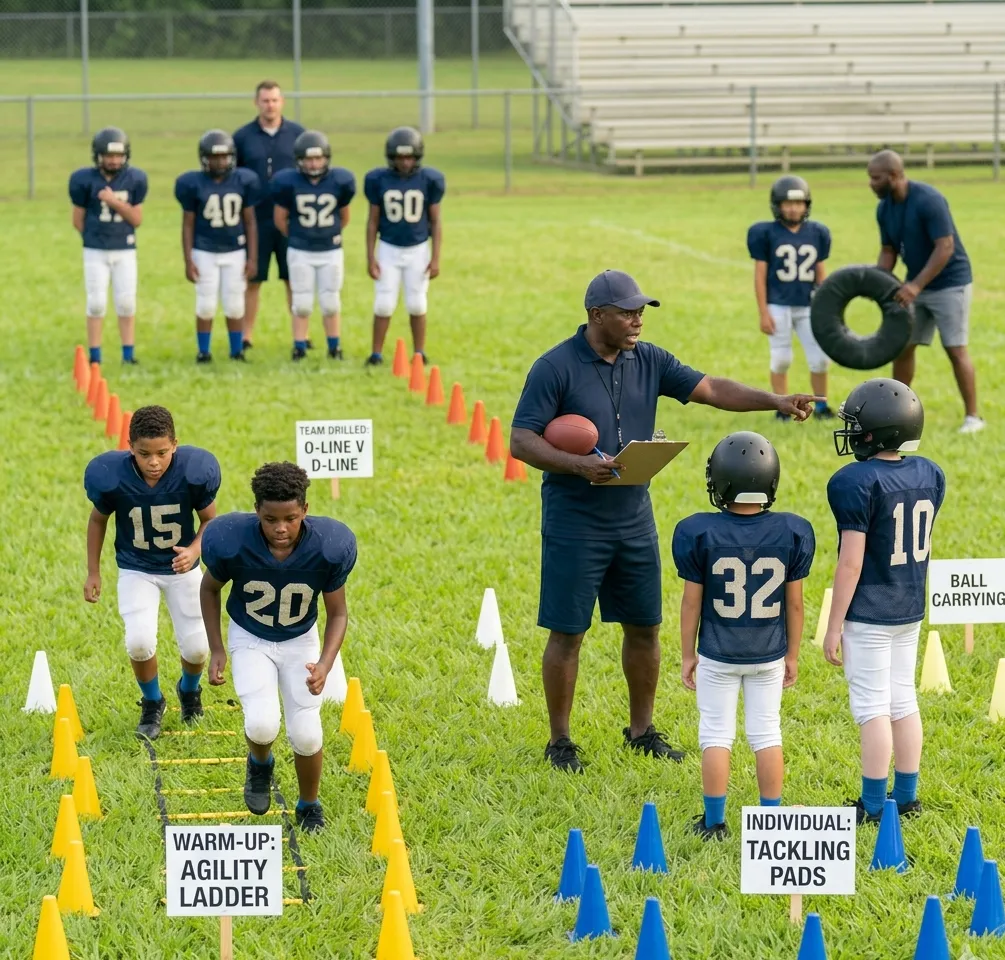
Use this simple flow:
- Warm-up – 10 minutes
- Individual skills – 20 minutes
- Group drills – 20 minutes
- Team period – 20–25 minutes
- Conditioning and cool down – 10 minutes
This structure keeps players moving and reduces idle time.
60-Minute Practice Flow
Warm-Up → Individual Skills → Group Drills → Team Period → Conditioning
Short, focused blocks prevent boredom and increase reps.
Drill Progression Overview (Ages 9–12)
| Drill | Level 1 (Intro) | Level 2 (Build) | Level 3 (Challenge) |
|---|---|---|---|
| Carioca | Slow controlled pace | Moderate speed | Add reaction command |
| Fumble Drill | Jog speed | Light strip attempt | Add second defender |
| Chute Drill | Air form | Pad contact | Controlled live rep |
This progression allows players to improve safely without rushing into full contact.
Warm-Up Drills
Carioca Drill
Purpose: Hip mobility and coordination
Coach cue: “Stay light and smooth.”
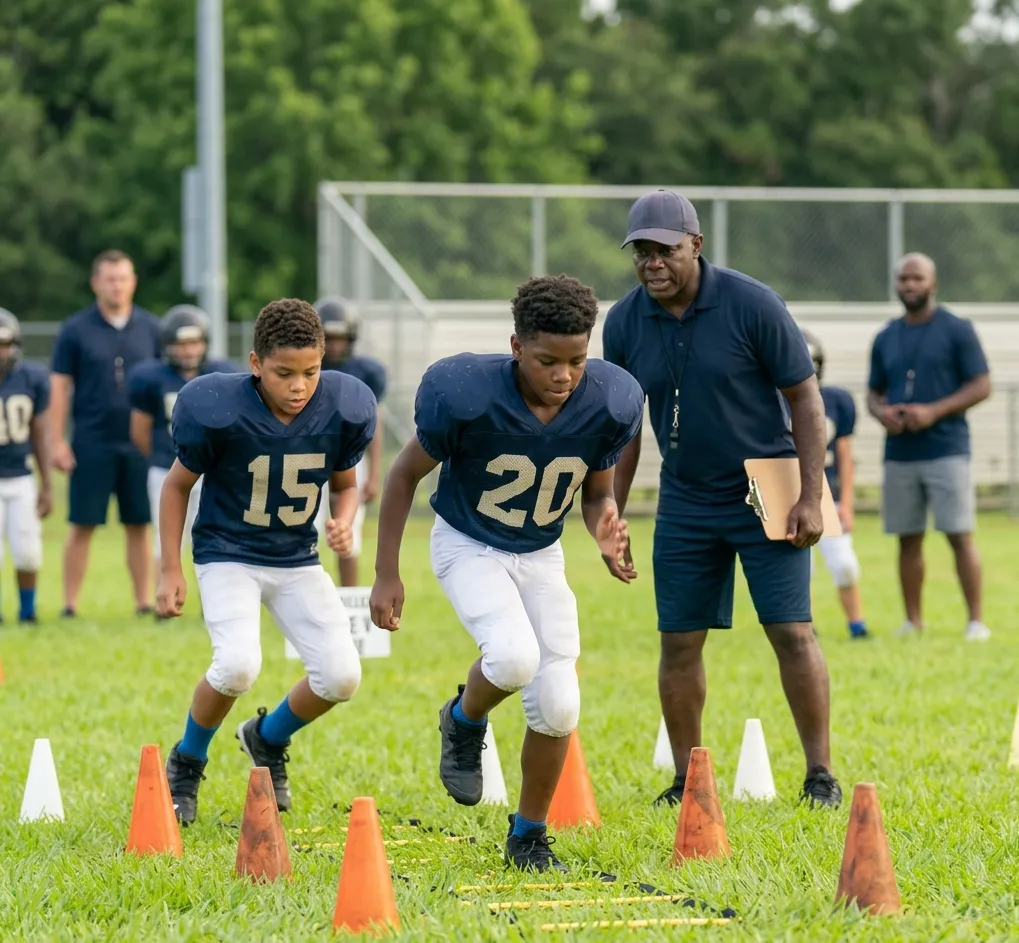
Quick Feet Drill
Purpose: Speed and agility
Coach cue: “Short steps. Fast feet.”
Individual Skill Drills
Fumble Drill
Focus: Ball security
Coach cue: “High and tight.”
Track fumbles weekly to measure improvement.
Pepper Receiving Drill
Focus: Catching under pressure
Coach cue: “Eyes first. Hands second.”
Track catch percentage out of 10 attempts.
Group Skill Drills
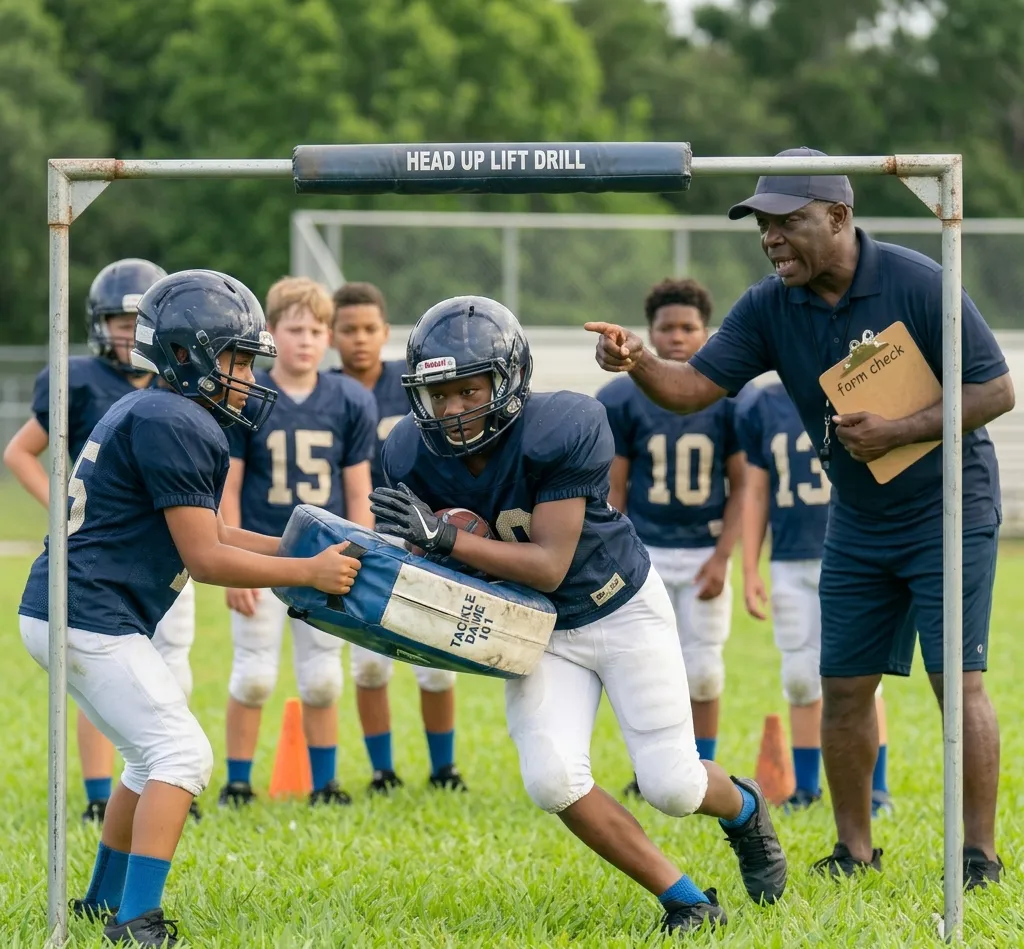
Chute Drill (Safe Tackling Form)
Contact Progression:
Air → Pad → Controlled Wrap → Limited Live
Coach cue: “Head up. Drive legs.”
Shuffle Drill
Focus: Defensive movement
Coach cue: “Stay square.”
Offensive Period Drills
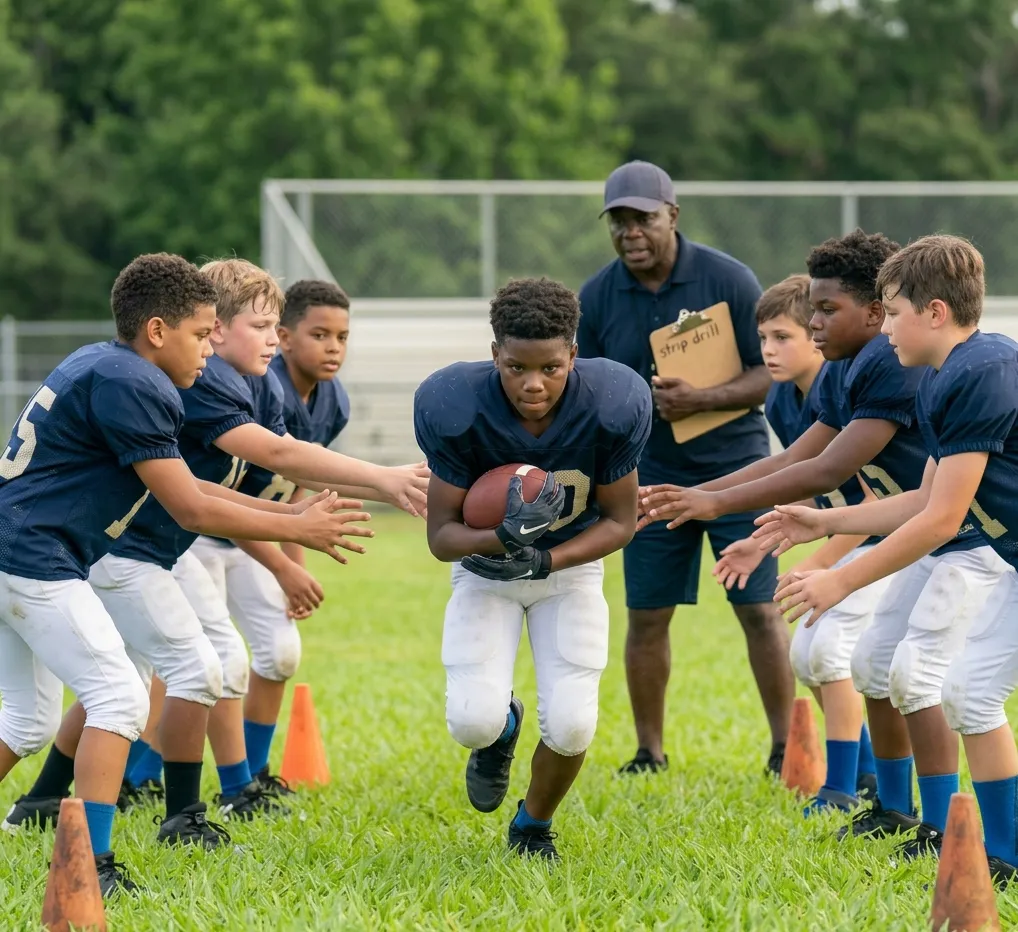
Gauntlet Drill
Focus: Ball protection in traffic
Track fumbles weekly.
5 Man Seat Roll
Focus: Offensive line pad level and coordination
Coach cue: “Low and strong.”
Defensive Period Drills
Fit Position
Focus: Proper alignment
Coach cue: “Head up. Eyes forward.”
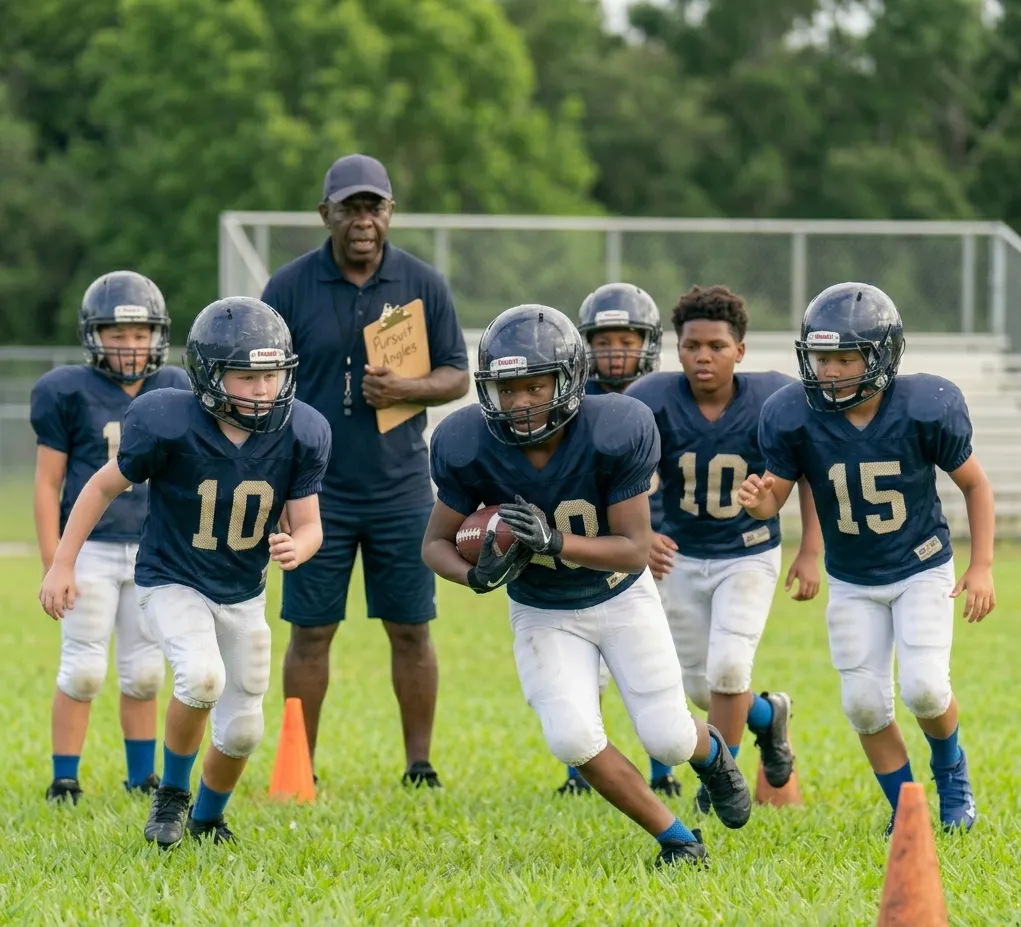
Pursuit Drill
Focus: Defensive angles
Track containment success.
Special Teams Drills
Staying Onside
Watch the ball, not the kicker.
Return Kick Drill
Secure catch first. Protect the ball immediately.
Flag Football Adaptation for Ages 9–12
If you coach flag football instead of tackle, these drills can still work with small adjustments.
Adapt drills by:
- Replacing contact drills with controlled flag pull drills
- Removing live tackling and focusing on angle tracking
- Increasing agility and open-field movement reps
- Emphasizing route timing and spacing
Flag football drills for ages 9–12 should focus on speed, decision-making, and ball control. Even without contact, players build strong fundamentals that transfer to tackle football later.
Position-Specific Football Drills for Ages 9–12
Position clarity builds football IQ.
Quarterback
- Three-step drop
- Accuracy throws
Track completion percentage.
Running Back
- Strip protection drill
- Cut and accelerate drill
Track yards after first move.
Wide Receiver
- Cone route drill
- High point catch drill
Track catch rate.
Lineman
- Drive block
- Mirror dodge
Focus on leverage and foot placement.
Weekly Player Development Tracking Chart
| Week | 10-Yard Sprint | Catch % | Fumbles | Tackle Form Reps |
|---|---|---|---|---|
| Week 1 | ||||
| Week 2 | ||||
| Week 3 |
Tracking improvement increases accountability and motivation.
Common Mistakes and Quick Fixes
| Skill | Common Mistake | Quick Fix |
|---|---|---|
| Catching | Body catching | “Hands first” cue |
| Tackling | Dropping head | “Head up” reminder |
| Blocking | Standing tall | Lower pad level |
Correct mistakes immediately using short cues
Practice Day Checklist (Ages 9–12)
Before Practice:
- Equipment prepared
- Water ready
- Drill order planned
During Practice:
- Keep reps high
- Keep instructions short
- Monitor safety and contact levels
After Practice:
- Review metrics
- Reinforce fundamentals
- Note areas for improvement
Safety Tips for Ages 9–12
- Follow controlled contact progression
- Inspect helmets and mouthguards
- Provide water every 15–20 minutes
- Monitor heat conditions
- Limit full-speed contact reps
Safe youth football drills protect players while building strong habits.
Conclusion
After coaching youth players in the 9–12 age range, one truth becomes clear. Success at this stage is built on fundamentals, not complexity. The teams that improve the most are not the ones running advanced plays. They are the ones that repeat safe tackling form, ball security, footwork, and basic positioning every week.
At this age, your responsibility goes beyond winning games. You are teaching habits that protect players from injury and prepare them for higher levels of competition. When practice follows a structured plan, contact is introduced step by step, and progress is tracked consistently, players grow with confidence. Parents see organization. Players feel improvement. And your program builds long-term stability.
Strong youth football programs are built through consistent structure, safe progression, and commitment to fundamentals. When you apply these football drills for ages 9–12 with patience and clarity, you create an environment where young athletes improve safely, develop steadily, and enjoy the game for years to come.
